Learn Automation with MINATA #17: Proximity Sensors — Inductive and Capacitive
Proximity Sensors: Inductive and Capacitive
A pneumatic cylinder pushes a workpiece to position, the PLC waits for the "workpiece has arrived" signal before allowing the next step. The installer fits an inductive proximity sensor to catch the workpiece — but the workpiece is plastic. The sensor never operates, and the machine sits waiting forever at one step. Nothing is broken: an inductive sensor only catches metal, and a plastic workpiece is invisible to it.
The proximity sensor is the "eye that needs no light": it detects an object nearby without contact and without a straight, aligned light beam like a photoelectric sensor. Being sealed, durable and tolerant of dust and oil, it is the most common position sensor in machinery. But there are two very different families of principle — inductive and capacitive — and choosing the wrong family means a stalled machine, as above.
This article explains the principle of the two types, the difference in detectable objects and range, the detection-zone parameters, flush/non-flush mounting, the specialised variants, the NPN/PNP electrical side, and how to choose for the right application. This is the sensor you will meet at almost every mechanism, so mastering it saves a great deal of fault-hunting time later.
This article states principles of selection and use. The detection range, material correction factors and protection class must follow the real sensor catalogue and the mounting conditions.

The inductive sensor
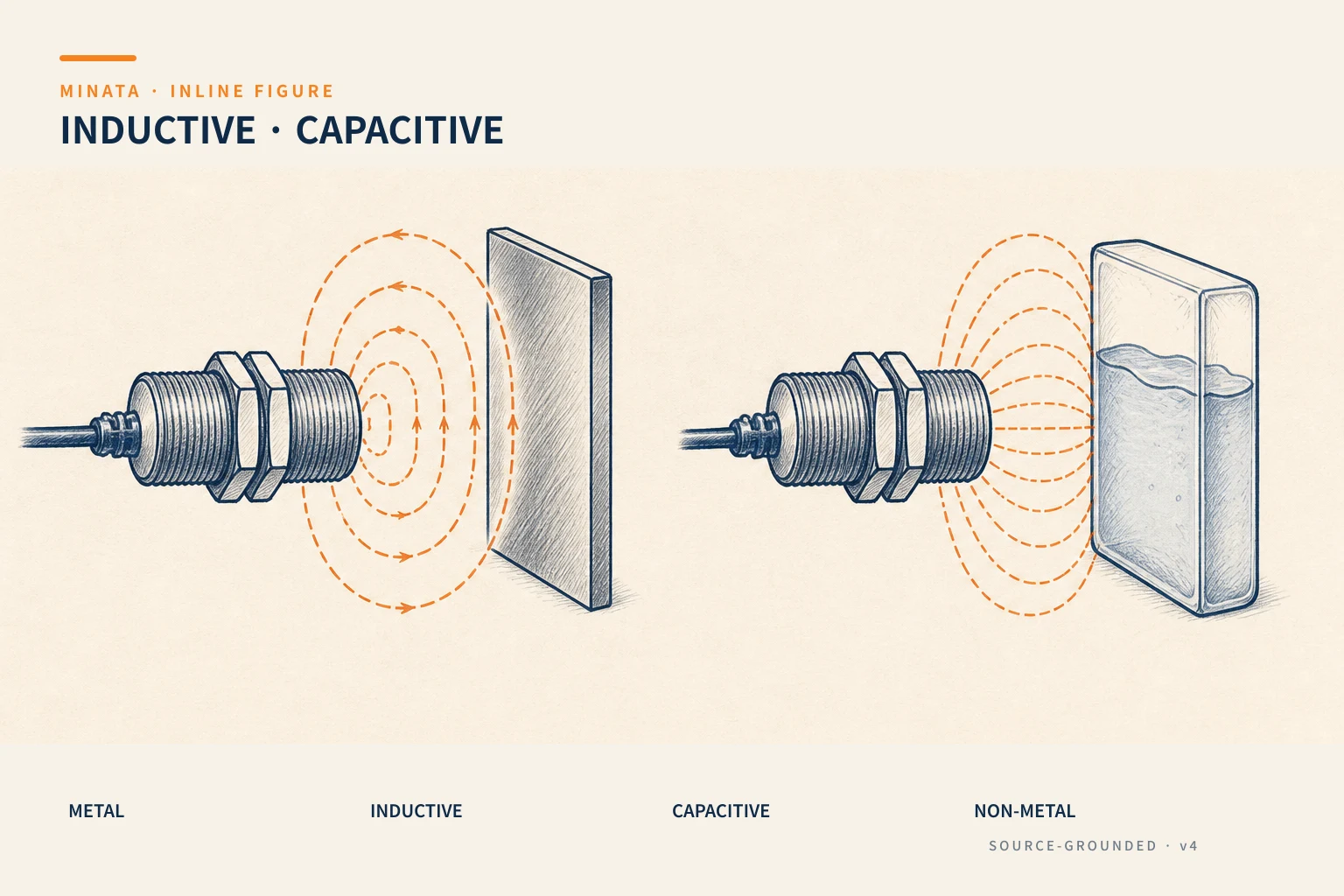
Inside is a coil generating a high-frequency electromagnetic field at the sensor face. When a metal object approaches, eddy currents induced in the metal absorb some energy, reducing the oscillation amplitude. The internal circuit detects this reduction and operates the output.
- Detects metal only — this is the decisive feature. Plastic, wood, water and glass are all "invisible".
- Very durable and sealed: no moving parts, the face is usually hard plastic, tolerant of dust, oil and vibration. This is why it dominates position sensing of metal mechanisms, cams and shafts.
- Detection range depends on the head size (a larger head reaches farther) and the metal type: mild steel reaches farthest; aluminium, copper and stainless reach nearer — there is a correction factor in the catalogue that must be applied.

The capacitive sensor
The sensor face acts as one plate of a capacitor. When any object (with a dielectric constant different from air) approaches, the capacitance changes, the circuit detects it and operates.
- Detects almost any material: metal, plastic, wood, paper, granules, and even liquids — so it is often used to signal level in a tank/silo (including detecting through a thin non-metallic wall).
- Sensitive to the environment: humidity, dust build-up and material changes can affect it; it usually has a sensitivity adjustment knob to tune onto the object you want and ignore the background.
- Shorter range than an inductive sensor of the same size, and needs more careful adjustment.
In short: need to catch a non-metal (plastic, water, granules) or signal level → capacitive; catch metal → inductive (more durable and stable for that).
One caution when using capacitive for level: because it is sensitive to everything, dust build-up or a film of material left on the sensor face can be read as "material still present" even when the tank is empty. For a long-term level application, choose a type with build-up compensation or a mounting that avoids deposits, and check periodically. An inductive sensor does not have this problem because it only reacts to metal, so for a metal tank/tray another approach may be worth considering.
Choosing the type by object and job
| Job to do | Choose |
|---|
| Position sensing of a metal mechanism/shaft/cam | Inductive |
| Counting/catching a non-metal workpiece (plastic, wood, paper) | Capacitive |
| Level of liquid/granules in a tank | Capacitive |
| Dusty, oily environment needing durability | Inductive (if the object is metal) |
| Detection through a thin non-metallic tank wall | Capacitive |
The principle: if the object is metal and an inductive sensor can be used, favour it because it is durable and little affected by the environment; use capacitive only when you genuinely need to catch a non-metal or measure level.
Flush and non-flush mounting
A mounting detail often overlooked yet a frequent cause of faults:
- Flush (embeddable) type: has magnetic shielding on the sides, allowing it to be mounted flush with the surrounding metal surface without interference. In exchange, the detection range is shorter.
- Non-flush type: the field radiates on both sides too, giving a longer range, but you must leave a metal-free clearance around the head — mount it embedded in a metal plate and that very plate is "detected" and the sensor operates continuously.
Mounting a non-flush sensor embedded in a metal bracket is the classic mistake that makes a sensor "always report an object present". Read the documentation carefully on mounting distances and the spacing between two nearby sensors to avoid them interfering with each other.
Detection zone, hysteresis and repeatability
Three parameters govern how precisely a sensor "reports an object present":
- Rated detection distance (Sn): the catalogue figure, measured with a standard target (standard-size steel) under ideal conditions. For an object different from the standard or smaller, the actual distance is shorter. So place the object at a safe distance (usually ~80% of Sn), not right at the boundary.
- Hysteresis: the distance to "catch" and to "release" differ slightly — the object must come within a certain level to operate, and must move farther out than that level to release. This hysteresis is useful: it stops the sensor chattering 0-1-0 when the object sits right on the boundary. But when positioning precisely, you must account for it.
- Repeatability: the sensor's ability to operate at exactly the same point across many cycles. For positioning applications, repeatability matters more than the absolute range figure.
Understanding these three parameters helps avoid the "sometimes reports, sometimes not" fault caused by placing the object at the edge of the detection range, or by vibration making the distance swing around the threshold.
Specialised variants
Beyond the ordinary type, inductive and capacitive have many variants for difficult environments:
- Factor 1: a special inductive that catches all metals at the same distance (steel, aluminium, stainless alike), no correction factor needed — handy when the object may be several kinds of metal.
- Weld-field immune: for use near welding machines, resisting interference from the large welding current; the housing withstands sparks.
- High temperature: for furnaces and hot areas.
- Analog output: some proximity sensors give a signal proportional to distance (not just present/absent), used to measure gap, thickness or run-out.
- NAMUR / intrinsically safe type: for hazardous areas, through a safety amplifier.
Know these variants so you do not force an ordinary sensor to work in a harsh environment — choosing the right variant from the start is far cheaper than the machine stopping because the sensor died early.

The electrical side: 2-wire, 3-wire, NPN/PNP
- 3-wire sensor (common): has power (+, −) and one signal wire, with a transistor output of NPN (sinking) or PNP (sourcing). Choose it to match the PLC input (usually PNP in Vietnam) — wire it wrong and the sensor's LED lights but the PLC does not read it (exactly as discussed in #10 and #16).
- 2-wire sensor: wired in series like a switch, tidy on wiring but has a leakage current when off and a voltage drop when on — compatibility with the PLC input must be checked.
- NO or NC: choose by the logic you want; for a safety/important-position signal, consider NC so that "loss of signal = safe" (the fail-safe spirit of #10).
- Response frequency: for a fast-moving mechanism (counting teeth, a high-speed cam), choose a sensor with a high enough frequency.
A reference engineering scenario
The illustration below is a reference approach in the spirit of MINATA's design thinking; the final ratings and configuration must be confirmed against the actual documentation, standards and equipment.
On a MINATA machine, the metal-mechanism positions (a sliding table, cams, clamps) use an inductive sensor brought back to a Delta AX-308E input (PNP type). Because these mechanisms are steel and the environment has oil and dust, inductive is both durable and stable, not thrown off by oil build-up the way a photoelectric sensor would be.
The "plastic workpiece present in the tray" position, however, is useless for inductive, so MINATA uses a capacitive sensor with sensitivity tuned to catch the workpiece while ignoring the tray wall. The PLC reads these signals as step-transition conditions; if a position reports abnormally (for example a workpiece reported present but not taken for too long), the PLC stops cleanly and warns — true to the "status from a real sensor" spirit of #09.
Common mistakes
- Using inductive to catch a non-metal object (plastic, wood) → it never operates.
- Mounting a non-flush sensor embedded in metal → it reports an object present continuously.
- Forgetting the material correction factor (aluminium/stainless) → the actual detection range is shorter than calculated.
- Mis-wiring NPN/PNP against the PLC input.
- Using capacitive in a humid/dusty place without re-adjusting sensitivity → false triggers.
- Placing two sensors too close and causing cross-interference.
Proximity sensor checklist
- [ ] Metal object → inductive; non-metal/liquid/level → capacitive.
- [ ] Apply the material correction factor to the detection range.
- [ ] Choose flush/non-flush correctly by the mounting (embedded or not).
- [ ] Leave the clearance per the documentation; avoid interference between two sensors.
- [ ] NPN/PNP output (and 2/3-wire) matches the PLC input.
- [ ] Consider NC for an important position signal (fail-safe).
- [ ] Capacitive: tune sensitivity to the object, re-check when the environment changes.
- [ ] Place the object within the safe range (~80% of Sn), accounting for hysteresis and repeatability.
- [ ] Harsh environment: choose the right variant (factor 1, weld-field immune, high temperature).
The proximity sensor is so simple it is easily chosen carelessly, but choosing the wrong family of principle is the fault that leaves a machine waiting for a signal that never comes. Ask first: is the object to be caught metal or not — that answer decides half the problem, and the head size, mounting and output type decide the other half.
Read more automation knowledge at MINATA: https://minatavn.com/en/blog/industrial-automation
Previous — #16: Photoelectric sensors: through-beam, retroreflective and diffuse: https://minatavn.com/en/blog/automation-16-photoelectric-sensors
Next — #18: Limit switches and pneumatic-cylinder sensors: https://minatavn.com/en/blog/automation-18-limit-switches-cylinder-sensors
View all MINATA technical articles