Learn Automation with MINATA #24: Star-Delta Starting — Reducing Motor Starting Current
Star-Delta Starting: Reducing Motor Starting Current
Every time a large pump in the workshop starts, the lights flicker and a few other machines report an under-voltage fault. The cause: a squirrel-cage motor started direct-on-line draws a current 6–8 times its rated value, pulling the mains voltage down for a few seconds. For a small motor this is fine, but a large motor started direct (DOL) makes the whole electrical branch "wobble". The classic, cheap and common solution: star-delta (Y/Δ) starting.
The idea is simple: let the motor start in the star connection (the voltage on each winding drops, and the starting current falls to about one third), then after a few seconds once it has spun up, switch to the delta connection to run at full load. This circuit is a neat application combining everything learned: three contactors (#12), the interlock (#22) and the timing relay (#25) coordinated in a sequence.
This article explains why the star connection reduces the current, the three-contactor structure, the Y→Δ transition sequence, the role of the timing relay and the interlock, when not to use star-delta, and the modern alternatives.
This article states principles. Choosing the starting method, the transition time and the devices must follow the real motor-load characteristics and the applicable standards; the motor must support the Y/Δ connection at the mains voltage.

Why the star connection reduces the starting current
A three-phase motor connected in delta (Δ) has each winding taking the full line voltage. Connected in star (Y), the three winding ends meet at one point, so each winding takes only the phase voltage = line voltage / √3. The winding voltage drops by √3 → the winding current drops, and the starting current drawn from the mains falls to about one third of a direct start in delta.
The price paid: the starting torque also drops to about one third (torque is proportional to the square of the winding voltage). This is the decisive point of "usable or not" — explained below.
In other words, star-delta is not a "magic" that reduces the current for free: it trades starting torque for a low starting current. Whether that trade works depends entirely on whether the load needs much torque at start — something the designer must know before choosing.
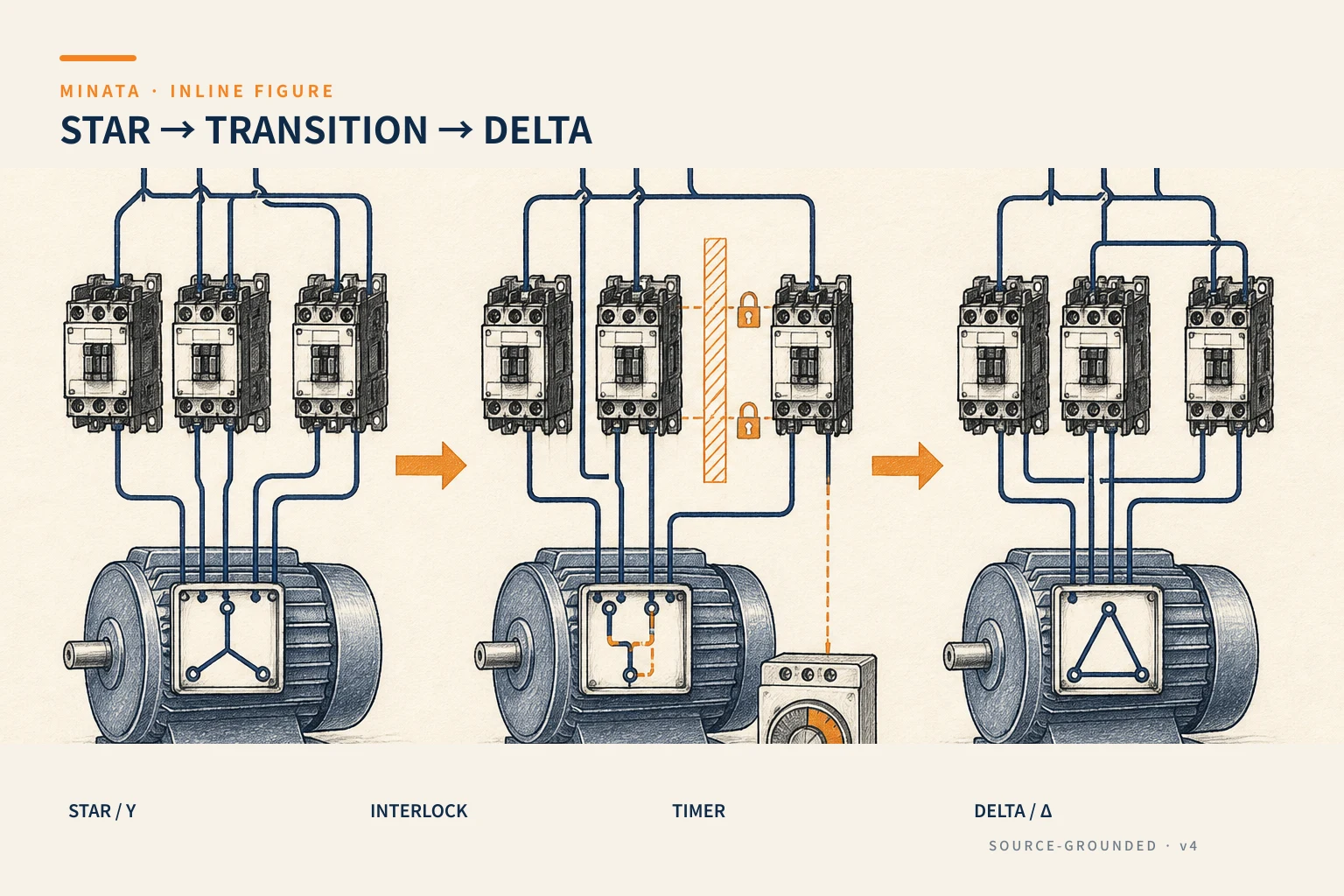

The three contactors
The star-delta circuit needs three contactors:
- Main contactor (KM): supplies power to one end of the windings, closed throughout the process.
- Star contactor (KM-Y): brings the other three winding ends together at one point → forming the star connection. Closed only during the starting stage.
- Delta contactor (KM-Δ): connects the windings into a delta ring → running at full load. Closed after the star has released.
KM-Y and KM-Δ must absolutely never close at the same time — it would cause a short circuit. So they must be interlocked (electrical + mechanical, #22), exactly like the reversing circuit.
The Y → Δ transition sequence
- Start: the main contactor closes, KM-Y closes → the motor starts in star, low current. The timing relay starts counting.
- Time elapsed (a few seconds, when the motor has spun up near speed): the timing relay releases KM-Y first.
- After a small gap (ensuring KM-Y has opened decisively), KM-Δ closes → the motor switches to delta, running at full load.
The small gap between releasing star and closing delta is very important: closing delta while star has not fully opened → a short circuit. Many dedicated star-delta timing relays have this transition time built in.
Choose a sensible star time: too short and it switches to delta before the motor is up to speed, causing a large current peak on transition; too long and the motor "labours" at low torque and heats up. Usually a few seconds, fine-tuned to the load.

The motor's six leads and how to connect them
To be able to star-delta start, the motor must have all six winding leads brought out to the terminal box (U1-V1-W1 and U2-V2-W2), not a type with only three leads already connected internally. These six leads let the external circuit reconfigure the connection:
- Star (Y): bring U2-V2-W2 together to one point (done by KM-Y), supply power to U1-V1-W1 (through the main contactor).
- Delta (Δ): connect U1-W2, V1-U2, W1-V2 into a ring (done by KM-Δ).
The spot easily gotten wrong when connecting delta is the ring order: a wrong connection makes two windings oppose each other, and the motor vibrates, hums, has poor torque or does not run. You must follow the maker's terminal diagram exactly. This is also why the star-delta power circuit has more wires and is more error-prone than a DOL circuit — it needs clear wire numbering (#28) and careful checking before energising (#39).
Also, the current flowing in the wires to KM-Δ is the phase current (the current through a winding), smaller than the line current; this affects how you rate the contactors in a star-delta set — usually KM-Δ and the main contactor are chosen for the appropriate current, not all three the same size. Using a maker's pre-packaged star-delta set helps avoid miscalculating this.
The role of the timing relay
The timing relay (#25) is the "conductor" of the sequence: it counts the star time then triggers the switch to delta. A dedicated star-delta type integrates the release-Y / delay / close-Δ logic, simplifying the wiring. In a PLC, this is replaced by a timer plus interlock logic, letting you fine-tune the time and transition gap in software rather than turning a relay knob.
When NOT to use star-delta
This is the most important point and often overlooked: because the starting torque in star is only ~1/3, star-delta only suits a LIGHT-starting load (a fan, an unloaded centrifugal pump, a machine that starts unloaded then engages the load):
- If the load needs a high starting torque (a fully-loaded conveyor, a compressor, a high-friction load), the motor will labour in the star stage, not accelerate enough, and switching to delta will still create a large current peak — losing all the benefit.
- The motor must allow both Y and Δ connections at the mains voltage (check the nameplate: for example 400/690V means only at 400V mains can it run in delta).
If the load is heavy or a smoother start is needed, consider a soft starter or a VFD (Stage 7) — better control but more expensive.

Compared with other starting methods
Star-delta is just one of several ways to "tame" the starting current; set it beside the alternatives to choose right:
| Starting method | Starting current | Starting torque | Cost | Note |
|---|
| Direct (DOL) | High (6–8×) | Full | Cheapest | Only suits small motors |
| Star-delta | ~1/3 | ~1/3 | Cheap | Only light-starting loads |
| Soft starter | Adjustable | Adjustable | Moderate | Smooth start, no speed change while running |
| VFD | Low, controlled | Well controlled | High | Changes speed while running too |
This table makes star-delta's place clear: an economical solution for a large, light-starting motor, when a soft starter/VFD is not yet needed. When the load is heavy, a truly smooth start is needed, or the speed must change while running, star-delta is not the choice — knowing the limits avoids choosing wrongly.
Maintenance and operating notes
- Check the transition gap: over time, the Y→Δ switch moment can drift if the timing relay drifts; check periodically so there is no abnormal current peak on transition.
- Listen at the transition: a light "thunk" at the Y→Δ switch is normal; if you hear a bang, heavy vibration or the breaker on the edge of tripping, recheck the interlock and the timing.
- Motor temperature: if the real load is heavier than expected, the motor labours in the star stage and heats up — the thermal relay will protect it, but review whether a different starting method is warranted.
- Many wires, number them carefully: the six-lead power circuit is easy to mis-wire; clear wire labels make maintenance fast and safe.
A reference engineering scenario
The illustration below is a reference approach in the spirit of MINATA's design thinking; the final ratings and configuration must be confirmed against the actual documentation, standards and equipment.
On a cell with a large centrifugal pump (starting unloaded), MINATA uses star-delta starting to avoid a voltage sag on start. Three contactors with KM-Y and KM-Δ interlocked electrically + mechanically; a thermal relay protects against overload. The Delta AX-308E controls the sequence with a timer (the star time) and exclusion logic, with a transition gap; it also keeps the hardware interlock.
The PLC also monitors: if after the star time the current/speed has not reached expectation, it warns (the load may be abnormally heavy). As a result the pump starts smoothly without wobbling the mains, and stays safe thanks to three protection layers like the reversing circuit in #23.

Common mistakes
- Using star-delta for a heavy-starting load → the motor labours in star, losing the benefit.
- Not interlocking KM-Y and KM-Δ, or missing the transition gap → a short circuit on transition.
- Setting the star time too short → a large current peak when switching to delta.
- Using a motor that does not support the Y/Δ connection at the mains voltage.
- Forgetting the thermal relay or placing it in the wrong protection position.
- Expecting star-delta to be "as smooth as a VFD" — it still has a step at the transition.
Star-delta checklist
- [ ] A LIGHT-starting load; the motor supports Y/Δ at the mains voltage.
- [ ] Three contactors: main, KM-Y, KM-Δ.
- [ ] KM-Y and KM-Δ interlocked electrically + mechanically, with a transition gap.
- [ ] A timing relay (or PLC timer) sets a sensible star time.
- [ ] A thermal relay protects against overload, in the right position.
- [ ] Heavier/smoother load: consider a soft starter or a VFD.
- [ ] PLC: monitor to detect an abnormal load in the star stage.
- [ ] Connect the delta ring order correctly per the maker's terminal diagram; number the wires clearly.
- [ ] Check the Y→Δ transition gap periodically; listen at the transition to catch anomalies.
Star-delta starting is a neat, economical sequence circuit for "taming" the starting current of a large motor — but only when the load starts light. Understanding both the strength (current down to 1/3) and the limit (torque also down to 1/3) is what separates a right choice from a circuit that "runs but does not solve the actual problem".
Read more automation knowledge at MINATA: https://minatavn.com/en/blog/industrial-automation
Previous — #23: Forward-reverse reversing of a three-phase motor: https://minatavn.com/en/blog/automation-23-motor-reversing
Next — #25: Timing relays: ON-delay, OFF-delay and applications: https://minatavn.com/en/blog/automation-25-timing-relays
View all MINATA technical articles