Technical Japanese #07 — Reading Japanese Safety Signs: Danger, Caution and Restricted Areas
Safety signs are the one group of characters you are not allowed to misread. Take 高電圧 (high voltage) for something harmless and the price can be a life. The good news is that they are heavily standardised: learn the hierarchy of signal words and a few dozen core characters and you can read almost all of them, even with limited Japanese.
The warning hierarchy (JIS Z 9101) — the colour tells you the level
| Signal word | Level | Background | If ignored |
|---|
| 危険 (kiken) | DANGER — highest | Red | Death or serious injury is close to certain |
| 警告 (keikoku) | WARNING — medium | Orange | Serious injury is possible |
| 注意 (chūi) | CAUTION — low | Yellow | Minor injury or equipment damage |
Two more families sit beside them: 禁止 prohibition signs, a red circle with a diagonal bar, and 指示 mandatory signs on blue, telling you which protective equipment to wear.
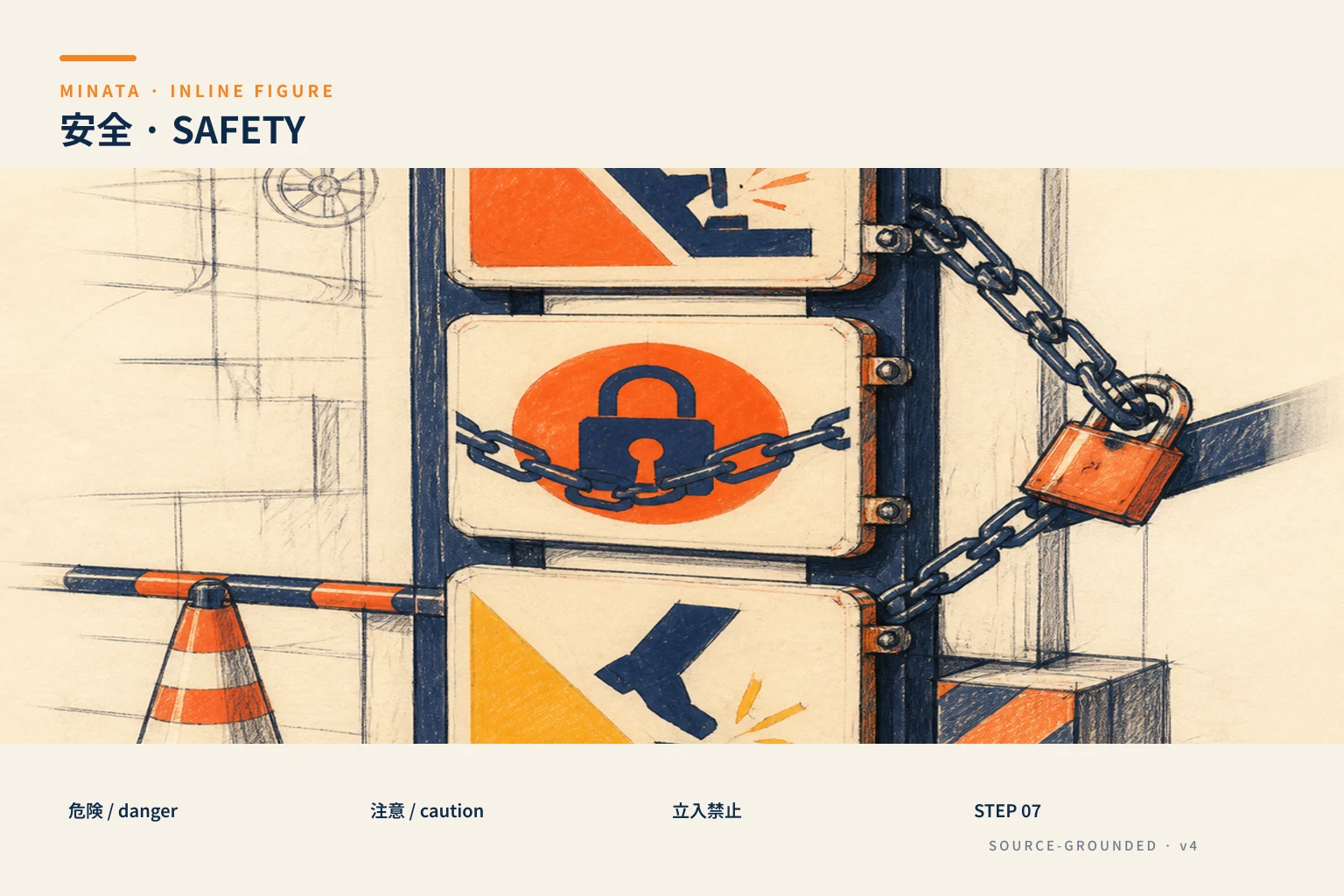
Core safety signs
| Japanese | Reading | Meaning | Field note |
|---|
| 危険 | きけん kiken | danger | Highest level, red ground |
| 警告 | けいこく keikoku | warning | Medium level, orange ground |
| 注意 | ちゅうい chūi | caution | Low level, yellow ground |
| 立入禁止 | たちいりきんし tachiiri kinshi | no entry | Hazardous area, authorised staff only |
| 高電圧 | こうでんあつ kōden'atsu | high voltage | Panels and substations |
| 火気厳禁 | かきげんきん kaki genkin | no open flame | Chemical, paint and solvent stores |
| 手を挟まれ注意 | てをはさまれちゅうい te o hasamare chūi | caution, pinch hazard | Presses and conveyors |
| 落下注意 | らっかちゅうい rakka chūi | caution, falling objects | Suspended loads, cranes |
| 保護帽着用 | ほごぼうちゃくよう hogobō chakuyō | helmet required | Mandatory, blue ground |
| 保護メガネ着用 | ほごメガネちゃくよう hogo megane chakuyō | eye protection required | Grinding, cutting, welding |
| 禁煙 | きんえん kin'en | no smoking | The whole production area |
| 点検中 | てんけんちゅう tenken-chū | inspection in progress | Do not operate the machine |
| 非常停止 | ひじょうていし hijō teishi | emergency stop | The red mushroom button — know where it is |
| 非常口 | ひじょうぐち hijōguchi | emergency exit | Green ground, running figure |
Reading colour and shape — most of the message before you read a word
| Shape / colour | Meaning | Example |
|---|
| Yellow triangle, black border | Warning of a hazard | Electricity, pinch point, falling object |
| Red circle with a diagonal bar | Prohibition (禁止) | 禁煙, 火気厳禁 |
| Blue circle | Mandatory action (指示) | 保護帽着用, eye protection |
| Green square | Safe condition, information | 非常口 |
| Red square | Firefighting equipment | 消火器, 消火栓 |
Train the reflex in this order: colour first, shape second, characters last. Red is prohibition, danger or firefighting; yellow is a warning; blue is mandatory protective equipment; green is safety and escape.
Rescue and emergency equipment signs
| Japanese | Reading | Meaning |
|---|
| 非常口 | ひじょうぐち hijōguchi | emergency exit |
| 避難場所 | ひなんばしょ hinan basho | assembly point |
| 消火器 | しょうかき shōkaki | fire extinguisher |
| 消火栓 | しょうかせん shōkasen | fire hydrant |
| 救急箱 | きゅうきゅうばこ kyūkyūbako | first aid kit |
| 火災報知器 | かさいほうちき kasai hōchiki | fire alarm |
What to do the moment you see the sign
- 立入禁止 — stop. Do not step in, not even as a short cut. It is a boundary, not a suggestion.
- 点検中 hanging on a machine — never press start. Someone is working inside it, or it is locked out.
- 高電圧 on a cabinet — do not open it unless that is your job. Wait for the electrician.
- Someone shouts 危ない! (abunai — look out) — stop moving and look around you.
The phrase to memorise: ここは入ってもいいですか。 (Koko wa haitte mo ii desu ka.) — May I go in here?
Dangerous mistakes to avoid
| Mistake | Why it is dangerous |
|---|
| Reading the colour but not the characters | Two signs on the same yellow background can warn of completely different hazards |
| Treating 注意 as "not important" | It is the lowest level, but it is still a real warning |
| Confusing 禁止 (prohibited) with 注意 (caution) | Prohibited means never do it; caution means proceed carefully |
| Ignoring 点検中 because the machine "looks normal" | A quiet machine can be locked out — the sign is an order, not a description |
See it, then react — quick self-check
- 立入禁止 across a short cut.
- 点検中 hanging on the machine you need.
- A colleague shouts 危ない!
- 火気厳禁 at the solvent store.
<details><summary>Answers</summary>
- Do not enter, however convenient the route.
- Do not operate it; find the person responsible and confirm.
- Stop what you are doing immediately and look for the hazard.
- No flame, no heat source, no sparks — no welding, no smoking.
</details>
Quick recall
- The levels: 危険 (red) above 警告 (orange) above 注意 (yellow).
- Absolute prohibitions: 立入禁止 · 火気厳禁 · 点検中.
- High hazard: 高電圧 — never open an electrical cabinet yourself.
- On day one, learn the five characters that can kill you — 危険・高電圧・立入禁止・非常停止・火気厳禁 — and learn the location of 非常口 and 消火器 rather than the translation.
Working with a Japanese partner and need someone who can read the technical documents, coordinate and close the work out in Japanese? MINATA takes on the Japan–Vietnam technical bridge: reading and translating documents and drawings, working with the Japanese side, designing and manufacturing to Japanese standards. See our Japan–Vietnam services and projects we have delivered.
Next in the series: how to ask again when you did not understand · safety practice (KY 危険予知, ヒヤリハット, 5S).
View all MINATA technical articles