Technical Japanese #34 — A 30-Second Japanese Morning Meeting Update (朝礼)
Many Japanese plants open the day with 朝礼: roll call, safety points, the goal for the day, and a short update from each person. You will often have to say a few sentences in Japanese in front of the group. It is short, but fumbling it costs you confidence for the rest of the day. This post gives you the frame for a 朝礼 turn and a 30-second progress report.
Core vocabulary of the 朝礼
| Japanese | Reading | Meaning | On the floor | Note |
|---|
| 朝礼 | ちょうれい chōrei | morning meeting | 朝礼を始めます | Start of shift |
| 本日 | ほんじつ honjitsu | today | 本日の予定 | The formal form of 今日 |
| 目標 | もくひょう mokuhyō | target | 本日の目標 | Goal |
| 予定 | よてい yotei | schedule | 本日の予定 | What is planned |
| 進捗 | しんちょく shinchoku | progress | 進捗を共有 | Progress |
| 昨日 | さくじつ sakujitsu | yesterday | 昨日の実績 | Yesterday |
| 安全 | あんぜん anzen | safety | 安全第一 | Safety |
| 注意点 | ちゅういてん chūiten | points to watch | 本日の注意点 | Cautions |
| 共有 | きょうゆう kyōyū | sharing | 情報共有 | Share it with everyone |
| 課題 | かだい kadai | open issue | 課題を報告 | Issue |
| よろしくお願いします | yoroshiku onegai shimasu | thank you in advance | Closing | How it ends |
| 以上です | いじょう ijō desu | that is all | End of a report | Signals you are done |
| 体調 | たいちょう taichō | physical condition | 体調管理 | Fitness for work |
| 点呼 | てんこ tenko | roll call | 点呼を取る | Roll call |
| 唱和 | しょうわ shōwa | chanting in unison | 安全唱和 | The safety chant |
The 30-second frame
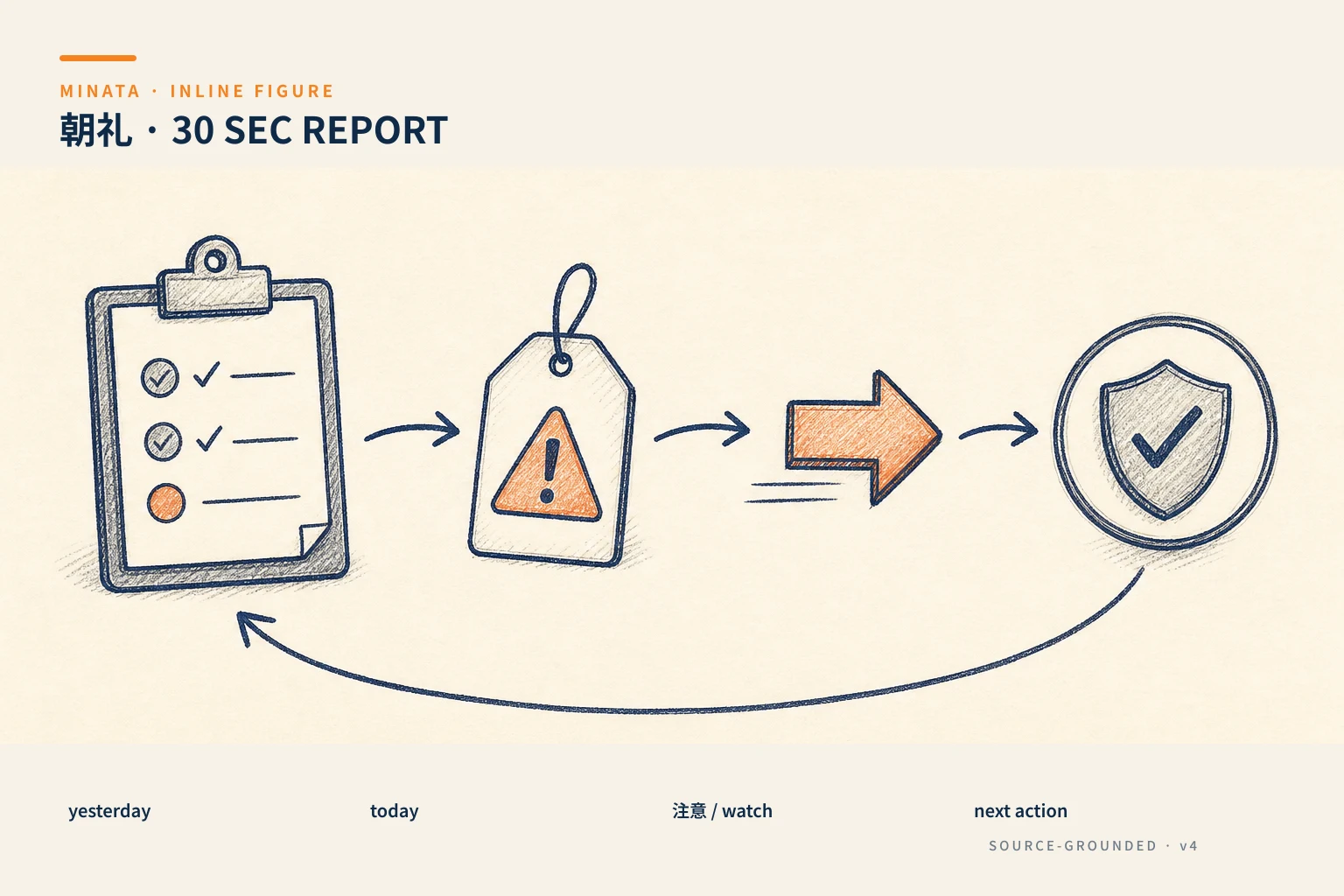
An individual turn follows yesterday → today → issues:
- Greeting and name:
おはようございます。○○です。 - Yesterday, actual:
昨日は○○を完了しました。 - Today, planned:
本日は○○を進めます。 - A caution or a problem, if any:
○○の点に注意します。 or 課題として○○があります。 - Closing:
以上です。よろしくお願いします。
Short, clear, conclusion first — the Japanese reporting instinct. No decoration required.
Phrases by situation
Reporting progress
- 本日はA工程を80%まで進める予定です。 — Today I plan to take process A to 80%.
- 昨日の不良対策は完了しました。 — Yesterday's defect countermeasure is complete.
Raising a safety point
- 本日は搬入があるので通路に注意してください。 — There is a delivery today, so watch the walkways.
- 安全第一でお願いします。 — Safety first, please.
When you are asked
- 特に問題ありません。 — Nothing in particular to report.
Mistakes to avoid
| Mistake | Why it hurts |
|---|
| Rambling without reaching a conclusion | 朝礼 has to be very short. Stay on 昨日 → 本日 → 課題 |
| Forgetting 「以上です。よろしくお願いします。」 | Your turn sounds unfinished |
| Saying "no problem" when there is a real 課題 | You lose the chance to get help early |
| Speaking too quietly, or skipping the greeting | At 朝礼, a clear voice and the greeting are part of what is being assessed |
Hear it, then act — quick self-check
It is your turn. Yesterday you finished inspecting 100 pieces, today you are on packing, and the floor is slippery. Assemble the turn.
<details><summary>Answer</summary>おはようございます。○○です。昨日は100個の検査を完了しました。本日は梱包を進めます。床が滑りやすいので注意します。以上です。よろしくお願いします。 — greeting and name, yesterday, today, caution, closing.</details>
The team leader ends with 「本日も安全第一で。」 What do you say?
<details><summary>Answer</summary>The group answers together: 「よろしくお願いします。」 — the standard closing of a 朝礼.</details>
How MINATA helps
Does your Vietnamese team need to speak at 朝礼 and report progress to Japanese management with confidence? MINATA trains the shop-floor phrases and acts as the Japan–Vietnam operating bridge for the plant or project. See our Japan–Vietnam projects or Japan–Vietnam business services.
View all MINATA technical articles