Technical Japanese #36 — Shift Handover Notes (引継ぎ): Results, Work in Progress and Alerts
In continuous multi-shift production, information cannot live in someone's memory. It belongs in the 業務日報 and in the 引継ぎ, the shift handover. Leave one abnormality out of the handover and the next shift carries on making the same defect. This post gives the frame for a complete, compact handover.
Core vocabulary of the daily report and the handover
| Japanese | Reading | Meaning | On the floor | Note |
|---|
| 業務日報 | ぎょうむにっぽう gyōmu nippō | daily work report | 日報を書く | Daily report |
| 引継ぎ | ひきつぎ hikitsugi | handover | 引継ぎ事項 | Shift handover |
| 引継ぎ事項 | ひきつぎじこう hikitsugi jikō | handover items | 引継ぎ事項3件 | The list you pass on |
| 交代 / シフト | こうたい kōtai / shifuto | shift | 交代勤務 | Shift work |
| 実績 | じっせき jisseki | actual output | 生産実績 | What was really produced |
| 異常 | いじょう ijō | abnormality | 異常なし | Anything out of the ordinary |
| なし | nashi | none | 異常なし | Nothing to report |
| 仕掛中 | しかかりちゅう shikakari-chū | in progress | 仕掛中の品 | Still being worked on |
| 未完了 | みかんりょう mikanryō | incomplete | 未完了作業 | Not finished |
| 要注意 | ようちゅうい yō-chūi | needs attention | 要注意事項 | Watch this |
| 対応済み | たいおうずみ taiō-zumi | handled | 対応済み | Already dealt with |
| 未対応 | みたいおう mitaiō | not yet handled | 未対応 | Still open |
| 申し送り | もうしおくり mōshiokuri | pass-on note | 申し送り事項 | What the next shift must know |
| 置き場 | おきば okiba | storage location | 仕掛品の置き場 | Where it is |
| 確認印 | かくにんいん kakunin-in | confirmation stamp | Signature | Sign-off |
The handover frame
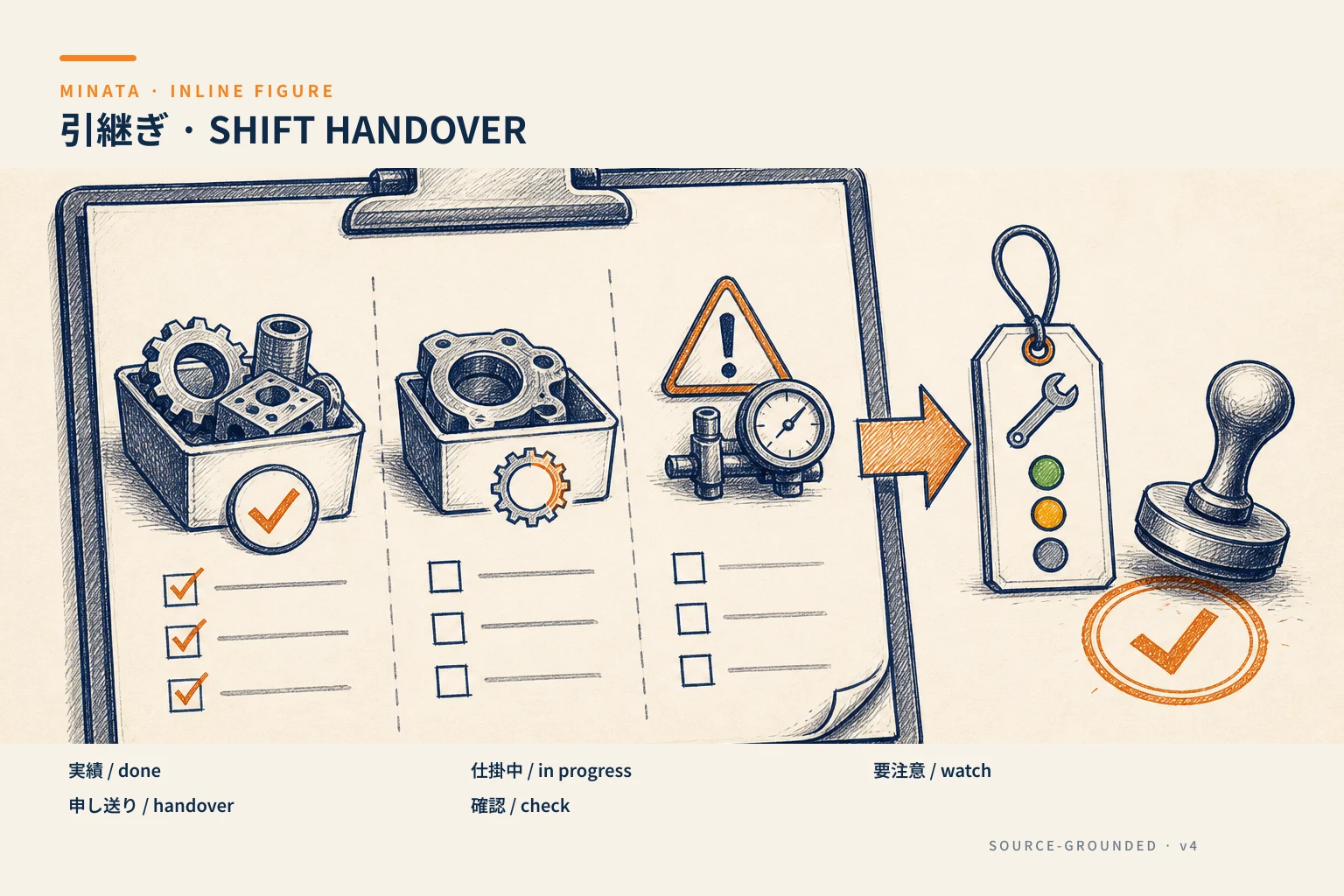
A good 引継ぎ answers: how far did you get, what is still open, what went wrong, and what does the next shift need to do.
- 実績 — output or progress this shift, as a number.
- 仕掛中 / 未完了 — what is in progress, at which step, and in which 置き場 it is sitting.
- 異常 / 要注意 — what happened, whether it is 対応済み or 未対応, and what to keep an eye on.
- 申し送り — what the next shift is waiting on: material, an approval, a spare part.
- 確認印 — the next shift signs to confirm they have taken it in.
One rule: write 異常なし when nothing happened. A blank leaves the next shift unable to tell whether it was fine or simply not written down.
Phrases by situation
Handing over in person
- 引継ぎ事項は3件あります。 — There are three handover items.
- A工程は仕掛中で、置き場は3番です。 — Process A is in progress; the parts are in location 3.
- 昨夜の異常は対応済みです。 — Last night's abnormality has been dealt with.
Flagging something to watch
- この設備は要注意です。時々チョコ停します。 — Watch this machine; it micro-stops from time to time.
- ○○の入荷待ちです。 — We are waiting on delivery of ○○.
Mistakes to avoid
| Mistake | Why it hurts |
|---|
| Handing over verbally and writing nothing down | The next shift forgets, and there is no record |
| Leaving 異常 blank instead of writing 異常なし | Ambiguous — nobody knows which it was |
| Reporting only what is finished and hiding 未対応 | The next shift walks into it |
| Not recording the 置き場 of work in progress | They spend the first hour looking for the parts |
Read it, then act — quick self-check
At the end of your shift, 20 pieces are still uninspected and a machine keeps micro-stopping, unresolved. Write the 引継ぎ.
<details><summary>Answer</summary>引継ぎ事項2件。①検査未完了20個、置き場は検査台横。②B設備が要注意、チョコ停あり、未対応。 — the number of items, the open work with its location, and the 要注意 / 未対応 point stated plainly.</details>
The shift ran cleanly with no incidents. What goes in the 異常 field?
<details><summary>Answer</summary>Write 「異常なし」. Never leave it blank — the next shift has to know it was fine, not merely unrecorded.</details>
How MINATA helps
Do you need bilingual 業務日報 and 引継ぎ forms for multi-shift production, so nothing falls between the shifts? MINATA designs the handover form and the recording flow to Japanese practice, in a shape a Vietnamese team will actually use. See our Japan–Vietnam projects or Japan–Vietnam business services.
View all MINATA technical articles