Technical Japanese #01 — Why Vietnamese Engineers Need Shop-Floor Japanese, and How to Learn It
A familiar paradox on Japan–Vietnam projects: the engineer with the strongest technical judgement is the one who freezes in front of a Japanese drawing or the morning meeting report. Not because they are weak, but because the Japanese they need is not in the JLPT syllabus. You can hold N3 and still not know what 「バリ取り」 means, or misread 「C0.5」 on a drawing. This series fills that exact gap. Post #01 draws the map and the route that does not waste your time.
Shop-floor Japanese is not general Japanese
| On the shop floor | General Japanese |
|---|
| Vocabulary | Closed and repetitive (加工, 検査, 不良, 段取り, 治具) — a few hundred core words is enough | Broad, thousands of everyday words |
| Context | Very tight: 圧力を上げる (raise the pressure) is not 品質を上げる (raise the quality) | Flexible |
| Skills | Reading and writing matter as much as speaking: drawings, 仕様書, 報告書 | Weighted towards conversation |
General Japanese teaches you to live in Japan; shop-floor Japanese teaches you to do engineering. An engineer needs the second one first — and has an advantage while learning it: you already understand the concept, so you are only attaching a Japanese label to it. That is half the work a pure language learner faces.
The route, in four stages
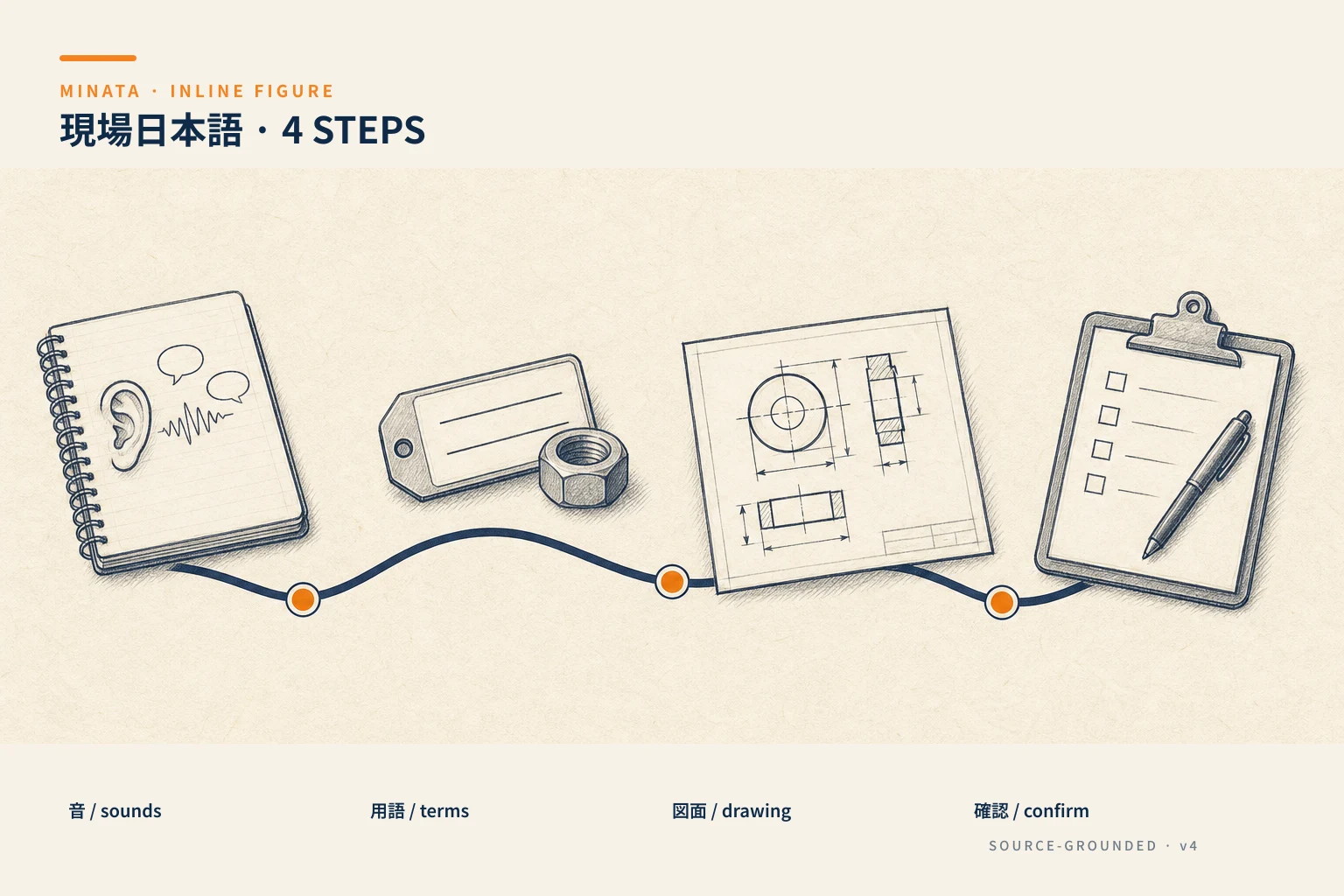
- Reading the floor — numbers and drawing units (寸法, ㎜, φ, R, C), technical katakana (モーター, センサー), verbs of action (締める, 緩める, 確認). Goal: a drawing is no longer a wall of characters.
- Vocabulary by department — 生産技術, 品質, 設備, 保全, 製造, 安全. Each department reuses its own tight cluster.
- Reading technical documents — the title block (表題欄), machining notes (面取り, バリ取り), 仕様書, QC工程表, Misumi and Omron catalogues. This is where the Japanese you learned pays the most interest.
- Communicating and reporting — 報連相, email and 報告書, raising a 不具合, 朝礼, shift handover 引継ぎ. This stage decides whether you are rated as someone who can be trusted with the work.
The four stages are not a rigid queue — learn in parallel when the job demands it — but in this order each step stands on the one before it.
The four-column glossary that stops you forgetting
Every new word you meet on the floor goes straight into one fixed format, always with the reading:
| Japanese | Reading | Meaning | Field note |
|---|
| バリ | bari | burr, sharp edge | Left after machining, has to be 取り (removed) |
| 面取り | めんとり mentori | chamfer | Marked C or R on the drawing |
| 治具 | じぐ jigu | jig, fixture | Locates and clamps the part while it is machined |
| 段取り | だんどり dandori | set-up, changeover | The set-up time before a new lot runs |
That four-column table is the deliverable of every post in this series. Collected post by post, it becomes the notebook you carry for the rest of your career.
A 30-day start
| Week | Focus |
|---|
| 1 | Numbers and drawing symbols (mm, φ, R, C, t, ±) — read five real dimensions aloud each day |
| 2 | Technical katakana (モーター, センサー, ボルト) — work back to the English |
| 3 | The first 50 shop-floor kanji from the set of 100 in #04 — start with your own department |
| 4 | Ten confirmation and reporting phrases — use at least one for real every day |
After 30 days the target is not "good Japanese". It is being able to pick up a drawing with confidence and take part in a basic technical exchange.
Three misconceptions
| Belief | Reality |
|---|
| "I need good general Japanese first" | You can read a drawing and hold a basic exchange with modest grammar, as long as the terms are right |
| "Living in Japan is enough" | A trained ear is not the same as reading kanji or writing a report — it takes deliberate practice |
| "Machine translation will do" | Machine translation fails exactly on terms and drawing symbols, where speed and precision matter |
| Spreading study wide, JLPT style | Narrow and deep beats broad and shallow — learn the cluster your job actually uses |
| Learning the shape but not the reading | If you cannot read it aloud you cannot ask about it or look it up — always keep the reading |
| Holding back for fear of mistakes | A Japanese shop floor values someone who asks 確認 over someone who stays quiet and gets it wrong |
Who this series is for
Vietnamese engineers and technicians working with or inside Japanese companies gain the most directly. Engineering students planning to work in Japan get the vocabulary before they need it. Japanese managers who have to guide Vietnamese staff can use these posts as a shared reference — the bridging posts carry EN and JA editions for that reason.
First-week checklist
- [ ] Open the four-column notebook and enter the first ten words from your own job.
- [ ] Learn the basic numbers and drawing symbols (㎜, φ, R, C).
- [ ] Identify your department and collect its vocabulary cluster.
- [ ] Memorise one confirmation phrase: 「〜で よろしいでしょうか。」 (is this correct?)
Working with a Japanese partner and need someone who can read the drawings, coordinate and close out the technical work in Japanese? While your team learns, MINATA can take the Japan–Vietnam technical bridge: reading and translating drawings and documents, working directly with the Japanese side, designing and manufacturing to Japanese standards. See our Japan–Vietnam services and projects we have delivered.
Next in the series: reading numbers and dimensions on a Japanese drawing (stage 1) · the 100 shop-floor kanji · vocabulary by department.
View all MINATA technical articles