Technical Japanese #02 — Kanji, Hiragana and Katakana on the Shop Floor: What to Read First
In your first week at the machine, the control panel and the process sheet are covered in three scripts mixed together. The problem is not that your Japanese is thin. It is that nobody has told you which script to read carefully, which to merely recognise, and which to skip in order to work safely. This post is not about handwriting. The goal is to get the information you need as fast as possible, in the right order of priority.
Three scripts, three roles
| Script | Role on the floor | What you must recognise |
|---|
| Hiragana ひらがな | Grammar: particles and verb endings (する, して, ください) | Spot て・てください and you know it is an instruction |
| Katakana カタカナ | English loanwords: モーター, センサー, ボルト | Read it aloud and the English usually appears |
| Kanji 漢字 | The words that matter most: safety, quality, operations | A few hundred shop-floor kanji repeat endlessly |
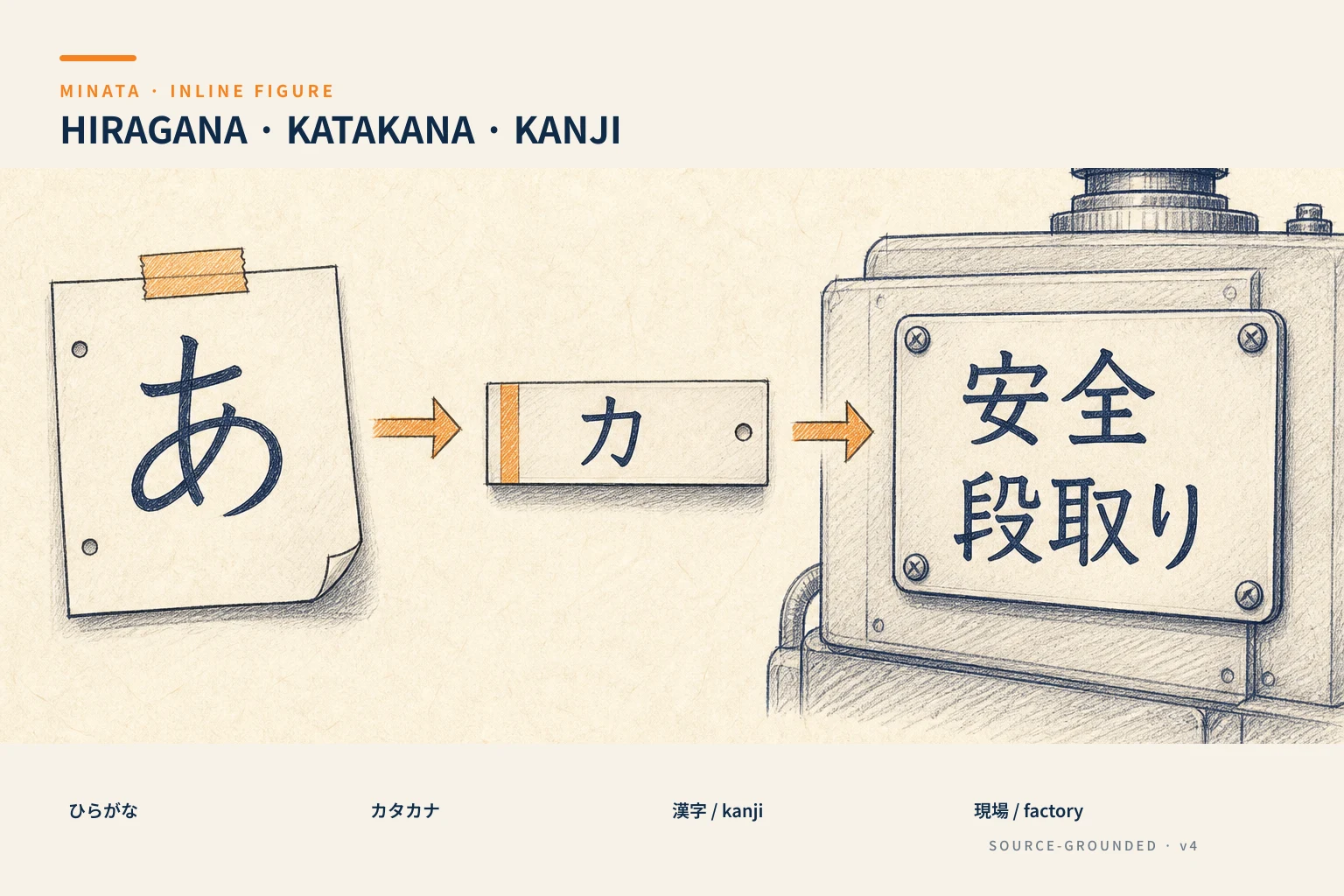
Read by risk, not by alphabet
- Safety kanji first — before you press anything: 危険・注意・停止・非常. Misreading or skipping these can put your hands into a hazard. They are almost always written in kanji, on red or yellow warning colour.
- Equipment katakana next — identify the part you are dealing with: モーター, センサー, バルブ, ポンプ. Easy, because the English is still in there.
- Instruction hiragana last — the verb endings that tell you what to do: 押す, 回す, 確認する.
Safety, then equipment, then action. If you have thirty seconds before you approach the machine, spend them on the safety kanji — do not try to translate the whole sentence.
The foundation set — recognise these on sight
| Japanese | Reading | Meaning | Field note |
|---|
| 危険 | きけん kiken | danger | Always in kanji, on red — read this one first |
| 注意 | ちゅうい chūi | caution | A lighter warning than 危険 |
| 停止 | ていし teishi | stop | Comes with 非常停止 |
| 非常 | ひじょう hijō | emergency | 非常停止 is the emergency stop |
| 運転 | うんてん unten | operation | 運転中 means it is running |
| 検査 | けんさ kensa | inspection | The QC step |
| 確認 | かくにん kakunin | confirmation | All over the paperwork |
| ボタン | botan | button | Katakana from "button" |
| スイッチ | suitchi | switch | Katakana from "switch" |
| モーター | mōtā | motor | Katakana from "motor" |
| センサー | sensā | sensor | Katakana from "sensor" |
| ください | kudasai | please | Signals that a request is being made |
Learn whole blocks, tied to an action
- 非常停止ボタンを押してください。 — Press the emergency stop button. Recognising 非常停止 + ボタン + 押して is already enough.
- 運転中、手を入れないでください。 — Machine running: do not put your hands in. 運転中 plus ないでください means a prohibition, and usually a hazard.
- 確認してから、スタートしてください。 — Confirm first, then start.
Not sure about a katakana word? Say it out loud. スタート becomes "sutāto" and then start. ストップ becomes stop. リセット becomes reset.
Four ways to look up a kanji you do not know
- OCR — Google Translate, Lens or Takoboto: point the camera and you get the reading and the meaning. Fastest option.
- Radicals (部首) — 鉄 (iron) contains 金 (metal), which tells you the field of meaning.
- Stroke count — the traditional index, when you have no OCR.
- Ask a colleague — the most reliable route for a safety label: この漢字は何と読みますか。 (How is this character read?)
Every new shop-floor kanji goes into your personal notebook: meaning, 日本語, romaji, where you saw it. After a few months that notebook beats any textbook, because it contains exactly the characters your plant uses.
Mistakes to avoid
| Mistake | How to avoid it |
|---|
| Learning to write before learning to recognise | The floor only needs reading — start with the safety words |
| Skipping katakana because it looks strange | It is the easiest group, and the closest to English |
| Trying to translate a whole hiragana sentence | The safety meaning sits in the first few kanji |
| Confusing 止 (stop) with 正 (correct), or 力 (force) with 刀 (blade) | If safety depends on it and you are unsure, ask |
Read it, then act — quick self-check
- You see 非常停止 on a red button.
- A label reads 触らないでください.
- You meet an unfamiliar katakana word, リセット.
- There is a kanji on a safety label that you cannot read.
<details><summary>Answers</summary>
- That is the emergency stop. Learn where it is before you need it.
- "Do not touch" — a safety prohibition. Leave it alone.
- Say it aloud: "risetto", which is reset.
- Do not guess. Ask: この漢字は何と読みますか。
</details>
Quick recall
- Read by risk: safety kanji, then equipment katakana, then instruction hiragana.
- Say katakana aloud and the English appears; read the safety kanji 危険・停止・非常 before anything else.
- An unknown kanji on a safety label goes to OCR or a colleague, never to guesswork.
Working with a Japanese partner and need someone who can read the documents, drawings and technical standards in Japanese? MINATA takes on the Japan–Vietnam technical bridge: reading and translating documents and drawings, coordinating with the Japanese side, designing and manufacturing to Japanese standards. See our Japan–Vietnam services and projects we have delivered.
Next in the series: reading numbers and dimensions on a Japanese drawing (寸法・㎜・φ) · the 100 shop-floor kanji · technical katakana borrowed from English.
View all MINATA technical articles