Technical Japanese #05 — Technical Katakana: Recognising English Loanwords in Japanese
Katakana — the angular script — is used mainly to transcribe English loanwords. モーター is motor, センサー is sensor, ボルト is bolt. If you already have technical English, katakana is not a barrier but a bridge into shop-floor terminology. This post shows how to read katakana backwards into English in a few seconds. Katakana transcribes English the way a Japanese ear hears it, so the changes are regular enough to reverse.
Six sound-change rules — working katakana back to English
| Rule | Example | Reading it backwards |
|---|
| A vowel is added to a final consonant | bolt → ボルト (bo-ru-to) | Drop the spare vowel at the end |
| Both L and R become the ラ row | roller → ローラー | Try it with L and with R |
| "v" usually becomes B (バ row) | valve → バルブ | Seeing バ/ビ/ブ, try V |
| A long vowel is marked ー | motor → モーター | ー often stands for -er, -or, -ar |
| "th" and "f" take the nearest sound | filter → フィルター | フ is close to f, ス to th |
| Long words get clipped | air conditioner → エアコン | Think of the full original |
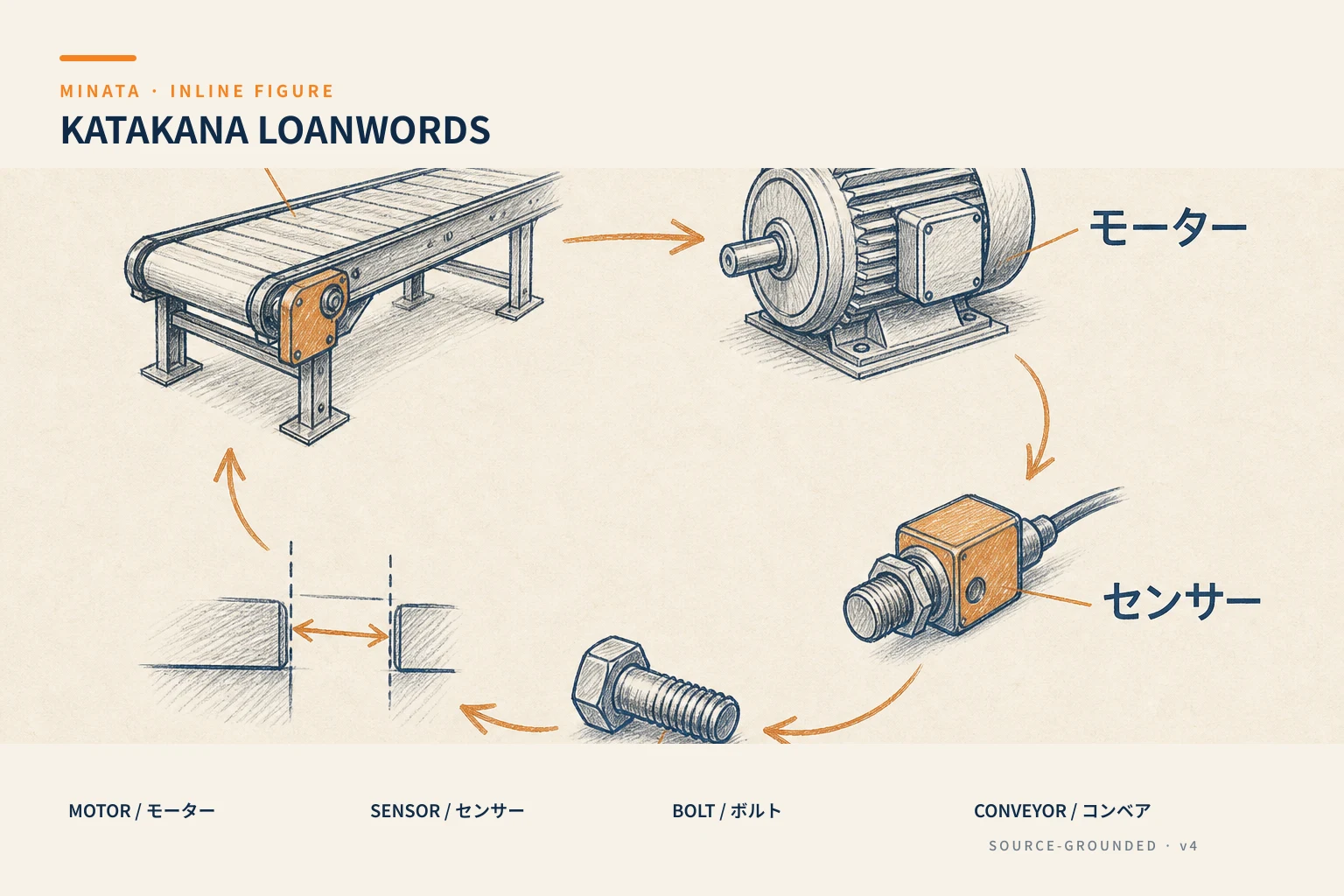
The component and command katakana you meet most
| Japanese | Romaji | Meaning | English |
|---|
| モーター | mōtā | motor | motor |
| センサー | sensā | sensor | sensor |
| スイッチ | suitchi | switch | switch |
| バルブ | barubu | valve | valve |
| ポンプ | ponpu | pump | pump |
| ボルト | boruto | bolt | bolt |
| ベルト | beruto | belt | belt |
| ベアリング | bearingu | bearing | bearing |
| フィルター | firutā | filter | filter |
| ローラー | rōrā | roller | roller |
| カバー | kabā | cover, guard | cover |
| シリンダー | shirindā | cylinder | cylinder |
| ジョイント | jointo | coupling, joint | joint |
| ヒューズ | hyūzu | fuse | fuse |
| シャフト | shafuto | shaft | shaft |
| コネクター | konekutā | connector | connector |
| スタート | sutāto | start | start |
| ストップ | sutoppu | stop | stop |
| リセット | risetto | reset | reset |
| オート | ōto | automatic | auto |
| マニュアル | manyuaru | manual | manual |
Katakana for consumables, units and machine states
| Japanese | Romaji | Meaning | English |
|---|
| パッキン | pakkin | gasket, seal | packing |
| グリス | gurisu | grease | grease |
| テープ | tēpu | tape | tape |
| ラベル | raberu | label | label |
| モード | mōdo | mode | mode |
| エラー | erā | error | error |
| レベル | reberu | level | level |
| データ | dēta | data | data |
| チェック | chekku | check | check |
| エア | ea | compressed air | air |
エラー plus a number on the HMI is a machine fault code. Write the code down and report it. Do not keep resetting it. ダブルチェック (double check) is a standard quality rule in Japanese plants.
Three marks that decide the reading
| Mark | What it does | Example |
|---|
| ー long vowel | Lengthens the vowel | メーター (mē-tā) is not メタ (meta) |
| ッ small tsu | Doubles the next consonant | カッター (kattā, a cutter) |
| ャ・ュ・ョ small kana | Makes a palatalised sound | ジョイント (jointo), シュ (shu) |
Sentences you will hear
- モーターが止まりました。 — Mōtā ga tomarimashita. — The motor has stopped.
- センサーを確認してください。 — Sensā o kakunin shite kudasai. — Please check the sensor.
- オートモードにしてください。 — Ōto mōdo ni shite kudasai. — Switch it to automatic mode.
- フィルターを交換します。 — Firutā o kōkan shimasu. — I am going to replace the filter.
Traps worth knowing
| Trap | Example |
|---|
| Wasei-eigo, English made in Japan | クレーム (kurēmu) is a customer complaint, not an insurance claim; ベテラン is a skilled veteran worker |
| Clipped past recognition | リモコン is remote control; エアコン is air conditioner |
| Not English at all | アルバイト is from German Arbeit, a part-time job; エネルギー from Energie |
| Look-alike characters | ソ↔ン and シ↔ツ are very close — confirm the reading on anything that matters |
Decode these — quick self-check
Read slowly, drop the padding vowels, put the English back together. Answers below.
- パッキン
- グリス
- コンプレッサー
- ワッシャー
- ゲージ
<details><summary>Answers</summary>
- packing — a gasket or seal
- grease
- compressor
- washer
- gauge
</details>
Quick recall
- Katakana is borrowed English — read it backwards with the six sound-change rules.
- ー, ッ and small ャュョ change the word; miss one and you have a different term.
- Japanese brand names are katakana too: オムロン Omron, ミスミ Misumi, キーエンス Keyence. Read them and you can search the right catalogue and part number.
Do you have Japanese drawings, 仕様書 or technical documents that have to end in a finished part, not just in understanding? Reading them yourself is a good skill, but when the deadline is short or the volume is large, MINATA takes on reading and breaking down Japanese drawings and specs, then designing and machining to Japanese standards. See MINATA's engineering services and projects we have delivered.
Next in the series: the 100 shop-floor kanji · action verbs (締める, 緩める and the rest) · electrical and automation vocabulary (電源, 配線, PLC).
View all MINATA technical articles