Technical Japanese #09 — Production Engineering Japanese: Core Terms and Department Flow
Walk into a Japanese plant and the organisation chart is full of 設計・生産技術・製造・品質・保全. Which department does what, and who should you be talking to? 生産技術 (seisan gijutsu) is the one most often misunderstood, even though it is the bridge between the design drawing and a product coming off the line. This post covers the department's role and the vocabulary you need to talk to it correctly.
What 生産技術 actually does
If 設計 answers "what are we making", 生産技術 answers "how do we make it repeatably, to quality, at the required rate". This is the department that designs the production process: choosing machines, designing jigs, laying out the process steps, calculating throughput, standardising the operation and improving it. It sits in the middle — it takes the drawing from 設計 and turns it into a process that 製造 can run.
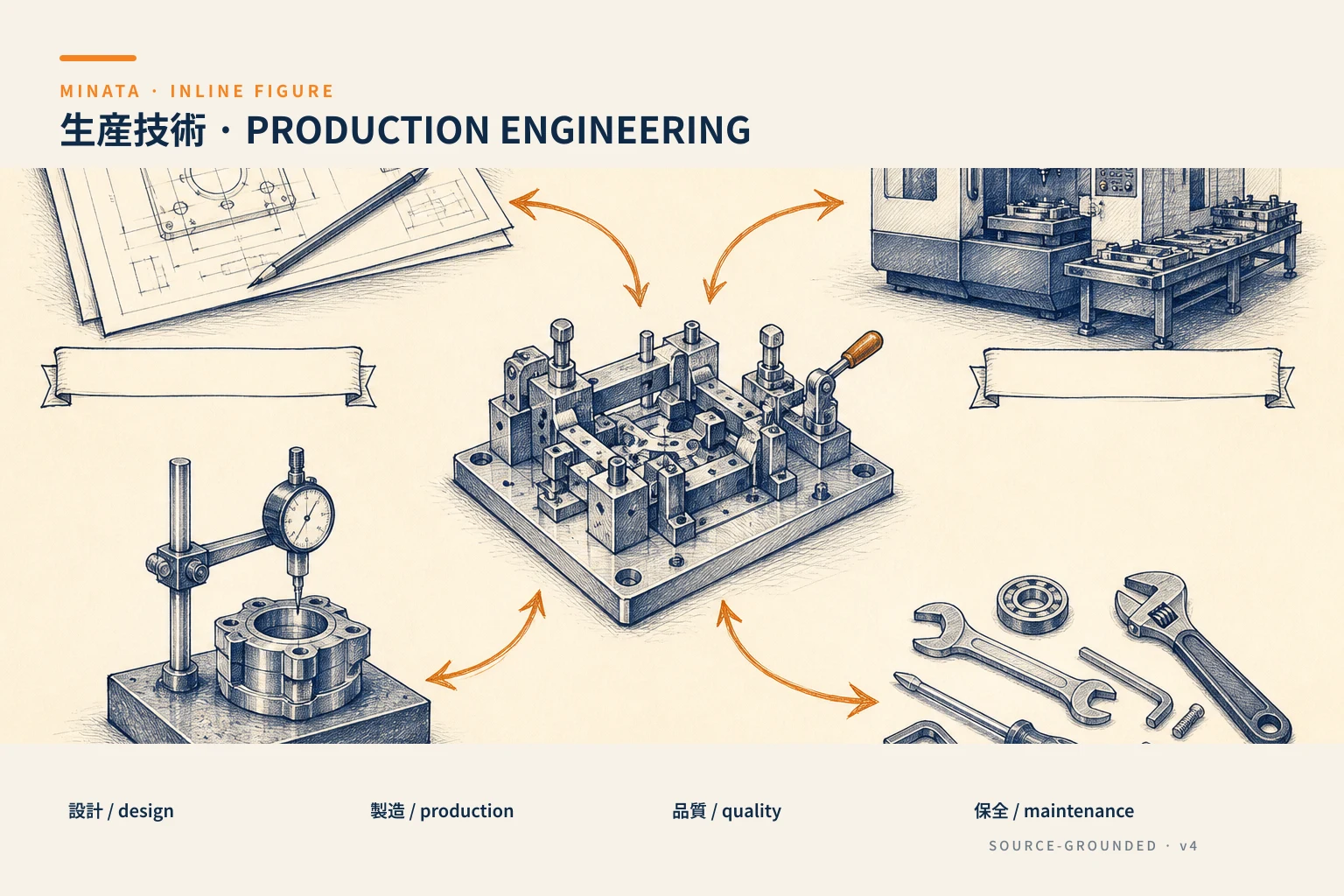
Core vocabulary of 生産技術
| Japanese | Reading | Meaning | Field note |
|---|
| 生産技術 | せいさんぎじゅつ seisan gijutsu | production engineering | The department that designs the process |
| 工程 | こうてい kōtei | process step | One step inside the process |
| 工程表 | こうていひょう kōteihyō | process chart | The order the steps run in |
| タクトタイム | takuto taimu | takt time | Target time per piece |
| 段取り | だんどり dandori | set-up, changeover | Preparation before a lot runs |
| 治具 | じぐ jigu | jig, fixture | Locates and clamps the part |
| 生産性 | せいさんせい seisansei | productivity | Output per unit of resource |
| 稼働率 | かどうりつ kadōritsu | utilisation rate | Share of time the machine really runs |
| 改善 | かいぜん kaizen | improvement | Continuous, incremental improvement |
| 標準作業 | ひょうじゅんさぎょう hyōjun sagyō | standard work | The standardised way of doing the job |
| レイアウト | reiauto | layout | How machines and lines are arranged |
Which department to ask, and about what
| Department | Japanese | What they own |
|---|
| Design | 設計 (sekkei) | Design intent, original tolerances, structural changes |
| Production engineering | 生産技術 | Process, jigs, productivity, layout |
| Manufacturing | 製造 (seizō) | How the line actually runs, the concrete operations |
| Quality | 品質 (hinshitsu) | Pass/fail criteria, handling of 不良 |
| Maintenance | 保全 (hozen) | Machine condition, 故障, 予防保全 |
| Purchasing | 購買 (kōbai) | Sources for 材料/部品, delivery dates |
The seven wastes (7つのムダ) — the language of improvement
| Waste | Japanese | Example |
|---|
| Overproduction | 作りすぎのムダ | Making more than demand |
| Waiting | 手待ちのムダ | Machine or person waiting on the other |
| Transport | 運搬のムダ | Moving material more than needed |
| Over-processing | 加工のムダ | Working to a finer standard than required |
| Inventory | 在庫のムダ | Work in process piling up |
| Motion | 動作のムダ | Reaching, bending and walking that adds nothing |
| Defects | 不良をつくるムダ | Rework and scrap |
If you hear 「これは運搬のムダですね」 in a 改善 meeting — "this is transport waste" — you are keeping up with the discussion.
標準作業 (standard work) — three elements
タクトタイム, the target rate; 作業順序, the order of operations; and 標準手持ち, the minimum work in process that keeps the line flowing. All three are written on the 標準作業票 posted at the workstation.
A typical exchange between 生産技術 and 製造
- 製造: この工程、タクトオーバーしています。 — This step is over takt.
- 生産技術: 原因は段取りですか、動作のムダですか。 — Is the cause the changeover, or wasted motion?
- 製造: 動作のムダだと思います。部品が遠いです。 — Wasted motion, I think. The parts are too far away.
- 生産技術: では、レイアウトを改善しましょう。 — Then let us improve the layout.
The whole method is in those four lines: detect it with a number (takt), trace it through the seven wastes (motion), act (改善 on the layout).
Mistakes to avoid
| Mistake | Why it hurts |
|---|
| Confusing 生産技術 with 製造 | 製造 runs production; 生産技術 designs the process they run — ask the wrong one and you get no answer |
| Treating 改善 as a slogan | It is measured work. Saying 改善 without numbers carries no weight |
| Ignoring タクトタイム | Without the takt you cannot understand why a step is called "slow" |
| Translating 段取り as "preparation" | It has the narrower sense of set-up and changeover time — a number people are trying to shrink |
Hear it, then act — quick self-check
- You need to ask about design intent and the original tolerance.
- You hear 稼働率が下がっています.
- You want to shorten the changeover.
- In a 改善 meeting someone points at 動作のムダ.
<details><summary>Answers</summary>
- Go to 設計, not 生産技術.
- Machine utilisation is falling — trace it: breakdowns, waiting for material, or a long set-up?
- Talk about reducing 段取り時間, with 生産技術.
- They mean wasted motion — reaching, bending, walking — usually fixed by changing the layout.
</details>
Quick recall
- 生産技術 designs the process and stands between 設計 and 製造.
- The core cluster: 工程 / 工程表 / タクト / 段取り / 治具 / 改善.
- 改善 needs numbers, and the seven wastes are the language you use to point at what to fix.
Do you need a process or a jig designed, or a Japanese 工程表 or 仕様書 read so that machining can start? MINATA takes on reading Japanese drawings and documents, designing 治具, standardising process steps and machining. See MINATA's engineering services and projects we have delivered.
Next in the series: 品質 quality · 設備 equipment · 保全 maintenance · and the Manufacturing Engineering series.
View all MINATA technical articles