Technical Japanese #32 — Reporting a Defect Without Blame: Japanese Fuguai Communication
In a Japanese plant, how you report a fault matters as much as how you fix it. The culture separates the problem from the person: the goal is the cause and the prevention of recurrence, not the assignment of blame. Fear of being scolded is what makes people report late or downplay the scale — and that is exactly what gets rated badly. This post shows how to report a fault in a way that is trusted.
Core vocabulary for reporting a fault
| Japanese | Reading | Meaning | On the floor | Note |
|---|
| 不具合 | ふぐあい fuguai | fault, problem | 不具合が出た | Neutral — it assigns no blame |
| 発生 | はっせい hassei | occurrence | 不具合発生 | It occurred |
| 現象 | げんしょう genshō | symptom | 現象を説明 | What you can observe |
| 原因 | げんいん gen'in | cause | 原因を調査 | Cause |
| 影響 | えいきょう eikyō | impact | 影響範囲 | What else it touches |
| 範囲 | はんい han'i | scope, range | 影響範囲 | How far it reaches |
| 応急処置 | おうきゅうしょち ōkyū shochi | first-aid action | 応急で止めた | The immediate stop-gap |
| 停止 | ていし teishi | stopped | ラインを停止 | The line was stopped |
| 再発防止 | さいはつぼうし saihatsu bōshi | recurrence prevention | 再発防止策 | Stopping it happening again |
| なぜなぜ | naze-naze | the five whys | 5回のなぜ | Root-cause questioning |
| 申し訳ございません | もうしわけ mōshiwake gozaimasen | I am very sorry | A formal apology | Formal |
| 直ちに | ただちに tadachi ni | immediately | 直ちに報告 | At once |
| 不良数 | ふりょうすう furyōsū | defect quantity | 不良数10個 | How many are affected |
| 隔離 | かくり kakuri | quarantine | 不良を隔離 | Segregate the parts |
| 調査 | ちょうさ chōsa | investigation | 調査中 | Under investigation |
Five pieces of information
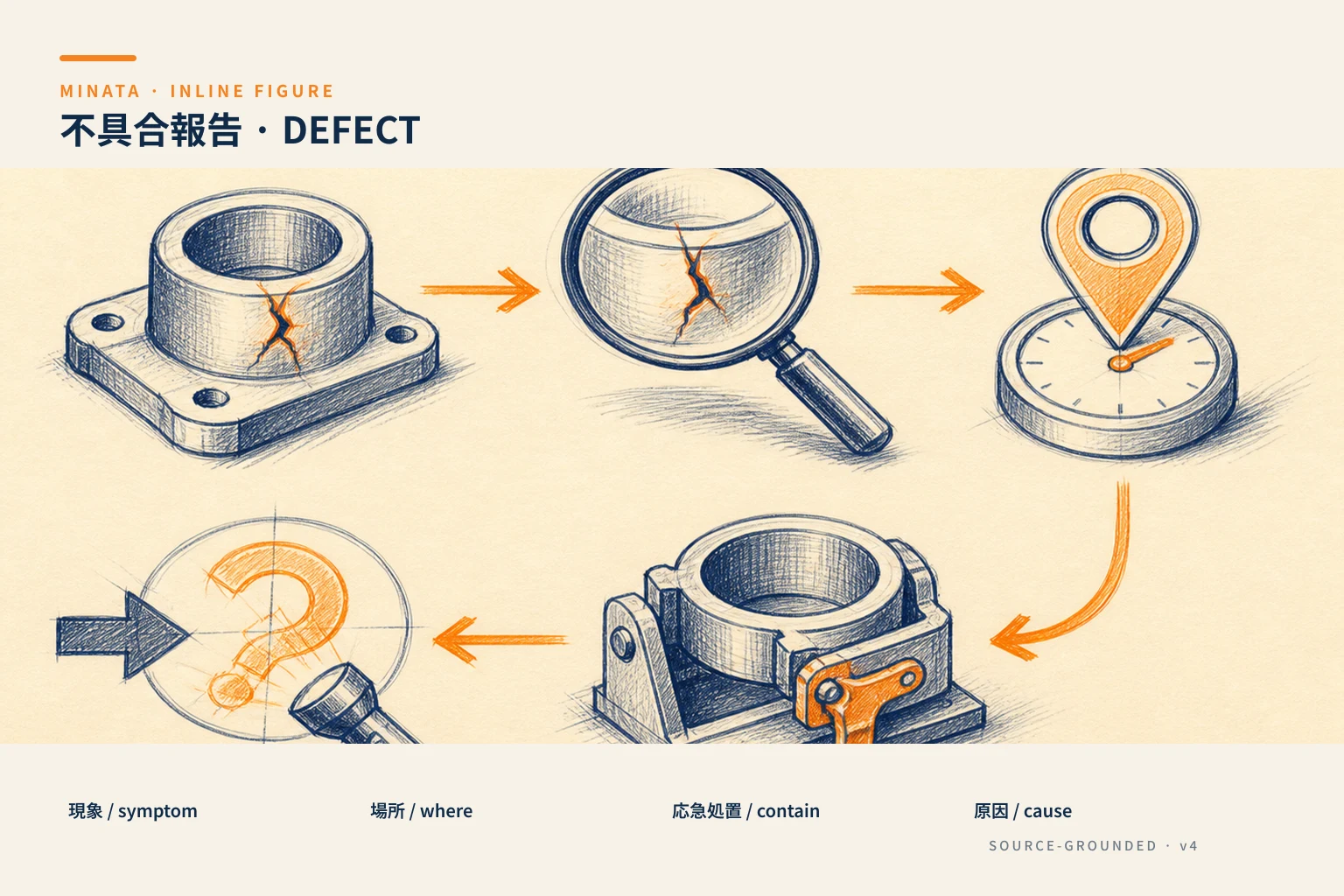
When a 不具合 occurs, report immediately (直ちに) with five points, in this order:
- What — the 現象, concretely: 「A社向けの部品で寸法不良」.
- When and where — the process step and the time.
- How many — the 不良数 and the 影響範囲.
- What you are doing now — the 応急処置: has the line been stopped, has the material been quarantined?
- The cause, if you know it. If you do not: 調査中.
The key move is stating objective fact and not opening with a justification. Responsibility is settled later; what the Japanese side needs first is containment.
Phrases by situation
Reporting immediately
- 不具合が発生しました。直ちにご報告します。 — A fault has occurred. I am reporting it immediately.
- 現象は○○で、不良数は10個です。 — The symptom is ○○, and ten pieces are affected.
- 応急処置としてラインを停止し、不良を隔離しました。 — As an immediate measure we stopped the line and quarantined the defects.
When the cause is not yet known
- 原因は現在調査中です。分かり次第ご報告します。 — The cause is under investigation. I will report as soon as we know.
Mistakes to avoid
| Mistake | Why it hurts |
|---|
| Reporting late for fear of being scolded | The problem spreads and the damage grows. In Japan a late report is treated as worse than the fault |
| Opening with blame or justification | "It was the machine", "it was the previous shift" — instead of the objective symptom |
| Skipping the 応急処置 | Reporting "there is a defect" without stopping or quarantining means the defect keeps being made |
| Hiding the real 不良数 | When it comes out, the trust is gone completely |
Hear it, then act — quick self-check
You have just found eight dimensionally defective pieces on the line. What is your first sentence?
<details><summary>Answer</summary>Report immediately, fact first: 「寸法不良が発生しました。不良数は8個、応急でラインを停止して隔離しました。原因は調査中です。」 — symptom, quantity, containment, cause under investigation. No justification.</details>
Your manager asks for the cause and you are not sure. What do you say?
<details><summary>Answer</summary>「現在調査中です。推測ですが…」 and mark clearly that what follows is a 推測, a guess, not a finding. Never invent a 原因.</details>
How MINATA helps
Does your team need the 不具合報告 process and a no-blame reporting culture established for work with Japanese customers? MINATA sets up the forms, the reporting script, and acts as the Japan–Vietnam bridge when something goes wrong. See our Japan–Vietnam projects or Japan–Vietnam business services.
View all MINATA technical articles