Device Selection #14: Ball, Cylindrical Roller or Tapered Roller Bearing — Choosing by Radial and Axial Load
Short answer: choose a ball bearing when the shaft rotates at a relatively high speed, the radial load dominates and the axial load is within the type's limit; choose a cylindrical roller bearing when you need a higher radial load or stiffness; choose a tapered roller bearing when the shaft takes a combined radial–axial load and you can arrange a pair to control clearance/preload. Do not choose just because of a familiar shaft diameter or bearing code. The load direction, shaft misalignment, heat, speed, how the inner/outer ring is fixed, and the lubrication approach decide how the bearing really works.
Quick comparison
| Criterion | Deep-groove ball | Cylindrical roller | Tapered roller |
|---|
| Prominent load | Radial; takes some axial per the model | High radial, good stiffness | Combined radial and axial |
| Speed | Usually suits high speed per the catalog | Depends on cage, lubrication and model | Depends on arrangement, preload and lubrication |
| Axial load | Check per the exact model | Many types favor radial; needs a separate arrangement for axial | Takes axial in one direction; usually used in pairs |
| Installation | Common, simple but still needs the correct fit | Needs understanding of the locating/non-locating type | Needs clearance/preload adjustment and mounting orientation |
| Application | Motor, pulley, fan, general rotary mechanism | Radial/stiff-load shaft, mechanical gearbox | Hub, gearbox, shaft with combined axial load |
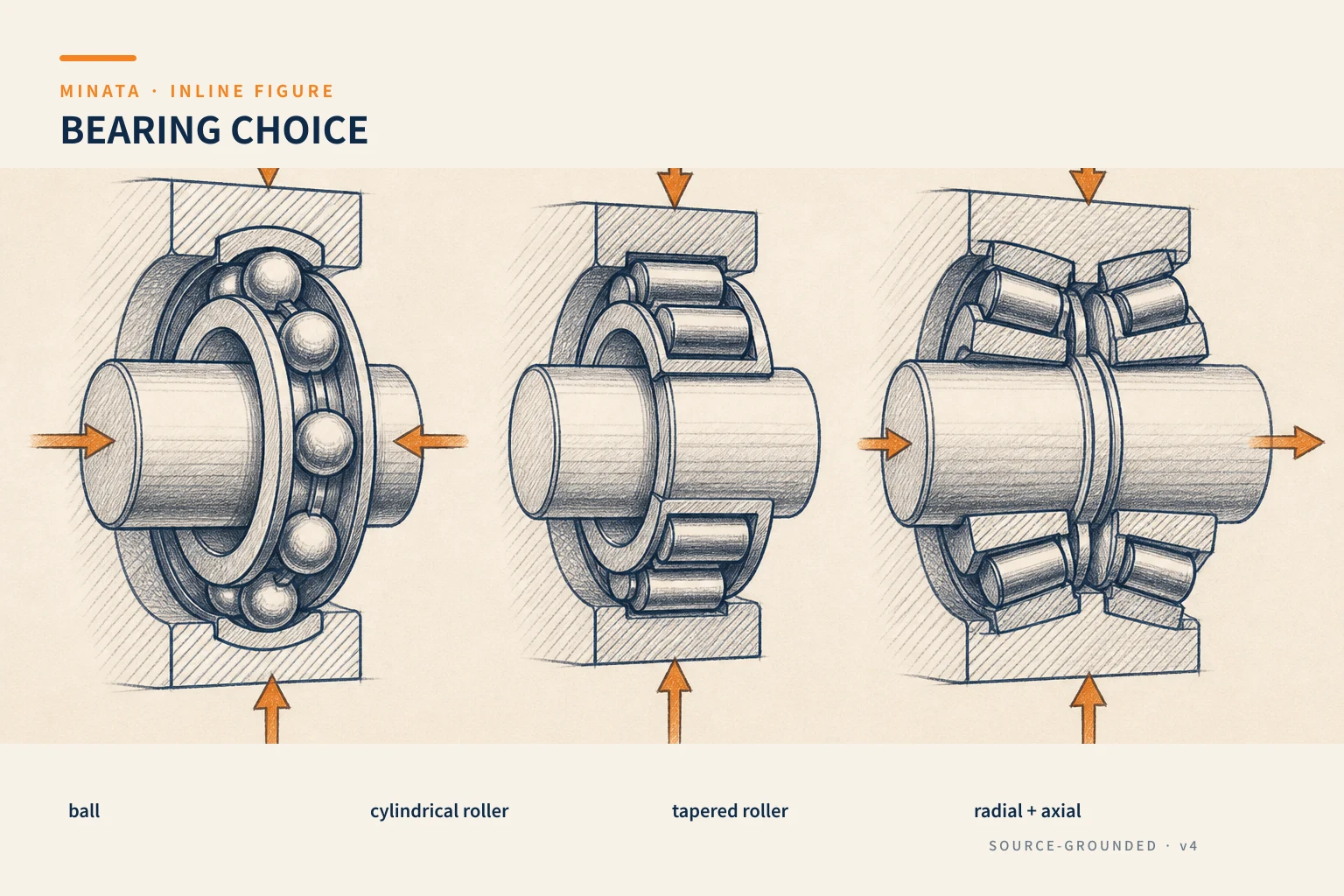
Start with the force diagram on the shaft
A shaft does not "have a load" in the abstract. A pulley creates a radial load from belt tension; a helical gear can add an axial force; a ball screw creates an axial force; a hanging or overhung load creates a moment that makes the two bearings take different loads. Draw the shaft, the bearing positions, the force-application points, the spacing and the direction of rotation before opening a catalog. This diagram also shows which is the locating bearing holding the axial position and which allows thermal expansion.
If you do not have the forces, you cannot choose a reliable bearing. Collect the transmitted forces, speed, cycle, temperature, cleanliness, shaft diameter, housing space and required life. For a changing load, record each running/idle/acceleration phase; a short peak load means something different from a continuous load. Use the exact maker's calculation software/documentation for life and load factor rather than taking the dynamic load rating as the "usable load."
Ball bearing: a common choice, not meaning use it everywhere
A deep-groove ball bearing is common because it is compact, low-friction and easy to find. They usually suit a radial load and can take an axial load within the specific limit of the series/model. They are all "ball bearings," but the seal, shield, internal clearance, material, accuracy grade, grease and groove type change considerably. The MISUMI catalog shows many ball-bearing variants: shielded, rubber-sealed, stainless, low-dust, thrust ball bearings and housing units, so you cannot substitute by the three numbers on the size code.
A ball bearing is a good choice for motors, pulleys, fans, light-to-medium rotary mechanisms and assemblies needing speed per the catalog. But it does not by itself handle a large axial load or overhung moment. If the shaft has a helical gear, a winding drum, a ball screw or a long-reach mechanism, compute the forces at the two supports and consider a more suitable bearing type/arrangement. Increasing the ball-bearing bore may not solve the load direction that is the constraint.
The internal clearance must also be understood correctly. When pressing the ring onto the shaft/housing, the temperature difference and preload from installation can change the working clearance. Too tight easily generates heat; too loose creates vibration and play. Choosing C3 or another clearance grade must be based on the fit, temperature and maker's guidance, not a rule of "every motor uses C3."
Cylindrical roller bearing: radial load and stiffness, with a shaft architecture
A roller bearing uses rollers instead of balls. The larger contact area usually helps meet the radial load and stiffness by design. There are many variants: cylindrical, needle, spherical roller and roller thrust; so the word "roller bearing" is not enough to conclude about axial load or self-alignment. SKF classifies bearings by their radial/axial load characteristics and emphasizes that the real load can be a combination of the two directions.
A cylindrical roller bearing can be useful when the radial load is high and when you need to arrange one support to allow axial displacement due to heat, depending on the ring/rib type. This is part of a fixed–floating arrangement: one position locates the shaft axially, the other lets the shaft expand. Using two supports both locking axially on a long shaft that heats up can create an internal load not visible on the force drawing.
For a needle bearing, the compact cross-section is an advantage, but the raceway/stiffness of the shaft and housing must meet the model's construction. Do not replace a ball bearing with a needle just to be "thinner" while ignoring the raceway requirement. For a spherical roller, the misalignment-compensation capability can help a deforming shaft/frame, but the speed, axial load, seal and lubrication must still be sized by the model.
Tapered roller bearing: combined load and a pair designed together
A tapered roller bearing has tapered rollers and raceways, so it suits taking a radial load together with an axial load in one direction. Because the axial load has a direction, the system usually uses an opposing pair to locate the shaft on both sides. A back-to-back, face-to-face or tandem arrangement changes the stiffness, the distance between reaction points and the directional load capacity; use the manufacturer's diagram to choose.
The important point when using a tapered roller bearing is adjusting the preload or endplay. Too loose creates play and vibration; too tight raises friction, heat and reduces life. The lock nut, spacer, shoulder face, housing squareness and the assembly procedure directly affect the result. You cannot just press the two tapered rings in and trust that the preload is automatically correct.
Tapered roller bearings often appear in a hub, gearbox, a shaft with load from gears, a winding drum or a mechanism carrying an axial load. If the application requires high speed, check the speed limit and the grease/oil. Braking, acceleration, shock loads and heat from the transmission also enter the bearing's condition; see #12 on brakes and clutches when the shaft has frequent dynamic stops.
Fit, shoulder and the fixing approach
A bearing only transmits load correctly when the inner/outer ring is supported on a sufficient shoulder, with the correct fit and not slipping in the wrong place. Whichever ring rotates relative to the load needs the creeping risk considered; whichever ring must be removed for maintenance affects the fit type. The shoulder needs a suitable radius/undercut to match the bearing chamfer. The lock nut, circlip or cover must be chosen by the real axial-holding task, not just to "keep the bearing from falling out."
The bearing housing must be stiff enough and the housing bore geometrically correct enough. A thin housing, a skewed mounting face or a misaligned press can deform the ring, create noise and reduce life. When installing, transmit force into the correct ring being pressed: press the inner ring when going onto the shaft, press the outer ring when going into the housing. Do not transmit force through the balls/rollers with a hammer to "install it quickly."
Lubrication, seal and environment
The correct grease type/amount is part of the life. Too little does not form a lubricating film; too much can generate heat at high speed. Cutting oil, wash-down water, fine dust, heat and corrosion decide whether you need a shield, a contact seal, a labyrinth or a sealed housing. A seal increases protection but can increase friction; choose by the machine's real environment.
For a clean or food mechanism, choose the material, grease and seal design per the project's regulations. For a dirty environment, do not just choose a sealed bearing while forgetting the ingress path through the shaft, cover and wash pressure. The lubrication/inspection schedule must be in the machine handover documentation.
Common selection and installation mistakes
- Choosing by the shaft diameter without drawing the radial/axial load.
- Using two supports both locking axially, leaving no room for thermal expansion.
- Using a roller bearing without understanding whether the model takes axial load.
- Setting a tapered-bearing preload by feel, not by the documentation/procedure.
- Pressing force through the rolling elements, damaging the bearing right at installation.
- Forgetting the seal, grease, wash-down water and the maintenance-removal method.
Read heat and vibration before the bearing fails
Rising temperature, a whining noise, increasing vibration or a color change in the grease are signals to check the load, preload, fit and lubrication. Do not immediately conclude a low-quality bearing; the cause can be a too-tight belt, an incorrect shaft shoulder, a misaligned housing, contamination or a wrong press fit. When replacing a bearing, keep the physical part and observe the raceway/cage to match the wear pattern with the real load direction.
In a drive-shaft assembly, the bearing relates directly to the pulley, coupling, gearbox and braking approach. Excessive belt tension increases the radial load; a misaligned coupling creates a moment/bending; an abruptly engaged brake creates a shock load. So the bearing-selection requirement needs data from the whole system, not from the person buying the bearing after the shaft drawing is locked.
For a product needing quick replacement, draw clearly how to pull the shaft, remove the cover and reinstall without damaging the seal. A correct bearing with no puller space, or one whose preload cannot be set after replacement, is still a poor operational choice.
Data to lock on the drawing and BOM
Record the full bearing code, the clearance grade or preload when applicable, the seal/shield type, the grease/oil type, the shaft and housing fit, the axial-holding approach, the tapered-pair mounting direction and the lock-nut tightening torque. "Bearing per sample" is not enough to re-purchase years later, because changing just the seal or internal clearance can make the operating condition different. For a bought-in housing, confirm the mounting diameter, center height and how the load transfers into the frame.
The shaft-assembly acceptance should include turning by hand, checking the endplay/preload per design, a no-load run, a representative-load run and recording the heat/vibration as a baseline. This baseline helps maintenance distinguish a gradual change from the machine's normal characteristic.
Record the test-run date, load condition and lubricant type in the machine file to trace maintenance.
Quick selection checklist
- [ ] Do you have the radial/axial force diagram, the force positions and the spacing of the two supports?
- [ ] Is the radial load dominant, the speed high and the axial within the model's limit? Yes → consider a ball bearing.
- [ ] Do you need a high radial load/stiffness or a floating arrangement for heat? Yes → consider the correct roller-bearing type.
- [ ] Is there a combined load and a need to locate axially on both sides? Yes → consider a tapered roller bearing by pair arrangement/preload.
- [ ] Have you checked the fit, shoulder, locating–floating approach, lubrication, seal and assembly procedure?
MINATA can help build the force diagram, choose the support arrangement and review the assembly drawing so the bearing is chosen to suit the shaft and operating conditions. Talk to the Engineering & Manufacturing team.
References
- SKF, Bearing types and design characteristics, accessed 2026-08-23.
- MISUMI, Factory Automation Catalog 2018, Bearings with Housing / Bearings chapter; cross-checked against MINATA's internal catalog on 2026-08-23.
View all MINATA technical articles