Technical Japanese #11 — Equipment Japanese: Machines, Fixtures, Setup and Operation
A Japanese shop floor moves around its 設備 (setsubi). But Japanese separates "machine", "equipment" and "fixture" far more finely than the words most of us reach for. Misread 治具 (a jig) or 段取り (a set-up) and you prepare the wrong thing and lose half a shift. This post sorts out the core 設備 vocabulary and the two numbers a Japanese plant watches minute by minute: 稼働 (running) and 段取り (changeover).
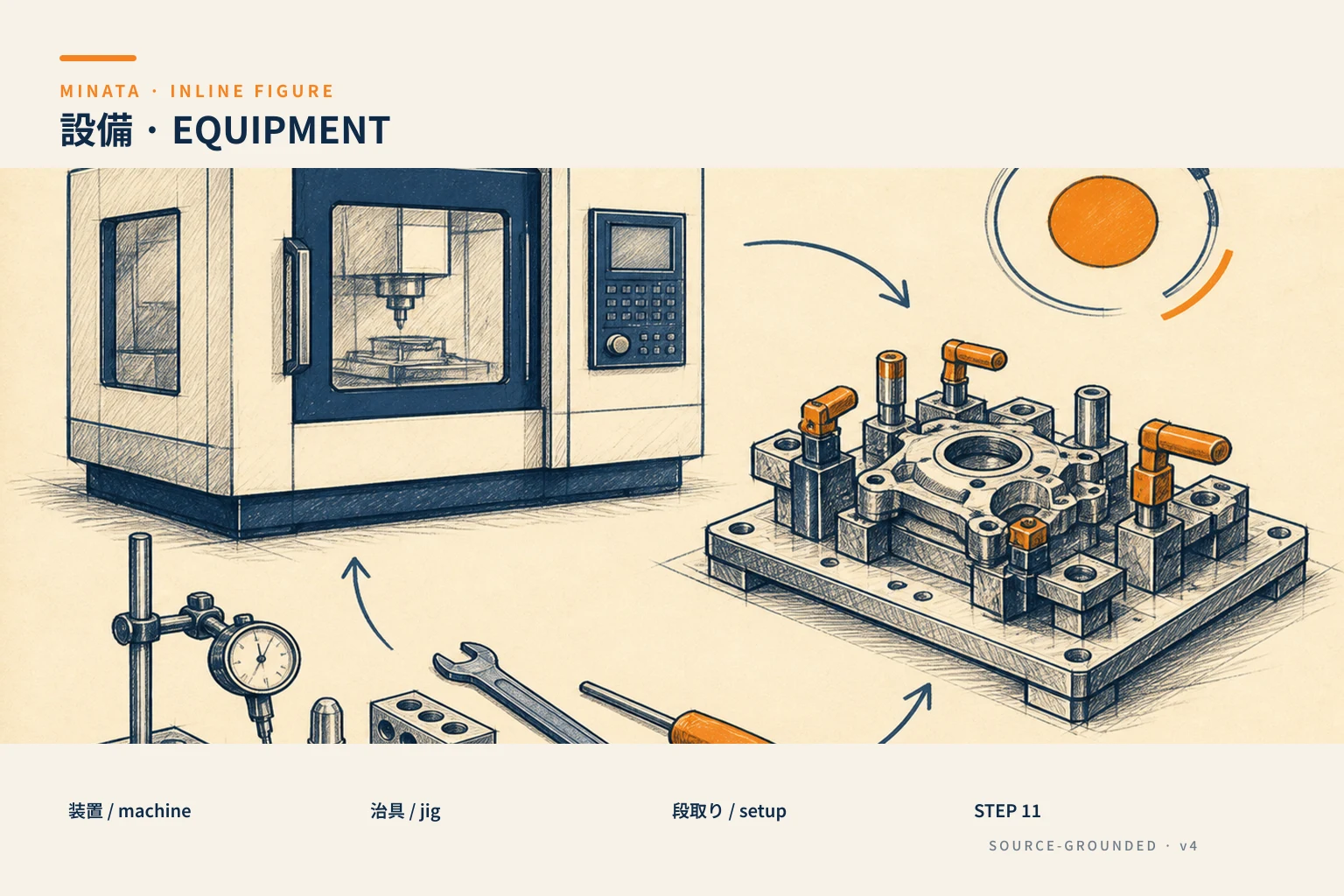
Four levels of equipment — do not confuse 装置 with 治具
| Japanese | Meaning | What it actually is |
|---|
| 設備 (setsubi) | equipment in general | All machinery and infrastructure in the plant |
| 装置 (sōchi) | a functional machine | 検査装置, 洗浄装置 |
| 機械 (kikai) | a mechanical machine | Lathe, mill, press |
| 治具 (jigu) | jig, fixture | Holds and locates the part — not a machine |
If someone says 「治具を交換して」 — change the jig — and you go and adjust the machine, you have misheard each other. 装置 is the machine that runs; 治具 is the fixture that goes with it.
Core equipment vocabulary
| Japanese | Reading | Meaning | Field note |
|---|
| 設備 | せつび setsubi | equipment (general) | All plant machinery |
| 装置 | そうち sōchi | functional machine | A machine built for one purpose |
| 機械 | きかい kikai | mechanical machine | Turning, milling, pressing |
| 治具 | じぐ jigu | jig, fixture | Holds and locates the part |
| 金型 | かながた kanagata | die, mould | For pressing and moulding |
| 段取り | だんどり dandori | set-up, changeover | Preparing for a different product |
| 稼働 | かどう kadō | in operation | 稼働率 = utilisation rate |
| 運転中 | うんてんちゅう unten-chū | running | The machine is working now |
| 停止 | ていし teishi | stop | Operation halted |
| 試運転 | しうんてん shiun'ten | trial run | Testing before production |
| 操作盤 | そうさばん sōsaban | operator panel | Where the machine is driven from |
| 制御盤 | せいぎょばん seigyoban | control cabinet | Holds the PLC and the relays |
| エア | ea | compressed air | Supply for the cylinders |
| 能力 | のうりょく nōryoku | capacity | Rated output or capability |
段取り and 稼働率 — the two efficiency ideas
- 段取り is everything involved in moving from product A to product B: changing the die, swapping the fixture, entering the settings. 段取り中 means the machine is not producing, it is being prepared. Shortening 段取り — the SMED idea — raises output without buying a machine. You will hear 段取りに何分かかりますか。 (How many minutes does the changeover take?)
- 稼働率 is the share of available time in which the machine actually runs. When it falls, trace the cause: a breakdown (故障), waiting for material, or a long set-up.
Reading the machine plate: 銘板 · 仕様 · 定格
| Japanese | Reading | Meaning | Unit |
|---|
| 仕様 | しよう shiyō | specification | The machine spec sheet |
| 定格 | ていかく teikaku | rating | Standard operating value |
| 電圧 | でんあつ den'atsu | voltage | V |
| 電流 | でんりゅう denryū | current | A |
| 出力 | しゅつりょく shutsuryoku | output power | kW / W |
| 圧力 | あつりょく atsuryoku | pressure | MPa |
| 回転数 | かいてんすう kaitensū | rotational speed | rpm |
Keep 定格 (the rating for safe continuous operation) apart from 最大 (a momentary maximum). Running above 定格 for long periods means heat, shortened life and eventually failure. "Can the machine do this?" is answered from the 定格 on the 銘板, not from a feeling. For an unfamiliar operation, go to the 取扱説明書 (取説).
Reading the アンドン (andon) lamp — status at a glance
| Colour | Japanese | Meaning |
|---|
| Green | 正常 (seijō) | Normal, running well |
| Yellow | 注意 — in 段取り, or waiting on material | Needs attention |
| Red | 異常 / 停止 | Stopped by a fault, needs intervention |
When the red lamp comes on, pull the cord or press the call button. That is the 自働化 (jidōka) principle: stop the line and fix the problem now. The phrase you will hear is 赤ランプがついています。
Sentences from the floor
- 装置が止まっています。 — The machine is stopped.
- 治具を交換してください。 — Please change the jig.
- 今、段取り中です。 — We are in changeover right now.
- 試運転をしてから、生産を始めます。 — We start production after the trial run.
- 稼働率が下がっています。原因は何ですか。 — Utilisation is falling. What is the cause?
Mistakes to avoid
| Mistake | Why it hurts |
|---|
| Confusing 装置 (machine) with 治具 (jig) | You prepare the wrong object entirely |
| Reading 段取り as just "preparation" | It is a technical changeover — die, fixture, settings, trial run — and skipping a step scraps the first pieces |
| Not separating 停止 (a deliberate stop) from 故障 (a breakdown) | Maintenance responds to the wrong situation |
| Skipping 試運転 before production | You pay for it in defects at the start of the run |
Hear it, then act — quick self-check
- The team leader says 段取り中.
- You hear 治具を交換して.
- 稼働率 is falling.
- You are asked whether the machine can run 5 kW continuously.
<details><summary>Answers</summary>
- It is not producing — it is being changed over. Do not feed material in yet.
- Change the jig, not the machine settings.
- Trace it: breakdowns, waiting for material, or a long set-up?
- Check 定格出力 on the 銘板. If the rating is under 5 kW, it cannot run there continuously.
</details>
Quick recall
- Four levels: 設備, then 装置 and 機械, then 治具, then 金型.
- 段取り中 means not producing; 稼働率 is the efficiency number.
- 試運転 comes after the set-up — never skip it.
- 定格 on the 銘板 is the safe continuous limit.
Do you need equipment or a line designed and built, or Japanese machine documents (仕様書, 銘板, 取説) read and acted on? MINATA takes on designing and machining equipment and jigs, and reading Japanese technical documentation. See MINATA's engineering services and projects we have delivered.
Next in the series: 保全 maintenance · 製造 manufacturing · 生産技術 production engineering.
View all MINATA technical articles