Technical Japanese #12 — Maintenance Japanese: Preventive Work, Faults and Inspection
In Japanese manufacturing, equipment is not run until it breaks. A whole department, 保全 (hozen), exists to keep machines in condition, and its language is saturated with prevention. This post gathers the core maintenance vocabulary and separates 予防保全 (preventive) from 事後保全 (after the failure) — a difference in thinking, not just in words.
Three kinds of maintenance
| Japanese | Meaning | Approach |
|---|
| 予防保全 (yobō hozen) | preventive | Inspect and replace on a schedule before failure — the mainstream |
| 事後保全 (jigo hozen) | corrective | Repair after failure — reactive, to be reduced |
| 予知保全 (yochi hozen) | predictive | Use data (vibration, temperature, current) to forecast failure |
TPM (全員参加の保全) means maintenance with everyone taking part. Operators do 日常点検 — the daily check — along with cleaning and lubrication.
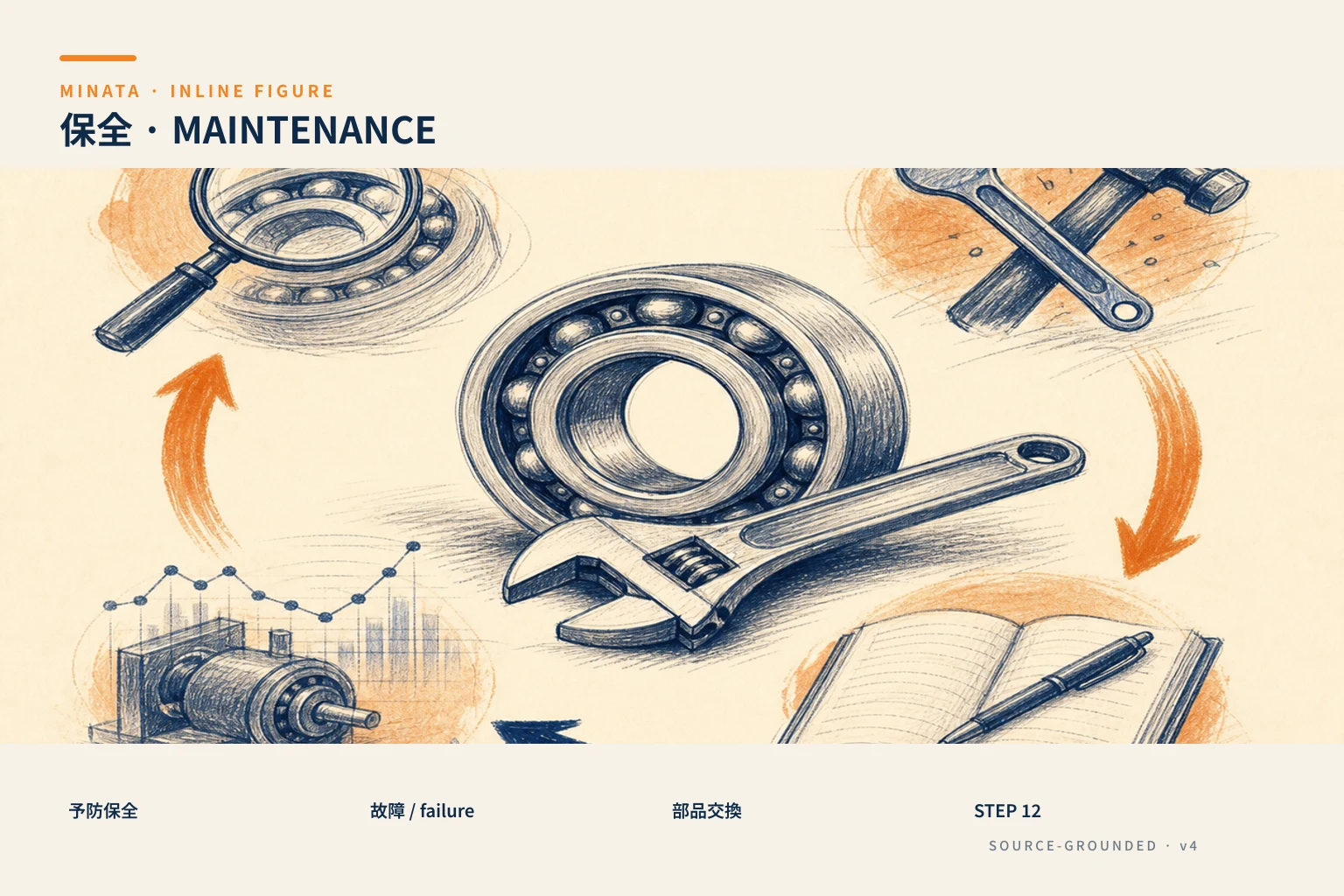
Core maintenance vocabulary
| Japanese | Reading | Meaning | Field note |
|---|
| 保全 | ほぜん hozen | maintenance | Name of the department |
| 予防保全 | よぼうほぜん yobō hozen | preventive maintenance | On a schedule, before failure |
| 故障 | こしょう koshō | breakdown | Machine stopped by a fault |
| 異常 | いじょう ijō | abnormality | A sign that something is off |
| 点検 | てんけん tenken | scheduled inspection | Has a schedule and a record |
| 日常点検 | にちじょうてんけん nichijō tenken | daily check | Done by the operator |
| 部品交換 | ぶひんこうかん buhin kōkan | parts replacement | Swapping a component |
| 予備品 | よびひん yobihin | spare part | Kept on hand |
| 給油 | きゅうゆ kyūyu | lubrication | Periodic oiling |
| 修理 | しゅうり shūri | repair | Fixing a failure |
| 原因 | げんいん gen'in | cause | Traced after an incident |
| 対策 | たいさく taisaku | countermeasure | The fix, and the prevention |
| 再発 | さいはつ saihatsu | recurrence | 再発防止 = preventing recurrence |
| 設備台帳 | せつびだいちょう setsubi daichō | equipment ledger | The machine history record |
The Japanese fault chain
異常 (something abnormal) → 故障 (a confirmed failure) → 原因 (cause) → 対策 (countermeasure) → 再発防止 (preventing recurrence). That last step is the soul of Japanese maintenance: not merely repairing, but making sure it does not happen again.
A fault report is not "the machine is broken". The usable structure is phenomenon, time, effect: "At 10:00 conveyor 3 stopped suddenly, the motor is not turning, suspected 故障, line A is down."
なぜなぜ分析 — five whys down to the root
- The machine stopped — the fuse blew.
- Why? The motor was overloaded.
- Why? A bearing seized for lack of lubrication.
- Why? The oil pump had failed.
- Why? The oil pump was not on the 点検 schedule.
The root cause is not "the fuse blew" but "the oil pump is missing from the inspection schedule". The correct 対策 is therefore to add the pump to the 予防保全 plan, not just to fit a new fuse. That is what 再発防止 actually means.
Reading a maintenance plan (保全計画): TBM against CBM
- TBM (時間基準保全) works on time: change the oil every six months regardless of condition. Easy to plan.
- CBM (状態基準保全) works on condition: act on measurements — vibration, temperature, wear. Cheaper to run, but it needs sensors.
The cycles on the plan read 毎日 (daily), 毎週 (weekly), 毎月 (monthly) and 年次 (annual).
Reading a maintenance plan (保全計画): TBM vs CBM
| Japanese | Reading | Meaning |
|---|
| 保全計画 | ほぜんけいかく hozen keikaku | maintenance plan |
| 点検項目 | てんけんこうもく tenken kōmoku | inspection item |
| 周期 | しゅうき shūki | interval |
| 担当 | たんとう tantō | person responsible |
| 完了 | かんりょう kanryō | completed |
| 未対応 | みたいおう mitaiō | not yet handled |
Filling in the チェックシート: a pass is ○ or 良; anything abnormal is × or 異常 and is reported at once. Filling it in honestly is the first link in the whole preventive system.
Sentences from the floor
- 機械が故障しました。 — The machine has broken down.
- 異常な音がします。 — There is an abnormal noise.
- 部品を交換してください。 — Please replace the part.
- 原因は何ですか。対策はありますか。 — What is the cause? Is there a countermeasure?
- 日常点検を記録してください。 — Please record the daily check.
Mistakes to avoid
| Mistake | Why it hurts |
|---|
| Confusing 異常 (a sign) with 故障 (a real failure) | Report 故障 too early and the machine stops for nothing; ignore an 異常 and the failure gets worse |
| Repairing without tracing the 原因 | The fault recurs, and Japanese practice expects 再発防止 |
| Skipping 日常点検 because "it is still running" | You throw away the main advantage of prevention |
| Not keeping the 設備台帳 | Every failure is investigated from scratch and the pattern never appears |
Hear it, then act — quick self-check
- You hear an 異常な音 from a running machine.
- A repair is finished and the team leader asks 対策は?
- Today's 点検 sheet shows an unusually high temperature.
- The same failure has happened for the third time.
<details><summary>Answers</summary>
- Report it immediately as an 異常, not yet a 故障, and record the phenomenon and the time.
- Give the measure that prevents recurrence (再発防止), not just "it is fixed".
- Enter × or 異常 on the チェックシート and report it. Do not let it pass.
- Run なぜなぜ down to the root cause and change the 予防保全 schedule.
</details>
Quick recall
- Three kinds: 予防保全 as the main mode, 事後保全 to be reduced, 予知保全 driven by data.
- The chain: 異常 → 故障 → 原因 → 対策 → 再発防止, and the goal is the last one.
- 異常 is not 故障. Take なぜなぜ to the root. Fill in 日常点検 honestly.
Do you have Japanese maintenance or equipment documents (保全計画, 取説, 台帳) that need reading and acting on, or replacement parts and jigs that need making? MINATA takes on reading Japanese technical documentation and designing and machining to Japanese standards. See MINATA's engineering services and projects we have delivered.
Next in the series: 設備 equipment · safety practice (KY, ヒヤリハット, 5S) · shop-floor action verbs.
View all MINATA technical articles