Technical Japanese #13 — Manufacturing Japanese: Process, Takt, Line and Lot
The heart of the plant is 製造 (seizō), where material becomes product one step at a time. Japanese production language is full of words for rhythm and flow: 工程 the process step, タクト the beat, ライン the line, ロット the lot. Miss the sense of them and it is hard to follow how a Japanese plant manages output and schedule.
Thinking in flow: 工程 and タクトタイム
- 工程 (kōtei) is one step in the process — 加工工程 machining, 組立工程 assembly, 検査工程 inspection. The product passes through them in order.
- タクトタイム is the standard time to produce one piece at each step, set to match customer demand. A takt of 60 seconds means one piece every 60 seconds.
If one step runs slower than takt, everything downstream is starved. That is why Japanese plants keep rebalancing the line (ラインバランス).
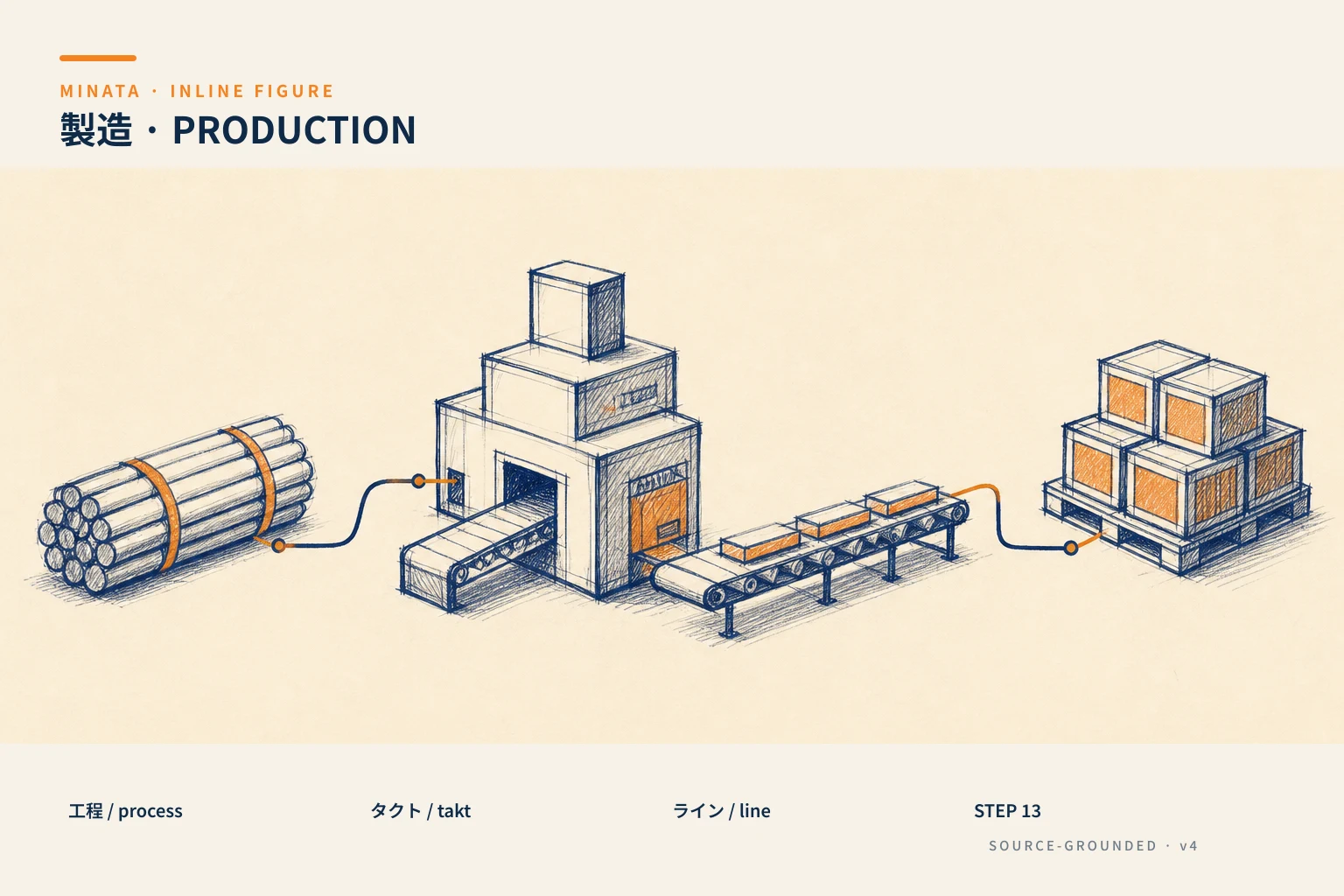
Core manufacturing vocabulary
| Japanese | Reading | Meaning | Field note |
|---|
| 製造 | せいぞう seizō | manufacturing | Name of the department |
| 工程 | こうてい kōtei | process step | One step inside the process |
| タクトタイム | takuto taimu | takt time | Time allowed per piece |
| ライン | rain | line | The production line |
| ロット | rotto | lot, batch | One production batch |
| 生産計画 | せいさんけいかく seisan keikaku | production plan | The production schedule |
| 加工 | かこう kakō | machining | Cutting, turning, milling |
| 組立 | くみたて kumitate | assembly | Joining parts together |
| 材料 | ざいりょう zairyō | material | What goes in |
| 半製品 | はんせいひん hanseihin | semi-finished goods | Past a stable step, not finished |
| 完成品 | かんせいひん kanseihin | finished goods | The final product |
| 仕掛品 | しかかりひん shikakarihin | work in process (WIP) | Still moving through the line |
| 出来高 | できだか dekidaka | actual output | What was really produced |
| 納期 | のうき nōki | delivery date | The deadline you are held to |
ロット and 納期 — lot control and the delivery date
- ロット is a group of pieces made under the same conditions at the same time. Lots exist so that quality can be traced: if lot 123 is bad, you can contain exactly that lot. You will hear ロット番号 constantly. Japanese practice leans towards smaller lots, which keeps 仕掛品 down.
- 納期 is close to sacred. Being late to a customer is barely tolerated. When you hear 納期に間に合いますか — will it make the delivery date — answer from the real 出来高, not from optimism.
かんばん, 平準化 and JIT — a pull flow
- かんばん is the signal card: production is triggered when the downstream step actually needs the parts. A pull mechanism keeps you from making too much, and keeps 仕掛品 low.
- 平準化 (heijunka) is levelling: spreading models and volume evenly instead of alternating rushes and idle time, so the タクト stays stable.
- The ジャストインタイム philosophy is the right thing, in the right quantity, at the right time. Which means that "we made more than the plan" is sometimes ムダ, not an achievement.
3M and 改善 — the language of improvement
| Japanese | Reading | Meaning |
|---|
| ムダ | muda | waste |
| ムラ | mura | unevenness, variation |
| ムリ | muri | overburden |
| 改善 | かいぜん kaizen | improvement |
| 改善提案 | かいぜんていあん kaizen teian | improvement proposal |
| 現場 | げんば genba | the shop floor itself |
改善 means small improvements proposed by the people on the line, accumulating into a large change. 現地現物 (genchi genbutsu) means going to the actual place and looking at the actual thing: the answer is at the 現場, not at the desk.
Sentences from the floor
- この工程のタクトタイムは60秒です。 — The takt time of this step is 60 seconds.
- ラインが止まっています。 — The line is stopped.
- このロットは何個ですか。 — How many pieces in this lot?
- 生産計画どおりに進んでいます。 — We are running to the production plan.
- 納期に間に合いますか。 — Will it make the delivery date?
Mistakes to avoid
| Mistake | Why it hurts |
|---|
| Confusing 半製品 with 仕掛品 | 半製品 has cleared a stable step; 仕掛品 is still moving through the line — the stock count comes out wrong |
| Treating タクトタイム lightly | Faster than takt piles up 仕掛品, slower starves the line. The target is to match the beat |
| Not recording the ロット番号 | Quality traceability becomes impossible the moment a defect appears |
| Reporting progress by feel | 納期 is answered from real 出来高. Reporting a delay early beats a hollow promise |
Hear it, then act — quick self-check
- Your step finishes 20% faster than takt.
- You are asked 納期に間に合いますか.
- You wrote up the quality record but forgot the lot number.
- You think of a small improvement at your own station.
<details><summary>Answers</summary>
- Not automatically good — running ahead of takt builds 仕掛品. Match the beat rather than racing.
- Answer from real 出来高 and the 生産計画, not "it should be fine".
- Add the ロット番号 now. It is mandatory for traceability.
- Submit a 改善提案. Small proposals from the 現場 are valued.
</details>
Quick recall
- The flow: 材料 → 工程 → 半製品 → 完成品; anything mid-line is 仕掛品.
- タクト: match the beat, do not race it. ロット番号 exists for traceability.
- 納期 is sacred — report from real 出来高.
- 3M (ムダ, ムラ, ムリ) plus 改善, at the 現場.
Do you have an order to machine or assemble to Japanese drawings, or a Japanese 生産計画 or 仕様書 that needs breaking down? MINATA takes on design, machining and production coordination to Japanese standards, on 納期. See MINATA's engineering services and projects we have delivered.
Next in the series: 品質 quality · 設備 equipment · 生産技術 production engineering.
View all MINATA technical articles