Technical Japanese #16 — Electrical and Automation Vocabulary: Power, PLC, Sensors and Motors
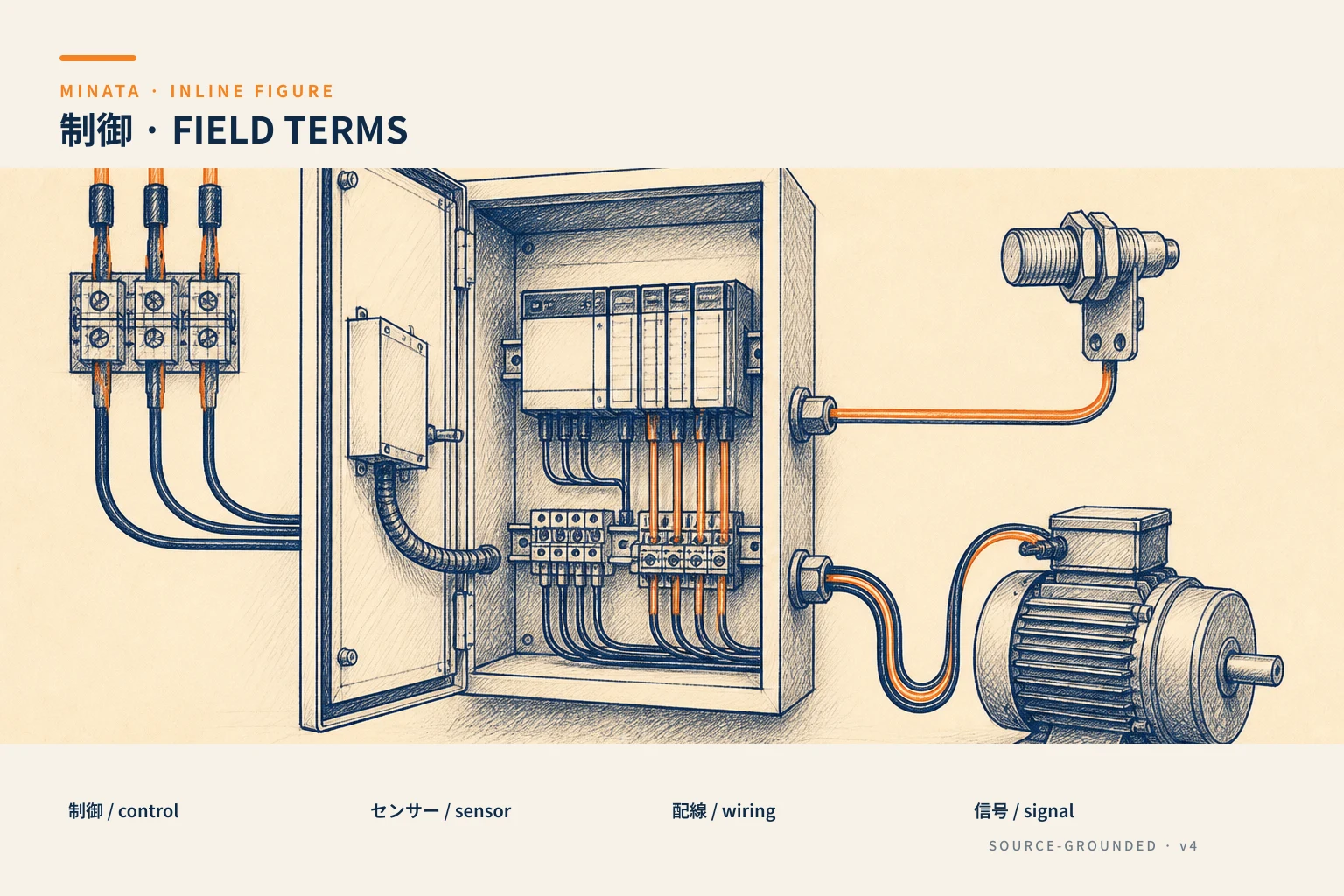
In a Japanese plant, the electrical and control side runs on its own vocabulary: 電源 power, 配線 wiring, PLC, and センサー sensors. This post concentrates the words you need to read a control panel and a wiring diagram, and to talk through the installation and commissioning of automated equipment.
Core electrical and automation vocabulary
| Japanese | Reading | Meaning | On the floor | Note |
|---|
| 電源 | でんげん dengen | power supply | 電源を入れる | 入れる to switch on, 切る to switch off |
| 電圧 | でんあつ den'atsu | voltage | 電圧を測る | Unit V |
| 電流 | でんりゅう denryū | current | 電流が高い | Unit A |
| 配線 | はいせん haisen | wiring | 配線を確認 | Check before energising |
| ケーブル | kēburu | cable | ケーブルを接続 | 電線 is also used |
| 端子 | たんし tanshi | terminal | 端子台に接続 | 端子台 is the terminal block |
| アース | āsu | earth, ground | アースを取る | 接地 (せっち) is the formal term |
| 制御盤 | せいぎょばん seigyoban | control cabinet | 制御盤を開ける | Where the control gear lives |
| PLC | pī eru shī | PLC | PLCのプログラム | Mitsubishi calls it シーケンサ |
| センサー | sensā | sensor | センサーが反応する | 反応 is the response |
| スイッチ | suicchi | switch | スイッチを押す | 押しボタン is a pushbutton |
| リレー | rirē | relay | リレーが動く | Makes and breaks the circuit |
| インバータ | inbāta | inverter, VFD | インバータで速度調整 | Motor speed control |
| モーター | mōtā | motor | モーターが回る | 回る means it turns |
| シリンダー | shirindā | cylinder | エアシリンダー | Pneumatic |
| 電磁弁 | でんじべん denjiben | solenoid valve | ソレノイドバルブ | Controls air or oil |
| 信号 | しんごう shingō | signal | 信号が来ない | Into and out of the PLC |
| 入出力 | にゅうしゅつりょく nyūshutsuryoku | input/output | I/Oを確認 | I/O |
| 故障 | こしょう koshō | fault, breakdown | 故障の原因 | The machine has failed |
| 試運転 | しうんてん shiunten | trial run | 試運転を始める | Covered in detail in #38 |
Phrases by situation
Requests and operations
- 電源を入れてください。 — Please switch the power on.
- 配線を確認してから電源を入れて。 — Check the wiring, then switch on.
- センサーの位置を調整してください。 — Please adjust the sensor position.
Prohibitions and safety warnings
- 通電中は触らないでください。 — Do not touch it while it is energised.
- 必ずアースを取ってください。 — Make sure it is earthed.
Reporting a fault
- センサーが反応しません。 — The sensor is not responding.
- PLCがエラーを出しています。 — The PLC is showing an error.
Reading the labels inside a 制御盤
On the terminal blocks and devices inside the panel, these markings recur:
- R / S / T — the three supply phases.
- N — neutral; PE / E / アース — earth.
- X — PLC input (入力); Y — PLC output (出力).
- CP / MCCB — circuit breaker; MC — contactor; THR — thermal overload relay.
- DC24V — the 24 V DC control supply, extremely common for sensors and signals.
Mistakes to avoid
| Mistake | Why it hurts |
|---|
| Reading 電源を切る as "cut the cable" | 切る here means switch off. It is the power that is being cut, not the wire |
| Confusing 信号 (signal) with 電源 (power) | An I/O point with "no signal" does not necessarily mean the supply is missing |
| Touching equipment while 通電中 | Confirm 電源を切る first, and lock the supply off when the work requires it |
Hear it, then act — quick self-check
A Japanese engineer says: 「Y10の出力が出ていないから、配線とセンサーを確認して。」
<details><summary>Answer</summary>PLC output Y10 is not coming on, so check the wiring (配線) and the sensor (センサー) associated with it.</details>
And: 「電源を切ってから制御盤を開けてください。」
<details><summary>Answer</summary>Switch the power off first (電源を切る), and only then open the control panel (制御盤). This is a safety rule, not a preference.</details>
How MINATA helps
Do you need an automation system installed, wired or commissioned from Japanese electrical documentation? MINATA reads the 制御盤 drawings, the I/O list and the PLC program, and coordinates installation and commissioning to Japanese practice. See our automation and Japan–Vietnam projects, or talk to us through engineering and production services.
For the underlying automation subject matter, see the Industrial Automation section.
View all MINATA technical articles