Technical Japanese #27 — Japanese Electrical Diagram Symbols: Contacts, Coils and Seal-In Circuits
A Japanese electrical drawing — 電気図面 or シーケンス図 — uses its own set of symbols and abbreviations. Without them you cannot wire a panel, trace a fault or commission the machine. This post collects the component symbols, the contact notation and the way a ladder diagram (ラダー図) is read.
Core vocabulary and symbols on an electrical diagram
| Japanese / symbol | Reading | Meaning | On the diagram | Note |
|---|
| 電気図面 | でんきずめん denki zumen | electrical drawing | — | The drawing set |
| シーケンス図 | shīkensu zu | sequence diagram | — | Control sequence |
| ラダー図 | radā zu | ladder diagram | — | Ladder logic |
| 配線用遮断器 / MCCB | はいせんようしゃだんき haisen-yō shadanki | moulded case breaker | Q, CP | Breaker |
| 電磁接触器 / MC | でんじせっしょくき denji sesshokuki | contactor | MC | Switches the power circuit |
| リレー / X | rirē | relay | X, R | Interposing relay |
| 熱動継電器 / THR | ねつどうけいでんき netsudō keidenki | thermal overload relay | THR | Overload protection |
| 押しボタン / PB | おしボタン oshi botan | pushbutton | PB | Push button |
| a接点 | エーせってん ē setten | normally open contact | ─\ | \ | ─ | NO |
| b接点 | ビーせってん bī setten | normally closed contact | ─\ | /\ | ─ | NC |
| コイル | koiru | coil | ─( )─ | Relay coil |
| 表示灯 / PL | ひょうじとう hyōjitō | indicator lamp | PL | Pilot lamp |
| センサー / SQ | sensā | sensor | LS, SQ | Limit or proximity |
| 制御電源 | せいぎょでんげん seigyo dengen | control power | DC24V | Control supply |
| 入力/出力 | にゅうりょく/しゅつりょく nyūryoku / shutsuryoku | input / output | X/Y | PLC I/O |
| 線番 | せんばん senban | wire number | Numbered wiring | Wire numbering |
| 凡例 | はんれい hanrei | legend | 凡例参照 | Read this first |
| インターロック | intārokku | interlock | — | Interlock |
| 自己保持 | じこほじ jiko hoji | self-holding | 自己保持回路 | Latching circuit |
Reading a ladder diagram
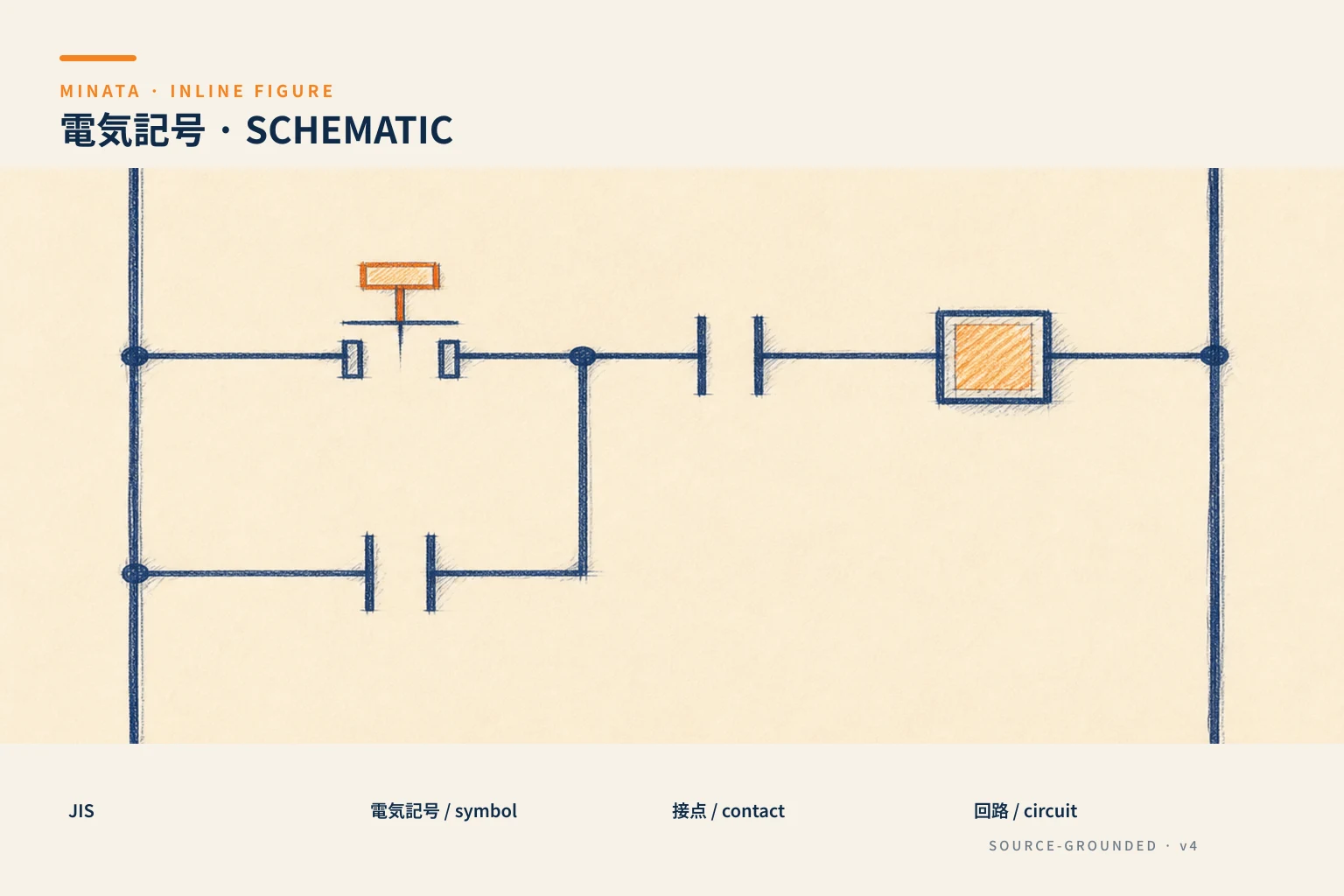
- The two vertical lines are the power rails, and each horizontal line is one rung.
- a接点 (normally open) is drawn as two bars; b接点 (normally closed) carries a diagonal slash. The output coil sits at the end of the rung.
- A 自己保持回路 is the seal-in circuit: the start button is paralleled by a contact of the relay it energises, so the circuit holds after you release the button.
- The 線番 (wire numbers) are what let you go from the diagram to the actual wire in the panel.
Phrases by situation
Asking and confirming
- この記号は何ですか。 — What is this symbol?
- a接点ですか、b接点ですか。 — Is that a normally open or a normally closed contact?
- 凡例はどこにありますか。 — Where is the legend?
Fault finding
- X10のコイルが動作していません。 — The X10 coil is not picking up.
- 線番15を確認してください。 — Please check wire number 15.
Mistakes to avoid
| Mistake | Why it hurts |
|---|
| Confusing a接点 with b接点 | The logic inverts: the circuit either does nothing or does the wrong thing |
| Skipping the 凡例 | Every company has its own conventions. Do not infer them |
| Ignoring the 線番 | You chase wires by hand instead of looking up the number — slower and error-prone |
Hear it, then act — quick self-check
The engineer says: 「この回路は自己保持だから、スタート押したら離しても動き続けるよ。」
<details><summary>Answer</summary>It is a self-holding circuit: press start and it keeps running after you let go, until a stop signal breaks the seal-in.</details>
You see ─|/|─ on the diagram, wired to a PB. What is it?
<details><summary>Answer</summary>The slash marks it as a normally closed contact (b接点) — typically a stop button or a safety contact.</details>
How MINATA helps
Do you need Japanese electrical drawings and シーケンス図 carried over into panel building, fault finding or commissioning in Vietnam? MINATA reads the ラダー図, builds a bilingual 線番 and 凡例 list, and supervises the electrical work to Japanese practice. See our Japan–Vietnam automation projects or engineering and production services.
For control-circuit fundamentals, see the Industrial Automation section.
View all MINATA technical articles