Technical Japanese #26 — Standard Samples and Limit Samples: Judging Appearance Consistently
Not every defect can be reduced to a number. For scratches, discolouration and small burrs, a Japanese plant uses a 限度見本 (gendo mihon): a physical sample that fixes the boundary between pass and fail. Together with the 公差表 for everything measurable, these are the two instruments of quality judgement. This post covers both.
Core vocabulary for tolerance tables and limit samples
| Japanese | Reading | Meaning | On the floor | Note |
|---|
| 限度見本 | げんどみほん gendo mihon | limit sample | 限度見本と比較 | The boundary sample |
| 標準見本 | ひょうじゅんみほん hyōjun mihon | master sample | 標準見本通り | The good master |
| 公差表 | こうさひょう kōsahyō | tolerance table | 公差表を参照 | Tolerance table |
| 一般公差 | いっぱんこうさ ippan kōsa | general tolerance | JISの一般公差 | Applies where nothing is stated |
| 等級 | とうきゅう tōkyū | class, grade | 中級 | 精級 / 中級 / 粗級 |
| 合格 | ごうかく gōkaku | pass | 合格品 | Accepted |
| 不合格 | ふごうかく fugōkaku | fail | 不合格品 | Rejected |
| 判定 | はんてい hantei | judgement | 判定する | Making the call |
| 外観 | がいかん gaikan | appearance | 外観検査 | Visual inspection |
| キズ | kizu | scratch | キズあり | Scratch present |
| 汚れ | よごれ yogore | stain, dirt | 汚れNG | Stain fails |
| バリ | bari | burr | バリ残り | Burr left on |
| 凹み | へこみ hekomi | dent | 凹みNG | Dent fails |
| 範囲内 | はんいない han'i nai | within range | 公差範囲内 | Inside tolerance |
| 境界 | きょうかい kyōkai | boundary | 合否の境界 | The pass/fail line |
| 比較 | ひかく hikaku | comparison | 見本と比較 | Compare against the sample |
| 観察条件 | かんさつじょうけん kansatsu jōken | viewing conditions | Lighting, distance | Fix these or judgements differ |
How a 限度見本 is used
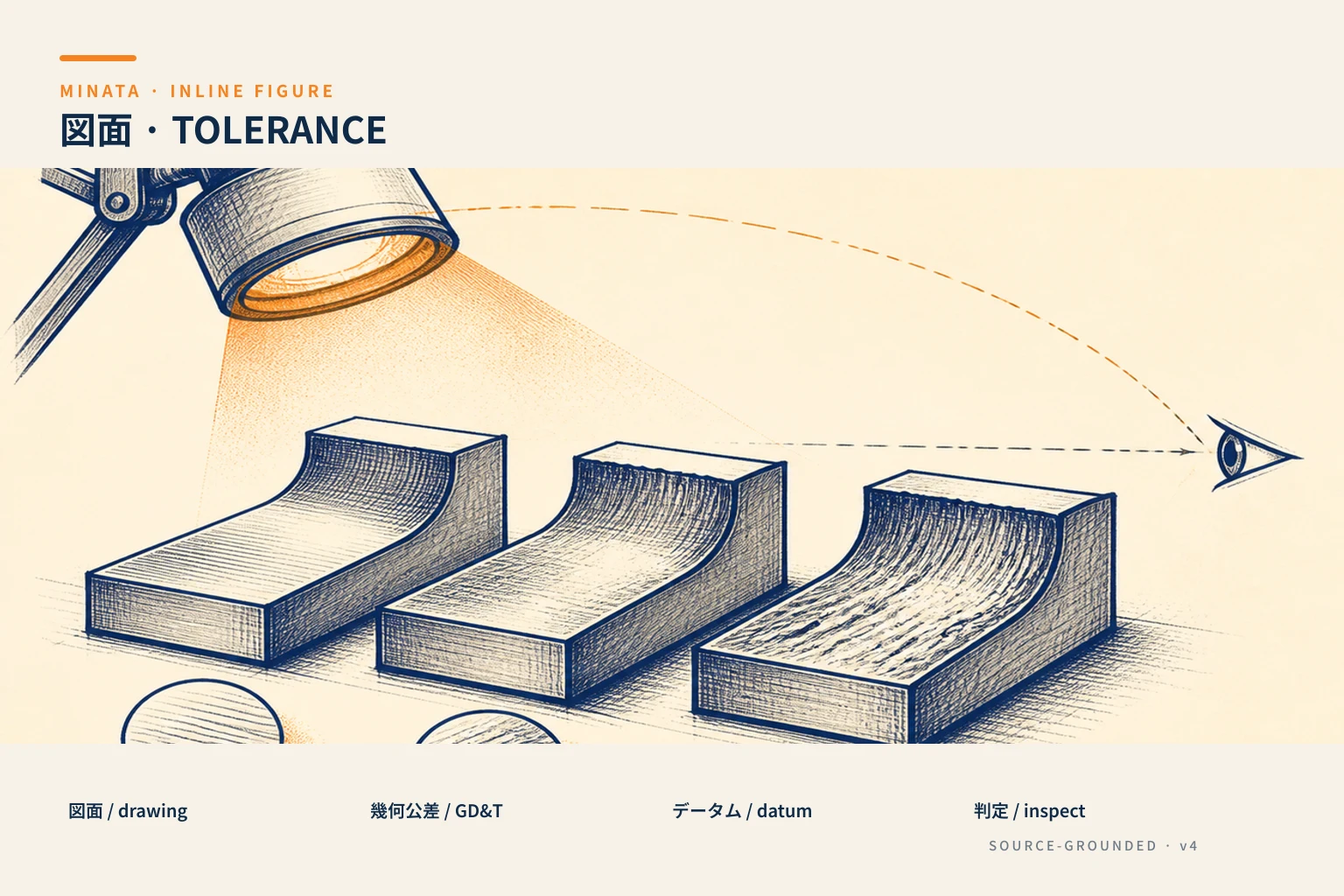
- 限度見本 is the boundary. A piece equal to the sample still passes; anything worse than the sample fails.
- Plants usually hold two: the 標準見本, a good master, and the 限度見本, the worst still acceptable.
- 観察条件 decides the verdict — viewing distance, lighting, angle. The same scratch looks different up close under a bright lamp than at the specified distance, so always judge under the stated conditions.
- Limit samples carry a control number and an expiry. A faded or damaged sample must be replaced.
Reading the general tolerance table (一般公差)
Where a dimension carries no individual tolerance, the 一般公差 of the standard applies, usually JIS B 0405. The table is organised by 等級 — 精級, 中級, 粗級 — and by size range: the larger the dimension, the wider the allowance. You need to know which class the drawing invokes, and it is normally stated in the 注記.
Phrases by situation
Judging and comparing
- 限度見本と比較してください。 — Please compare it with the limit sample.
- これは合格ですか、不合格ですか。 — Does this pass or fail?
- 観察条件を教えてください。 — What are the viewing conditions?
Reporting
- 限度見本より軽微なので合格と判定しました。 — It is lighter than the limit sample, so I judged it a pass.
Mistakes to avoid
| Mistake | Why it hurts |
|---|
| Judging appearance without the 観察条件 | Every inspector reaches a different verdict, and pass-or-fail turns into an argument |
| Treating the 限度見本 as the standard to achieve | It is the opposite: the worst condition still acceptable |
| Using an expired or faded 限度見本 | The whole judgement drifts with the sample |
Hear it, then act — quick self-check
An operator asks: 「このキズ、限度見本より目立つんですけど。」 What is the verdict?
<details><summary>Answer</summary>The scratch is more visible than the limit sample, so it is 不合格. The limit sample is the worst still acceptable.</details>
The engineer says: 「外観判定は50cm離れて、通常照明で見ること。」
<details><summary>Answer</summary>Appearance is judged at 50 cm, under normal lighting — the stated 観察条件. Not up against a bright lamp.</details>
How MINATA helps
Do you need a set of 標準見本 and 限度見本 with clear appearance criteria agreed between a Japanese customer and a Vietnamese shop, so that pass-or-fail stops being a debate? MINATA standardises the limit samples, the viewing conditions and a bilingual judgement sheet. See our Japan–Vietnam projects or engineering and production services.
View all MINATA technical articles