Technical Japanese #38 — Working with Japanese Engineers During Commissioning (試運転)
試運転 is the moment the equipment runs for real for the first time: high risk, fast exchanges, and usually a Japanese engineer supervising. Mishear one command — inch it, emergency stop, stand back — and you get an injury or a wrecked machine. This post collects the vocabulary and the phrases for a commissioning session.
Core vocabulary for a 試運転
| Japanese | Reading | Meaning | During the run | Note |
|---|
| 試運転 | しうんてん shiunten | trial run | 試運転開始 | Commissioning run |
| 空運転 | からうんてん kara unten | no-load run | まず空運転 | Run it empty first |
| 寸動 / 段階運転 | すんどう sundō | inching, step operation | 寸動で確認 | Move it a step at a time |
| 手動 | しゅどう shudō | manual mode | 手動で動かす | Manual |
| 自動 | じどう jidō | automatic mode | 自動に切替 | Switch to auto |
| 起動 | きどう kidō | start-up | 起動します | Starting now |
| 非常停止 | ひじょうていし hijō teishi | emergency stop | 非常停止押す | E-stop |
| 一時停止 | いちじていし ichiji teishi | pause | 一時停止して | Hold it there |
| 動作確認 | どうさかくにん dōsa kakunin | function check | 動作確認する | Verify the motion |
| 異常 | いじょう ijō | abnormality | 異常あり | Something is off |
| 異音・振動 | いおん・しんどう ion / shindō | odd noise, vibration | 異音がする | The first warning signs |
| 調整 | ちょうせい chōsei | adjustment | 位置調整 | Adjust |
| 速度 | そくど sokudo | speed | 速度を落とす | Slow it down |
| ゆっくり | yukkuri | slowly | ゆっくり動かす | Move it slowly |
| 安全確認 | あんぜんかくにん anzen kakunin | safety check | 安全確認よし | Safety confirmed |
| 離れて | はなれて hanarete | stand back | 危ないので離れて | Get clear |
The usual sequence, and the commands you will hear
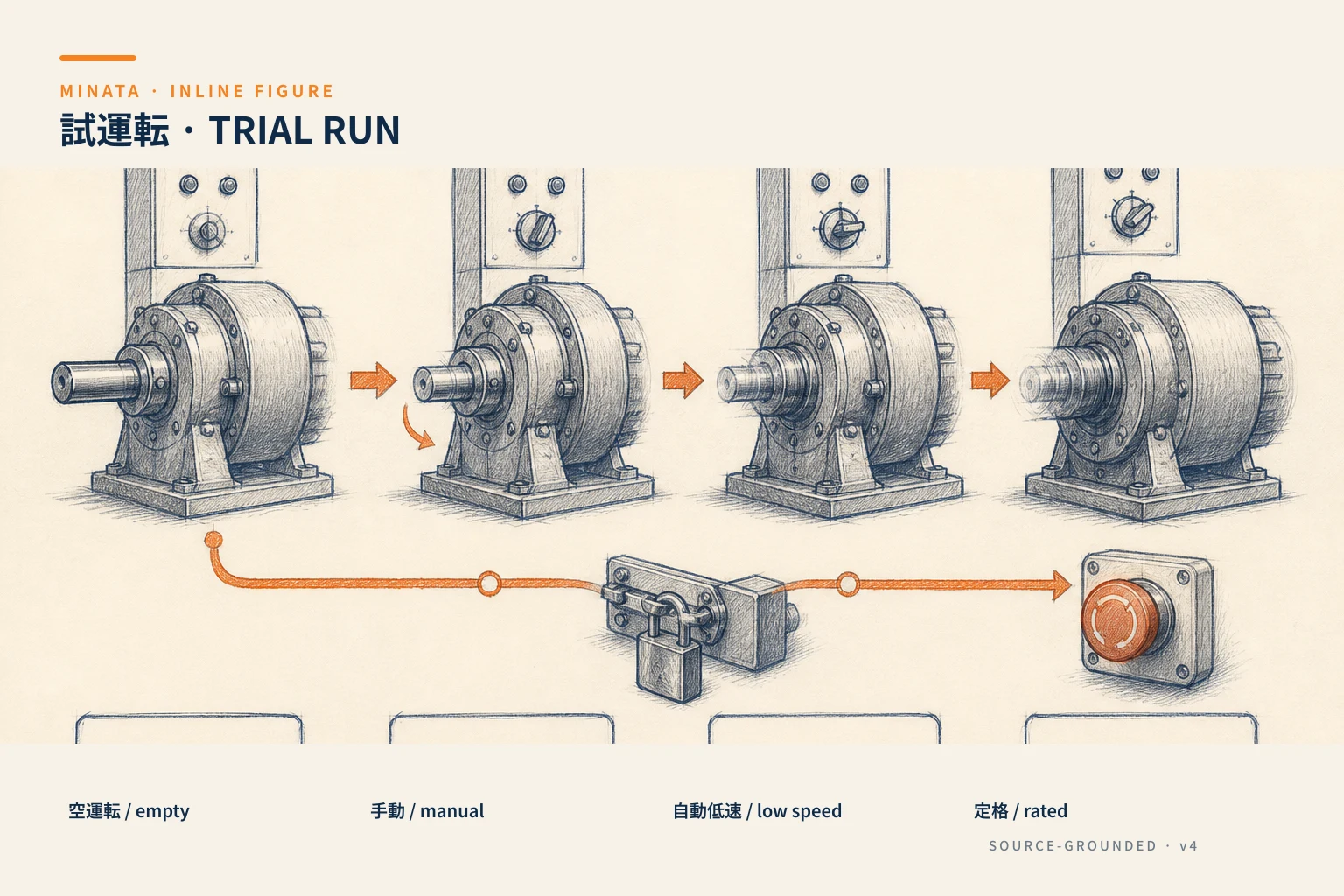
Commissioning moves from safest to most real: 空運転 → 手動 and 寸動 → 自動 at low speed → normal speed.
まず空運転で動作確認します。 — First a no-load run to check the motion.寸動でゆっくり動かして。 — Inch it, slowly.異音がしたらすぐ止めて。 — If you hear anything odd, stop immediately.安全確認よし。起動します。 — Safety check clear. Starting.
When you hear 「離れて」, 「危ない」 or 「止めて」, the reaction is stop and step back now. Ask afterwards.
Phrases by situation
Before the run
- 安全確認はよろしいですか。 — Is the safety check complete?
- 手動と自動、どちらで始めますか。 — Do we start in manual or automatic?
During the run
- 異音がします。一時停止します。 — There is an abnormal noise. I am pausing.
- 速度を少し落としてください。 — Please reduce the speed a little.
- 位置がずれています。調整します。 — The position has drifted. I will adjust it.
Emergency
- 非常停止します! — Emergency stop!
Mistakes to avoid
| Mistake | Why it hurts |
|---|
| Hesitating to ask why when you hear 「離れて」 | Step back first. The question comes after you are clear |
| Skipping 空運転 and going straight to 自動 | An assembly error wrecks the equipment or jams the part |
| Not reporting a small 異音 or vibration | The small signal becomes the large failure |
| Standing inside the danger zone at 起動 | Confirm where every person is before anything moves |
Hear it, then act — quick self-check
Mid-commissioning, the Japanese engineer shouts 「止めて!離れて!」 What do you do?
<details><summary>Answer</summary>Stop, hit the stop, and get out of the danger zone — immediately, without asking why in that moment. Safety comes first; the reason comes once everyone is clear.</details>
The engineer says: 「まず空運転で動作確認、問題なければ自動で低速から。」 What is the sequence?
<details><summary>Answer</summary>First a no-load run (空運転) for a function check (動作確認); if there is no problem, switch to automatic (自動) starting at low speed.</details>
How MINATA helps
Do you need a technical counterpart to run the 試運転 alongside the Japanese engineers — understanding the commands correctly, keeping the site safe and recording every adjustment? MINATA works as the Japan–Vietnam technical bridge on installation and commissioning sites. See our Japan–Vietnam automation projects or engineering and production services.
For machine safety and operation fundamentals, see the Industrial Automation section.
View all MINATA technical articles