Technical Japanese #39 — KAIZEN Japanese: Explaining an Improvement Proposal
改善 — continuous improvement — is the core culture of Japanese manufacturing: everyone, operators included, is encouraged to propose small improvements. Knowing how to write a 改善提案 to the expected shape — current state, problem, countermeasure, effect — is what gets your idea heard and recorded. This post gives you the vocabulary and the template.
Core vocabulary of 改善
| Japanese | Reading | Meaning | On the floor | Note |
|---|
| 改善 | かいぜん kaizen | improvement | 改善提案 | Continuous improvement |
| 改善提案 | かいぜんていあん kaizen teian | improvement proposal | 提案を出す | The suggestion you submit |
| 現状 | げんじょう genjō | current state | 現状の問題 | Where things stand now |
| 問題 | もんだい mondai | problem | 問題点 | The problem |
| ムダ | muda | waste | ムダを省く | The first of the 3M |
| ムリ | muri | overburden | ムリな作業 | Strain on people or machines |
| ムラ | mura | unevenness | ムラをなくす | Variation |
| 真因 | しんいん shin'in | root cause | 真因を探す | The cause underneath |
| 対策 | たいさく taisaku | countermeasure | 対策案 | Countermeasure |
| 効果 | こうか kōka | effect | 改善効果 | The measurable result |
| 前 / 後 | まえ / あと mae / ato | before / after | 改善前後 | Show both |
| 短縮 | たんしゅく tanshuku | shortening | 時間短縮 | Cutting time |
| 削減 | さくげん sakugen | reduction | コスト削減 | Cutting cost |
| 向上 | こうじょう kōjō | raising, improving | 効率向上 | Raising efficiency |
| なぜなぜ分析 | naze-naze bunseki | five-whys analysis | 5 Whys | Root-cause tool |
| 標準化 | ひょうじゅんか hyōjunka | standardisation | 標準化する | Make it the new standard |
| 定着 | ていちゃく teichaku | taking root | 改善を定着 | Making it stick |
The shape of a proposal that gets approved
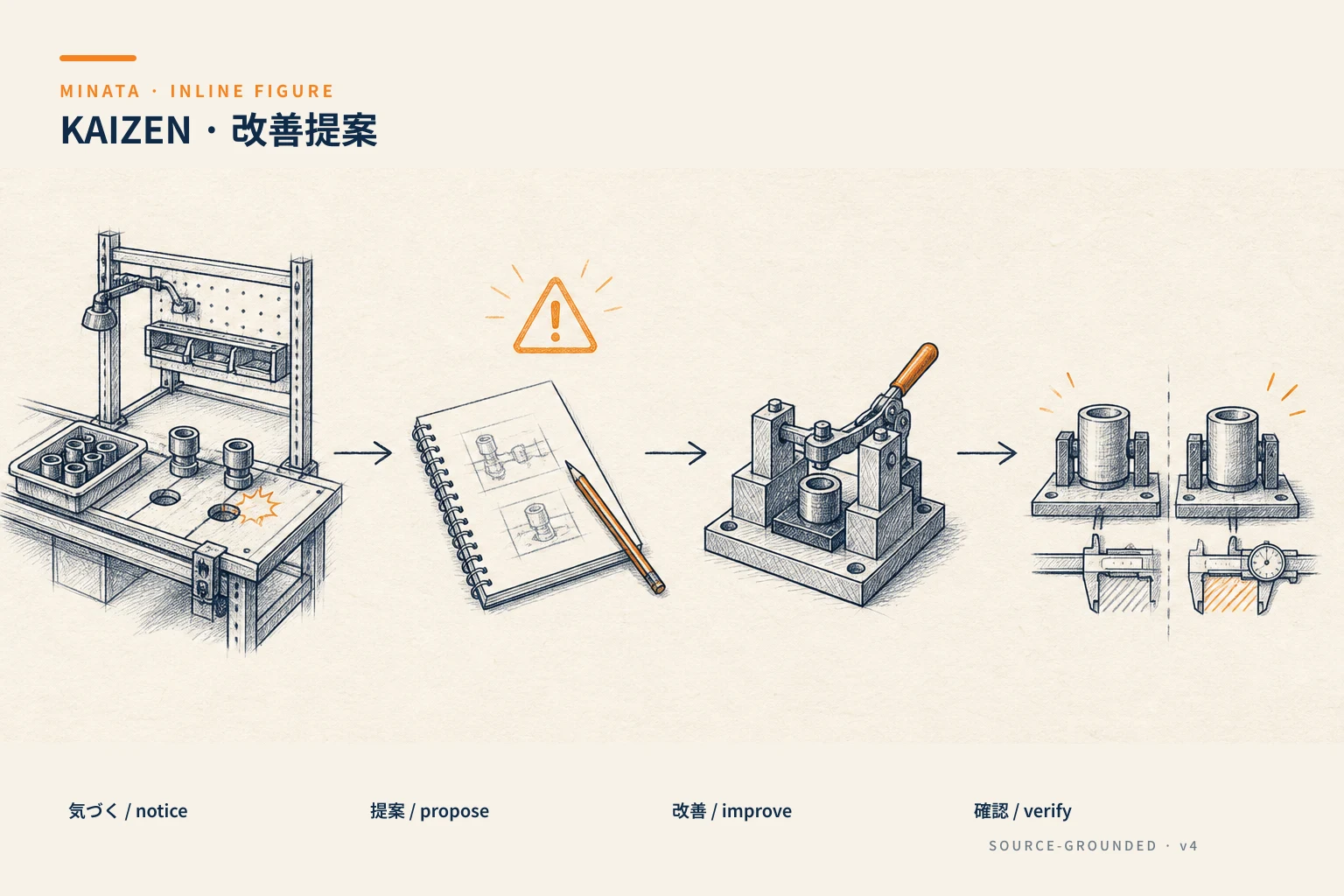
Approved proposals run 現状 → 問題 → 対策 → 効果, with evidence at each step:
- 現状 — how the job is done today, with numbers: time, number of steps, defect rate.
- 問題点 — the specific ムダ, ムリ or ムラ.
- 改善案 (対策) — what to do differently: simple and feasible.
- 効果, before and after — quantified:
作業時間 5分 → 3分 (40%短縮).
Japanese practice prefers an improvement that is small, certain, measurable and sustainable (定着) over a large vague idea.
The three wastes to name
- ムダ — waste: unnecessary motion, waiting, walking, inventory.
- ムリ — overburden: heavy or rushed work that causes defects and injuries.
- ムラ — unevenness: rushes and idle spells, quality that drifts.
A good proposal says plainly which of the three it is attacking.
Phrases by situation
- 作業のムダを見つけました。改善提案です。 — I found waste in the operation. Here is an improvement proposal.
- 現状は5分かかりますが、○○すれば3分に短縮できます。 — It takes five minutes today; with ○○ it comes down to three.
- 真因はなぜなぜ分析で特定しました。 — The root cause was identified with five-whys analysis.
- この改善を標準化して定着させたいです。 — I would like to standardise this improvement and make it stick.
Mistakes to avoid
| Mistake | Why it hurts |
|---|
| A proposal with no before-and-after figures | It cannot persuade. Always quantify the effect |
| Aiming at something large and expensive | Japanese practice favours small improvements that can start tomorrow |
| Naming the problem without a 対策 | That is a complaint, not a 改善 |
| Improving without 標準化 and 定着 | Within a week everyone is back to the old way |
Read it, then act — quick self-check
Operators walk to a distant tool rack ten times a shift. Sketch the proposal.
<details><summary>Answer</summary>現状: tools stored away from the station, ten trips a shift, roughly X minutes lost — walking ムダ. 対策: put a tool rack at the station. 効果: trips down to zero, around X minutes saved per shift. Name the waste type and give the before-and-after numbers.</details>
Your manager asks which of the 3M your improvement addresses, when you removed heavy bending from the job.
<details><summary>Answer</summary>That is ムリ — overburden. The work was physically hard, which brings fatigue and risk, and the improvement takes the load off the person doing it.</details>
How MINATA helps
Do you want a 改善 culture and bilingual 改善提案 forms for a Vietnamese team working with Japanese customers, or advice on optimising a process? MINATA supports process improvement and acts as the Japan–Vietnam technical bridge. See our Japan–Vietnam projects or engineering and production services.
View all MINATA technical articles