Technical Japanese #40 — Build a Personal Technical Japanese Notebook That You Will Actually Use
After thirty-nine posts, the rest is your own work: turning the terms you meet each day into a reference you own. Vocabulary learned from a list evaporates; vocabulary caught from the drawing in front of you and the meeting you sat in stays. This post is about how to build that notebook, and which sources are worth trusting.
Core vocabulary for studying on your own
| Japanese | Reading | Meaning | Example | Note |
|---|
| 用語集 | ようごしゅう yōgoshū | glossary | 用語集を作る | Build your own |
| 暗記 | あんき anki | memorisation | 暗記カード | Flash cards |
| 調べる | しらべる shiraberu | to look up | 意味を調べる | Look it up |
| 読み方 | よみかた yomikata | reading | 読み方を確認 | How it is read |
| 例文 | れいぶん reibun | example sentence | 例文を書く | Write one down |
| 復習 | ふくしゅう fukushū | review | 毎日復習 | Review daily |
| メモ | memo | note | メモを取る | Take a note |
| 現場 | げんば genba | the shop floor | 現場で使う | Where you will use it |
| 積み重ね | つみかさね tsumikasane | accumulation | 日々の積み重ね | Day after day |
| 辞書 | じしょ jisho | dictionary | 辞書で引く | Dictionary |
| 漢字 | かんじ kanji | kanji | 漢字の意味 | The characters |
| 部首 | ぶしゅ bushu | radical | 部首で引く | Look up by radical |
| 習慣 | しゅうかん shūkan | habit | 学習習慣 | The study habit |
Building your own 用語集
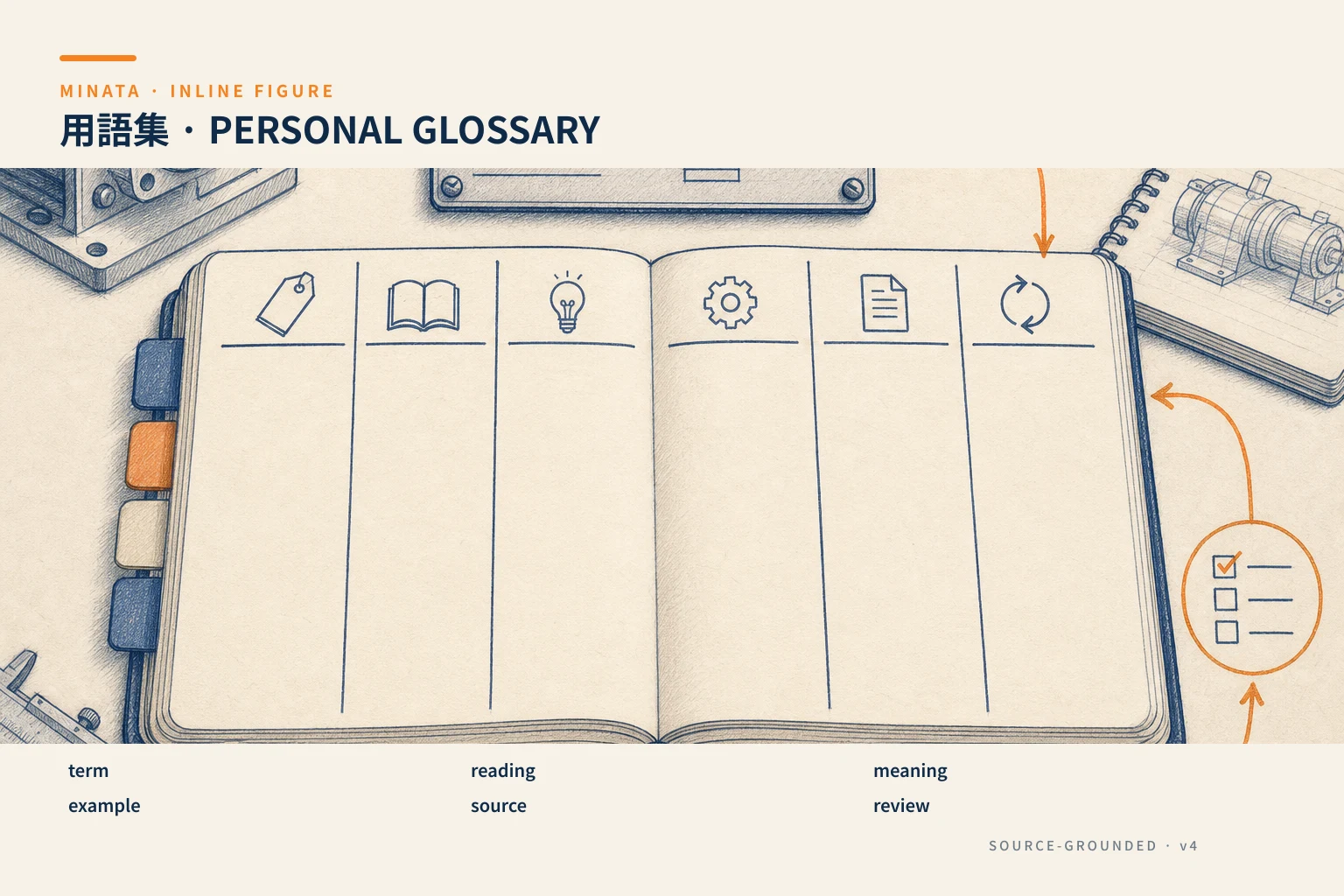
A usable notebook has the same six columns as the tables in this series:
Meaning · 日本語 · かな (furigana) · Romaji · a real field sentence · a note.
A few rules keep it alive:
- Catch words from real work. Every new term from a drawing, a 朝礼 or a 引継ぎ goes in immediately, together with the sentence you actually heard or read. A word tied to a situation is a word you keep.
- Group by department, not alphabetically. Cluster 品質, 設備, 加工 so that you can find things while doing that work.
- Always keep an example. A word on its own is easy to misuse; the sentence preserves the context.
- Review little and often. Five minutes at the end of each shift beats a long session at the weekend.
Sources worth trusting
- A kanji dictionary you can search by 部首 or stroke count — for the character on a drawing that you cannot read.
- Supplier catalogues (Misumi, Omron, SMC) — standard terminology alongside pictures and specifications (see #28).
- Published JIS standards — for checking that 図面, 公差 and 検査 terms are being used in their proper sense.
- Your colleagues and the Japanese engineers — the best source for how something is actually said on the floor. Ask while you confirm (see #33), then write it down.
Phrases for learning on the spot
- この漢字の読み方を教えてください。 — Please tell me how this kanji is read.
- この言葉、現場ではどう使いますか。 — How is this word used on the floor?
- メモしてもいいですか。 — May I make a note of that?
Mistakes to avoid
| Mistake | Why it hurts |
|---|
| Studying from a printed list you never use again | It disappears. Prefer words caught from your own work |
| Recording a word without furigana or an example | Next time you still cannot read it, and still do not know how to use it |
| Cramming once, then leaving it for a week | Five steady minutes a day beats it comfortably |
Read it, then act — quick self-check
You meet 治具 on a drawing and cannot read it. What are the steps?
<details><summary>Answer</summary>Ask for the reading — 「治具の読み方を教えてください」 (jigu) — enter it in the 用語集 with all six columns (jig, fixture · 治具 · じぐ · jigu · the sentence you found it in · a note), and review it at the end of the shift.</details>
Which sticks better: fifty words from a list, or five words from today with their sentences?
<details><summary>Answer</summary>The five, written with their examples and reviewed. Words attached to a real situation hold on far better than a detached list.</details>
How MINATA helps
If your work keeps running into Japanese documents, drawings or conversations, MINATA can take that part: reading and breaking down Japanese drawings and 仕様書, designing and machining to Japanese standards, and acting as the Japan–Vietnam technical bridge for the project. See our Japan–Vietnam projects or engineering and production services.
The whole series is collected in the Technical Japanese section.
View all MINATA technical articles