Device Selection #02: Absolute vs Incremental Encoders — Choosing by Power-Loss Recovery
Short answer: choose an absolute encoder when the machine must know its true position immediately at power-on without running a homing cycle — especially for vertical axes, robots, or a line that cannot be stopped for long; choose an incremental encoder when homing at startup is acceptable and you want a cheap, simple solution. The core difference comes down to one question: after power is lost and then restored, does the machine know where it is on its own. An absolute encoder remembers the position; an incremental encoder must return to a reference point to re-establish it. This article helps you decide based on the machine's power-loss recovery requirement and safety constraints, rather than on price.
Quick comparison of the two encoder types
| Criterion | Incremental | Absolute |
|---|
| Knows position at power-on | No, must home | Yes, read out immediately |
| Needs homing at startup | Yes | No |
| Holds position through power loss | No | Yes (multi-turn with battery/mechanism) |
| Signal type | A/B/Z pulses | Position code (SSI, BiSS, EnDat, Fieldbus) |
| Wiring complexity | Simple | More complex |
| Relative cost | Low | Higher |
| Risk of position loss under noise | Yes (a miscounted pulse drifts) | Low (re-reads the absolute code) |
| Typical application | Conveyors, axes that home easily | Vertical axes, robots, automated storage, hard-to-home axes |
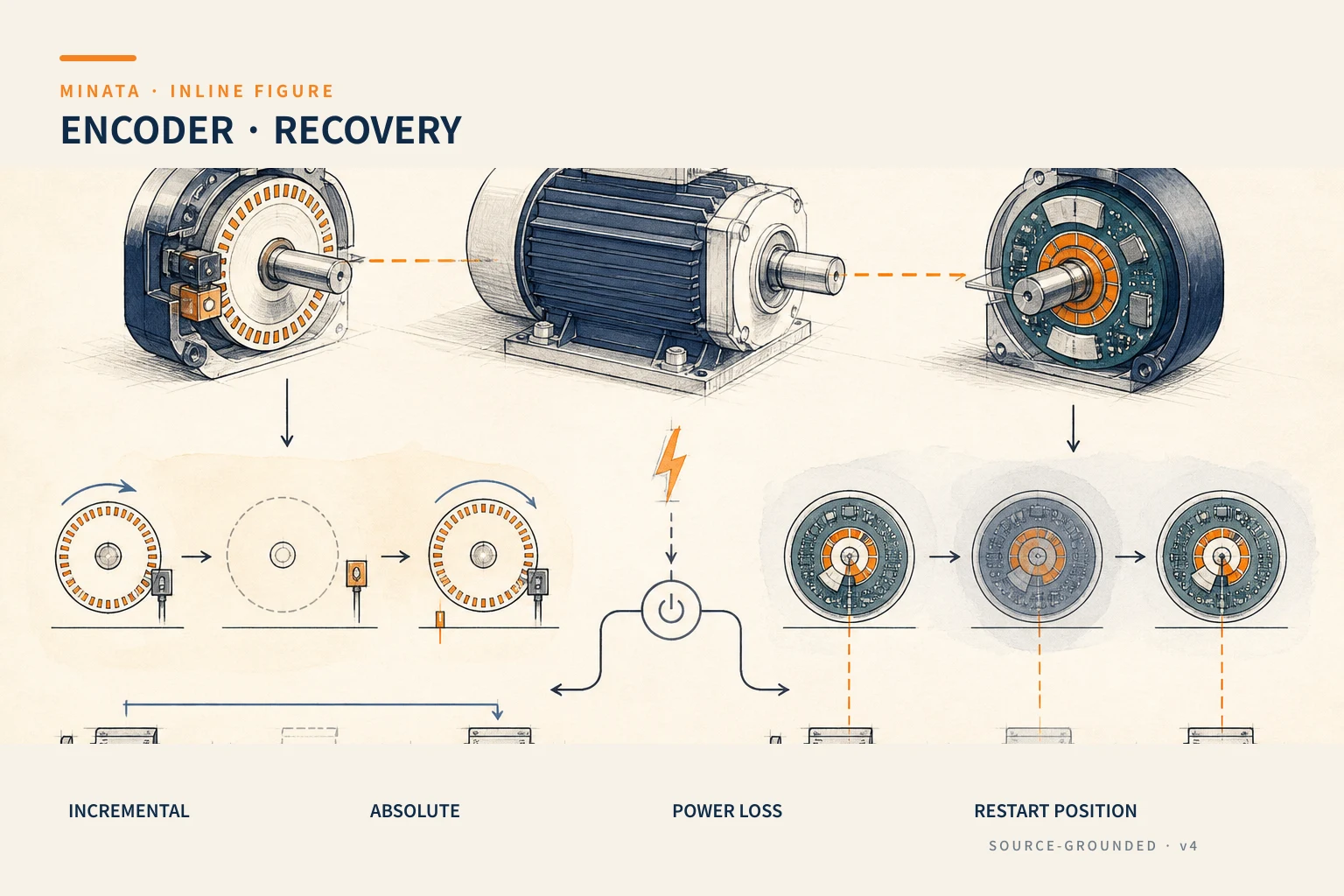
Incremental encoder: counting pulses from a reference
An incremental encoder emits a train of pulses as the shaft rotates: two channels A and B, 90 degrees out of phase to tell the direction of rotation, usually plus a Z channel (one pulse per revolution) as a reference mark. The controller counts pulses to know how far the shaft has moved from the starting point. The position is relative because it is always measured from where counting began.
The important consequence: right after power-on, the controller does not know where the shaft is — the counter is zero, but the shaft could be anywhere. So a machine using an incremental encoder must return to a reference point (homing) at startup: it drives the shaft until it meets a home switch or the Z channel, then resets the counter. After homing, the position is trustworthy.
Advantages: cheap, simple, easy to wire, high resolution easily achieved. Disadvantages: it must home every time it powers on (which costs time and needs room to travel to the reference), and if noise miscounts a pulse the position drifts without the system knowing until the next homing. For a horizontal axis with room and time to home, this is usually the economical choice.
Absolute encoder: every position has its own code
An absolute encoder assigns a unique code to each position, etched on a coded disc. The controller reads the code and immediately knows the true position — no counting from anywhere, no homing. Power on and it knows where the shaft is.
There are two types by memory range:
- Single-turn: knows the absolute position within one revolution; beyond one turn it repeats. Sufficient for a shaft that rotates within less than one turn, or where there is a reduction mechanism.
- Multi-turn: also remembers the number of turns made, thanks to a backup battery or a gear-based turn-counting mechanism. This is the type that truly "remembers position through power loss" for a shaft that moves many turns (for example a ball screw taking many turns for a long stroke).
Advantages: no homing needed, position known immediately, better noise immunity (it re-reads the absolute code instead of accumulating a count). Disadvantages: more expensive, more complex wiring (digital protocols such as SSI, BiSS, EnDat, or via fieldbus), and the battery-backed multi-turn type requires battery maintenance. For a vertical axis (power loss means a drop, and homing is dangerous), a multi-joint robot, automated storage, or a system that cannot stop long enough to home, an absolute encoder is all but mandatory.
Choosing: start from the power-loss question
The decision process:
- After power loss, is the machine allowed to run a homing cycle to re-establish position? No (a vertical axis drops its load, a robot collides, there is no room to home) → absolute. Yes → consider further.
- Does homing cost significant time/space at every startup? A line that must restart quickly after power loss → absolute is worth it.
- How many turns does the shaft move for one stroke? Many turns and it must remember through power loss → multi-turn absolute.
- If homing is safe, fast, has enough room, and cost matters? → incremental is reasonable.
In other words, the question is not "which type is better" but "can the machine tolerate homing after every power loss." If it can, incremental is cheap and enough. If it cannot (safety, time, or the nature of the axis), absolute is the right investment.
A quantitative way to make the case when comparing price: cost out the homing time. If a multi-axis line must home sequentially, taking several minutes at every startup, and power loss or emergency stops happen a few times a week, the accumulated downtime over a year can far exceed the price premium of absolute encoders. For a continuously running line, absolute encoders often pay for themselves just by shortening restart time, before counting the safety benefit. Conversely, a standalone machine that starts once per shift sees negligible homing time, and incremental remains the economically correct choice.
Resolution and protocol: read the specs correctly
Beyond the type, two things must match the control system:
- Resolution: pulses per revolution (PPR) for incremental, or number of bits for absolute (for example 13-bit single-turn is 8,192 positions per revolution). Choose by the position accuracy you need; do not over-specify pointlessly.
- Protocol/signal: incremental is usually A/B/Z pulses as a line driver or open collector; absolute is SSI, BiSS, EnDat, or directly onto a fieldbus (EtherCAT, PROFINET). The controller or servo drive must support that exact protocol. This is a common snag: buying an absolute encoder with a protocol the drive cannot read.
For servo systems, many motors already integrate an encoder (often a modern absolute type), so the question of an external encoder only arises when you need position feedback independent of the motor, or want to measure directly on the load to compensate for transmission error.
Example: reading two real axes
- A horizontal conveyor positioning products, with a home switch, starting once at the beginning of the shift: incremental. Homing at shift start is fast and safe, no need to pay for absolute.
- A Z axis raising and lowering the working head vertically: multi-turn absolute. On power loss the load holds its height; on restart it knows the position immediately, with no need to grope through homing on an axis suspending a heavy load — both safer and faster.
Noise and wiring decide reliability
An encoder chosen correctly can still report wrongly if the wiring is poor. With an incremental encoder, electrical noise makes the counter misread pulses, silently drifting the position until the next homing. A few practical rules:
- Use differential signals (line driver, RS-422) instead of open collector for long runs and noisy environments; differential signals reject noise far better.
- Use shielded cable, grounded at one end per the correct rule; route it in a separate tray from power cables and avoid running it parallel and close to inverter cables.
- Keep the cable length within the manufacturer's limit; absolute encoders with digital protocols also have length and read-speed limits that depend on the cable.
An absolute encoder has better positional noise immunity because it re-reads the absolute code each time rather than accumulating a count — a single noise pulse does not cause a permanent drift. This is one technical reason (beyond homing) that critical systems lean toward absolute.
The encoder in the control loop: position, speed, and load compensation
An encoder is not only for knowing position; in a servo system it also closes the speed and position loop. The controller compares the true position (from the encoder) with the commanded position, computes the error and adjusts the motor. The resolution and stability of the encoder therefore directly affect the smoothness and accuracy of the motion, not just "knowing where it is."
A common design decision: place the encoder on the motor shaft or on the load. On the motor it is simpler, but the transmission's error (gear backlash, belt stretch) is not measured. Adding an encoder on the load (a full-closed-loop configuration) measures the load's true position directly and compensates transmission error, in return for more complexity and cost. For a machine needing high load-position accuracy, consider measuring at the load; for an ordinary machine, the encoder integrated in the servo is enough. This choice ties closely to the transmission you use — see Device Selection #03 — Ball screw, timing belt or rack and pinion on the backlash and stiffness of each transmission type.
Common mistakes
- Using incremental on a vertical axis suspending a load. After power loss you must home an axis carrying a load, which is easily dangerous; use absolute.
- Forgetting the multi-turn type when the shaft rotates many turns. Single-turn repeats its code after one revolution and cannot remember enough position.
- Buying an absolute encoder whose protocol the drive/PLC does not support (SSI/BiSS/EnDat/fieldbus).
- Choosing excessive resolution. Paying for resolution the mechanical system cannot exploit.
- Ignoring battery maintenance on a battery-backed multi-turn; a dead battery means losing the remembered position.
Quick selection checklist
- [ ] After power loss, is the machine allowed to home safely? No → absolute.
- [ ] Does homing cost time/space at every startup?
- [ ] Is the axis vertical, suspending a load, or a robot prone to collision?
- [ ] How many turns does the shaft rotate for one stroke (single-turn or multi-turn)?
- [ ] Which protocol does the drive/PLC support (A/B/Z pulses, SSI, BiSS, EnDat, fieldbus)?
- [ ] Does the chosen resolution match the accuracy actually needed?
- [ ] If multi-turn with a battery, is there a battery-maintenance plan?
- [ ] Have you weighed homing downtime against the absolute price premium?
- [ ] Does the encoder cable use differential signals, shielding, and a separate tray from power?
If you are choosing position feedback for one axis or a multi-axis system and are torn between absolute and incremental, MINATA can advise based on safety requirements, power-loss recovery, and the controller you already have. See MINATA's Engineering & Manufacturing service.
More in the Device Selection series
View all MINATA technical articles