Device Selection #03: Ball Screw, Timing Belt or Rack and Pinion — Choosing by Stroke, Speed and Accuracy
Short answer: choose a ball screw when you need high accuracy and thrust over a short-to-medium stroke; choose a timing belt when you need high speed and a long stroke with moderate accuracy; choose a rack and pinion when the stroke is very long and you need high force that a belt cannot handle. All three convert the motor's rotation into linear motion, but they trade off differently between stroke, speed, accuracy and force. Choose wrong and the axis is either slow, not accurate enough, or wears quickly. This article helps you balance the three factors — stroke, speed, accuracy — to pick the right linear-motion mechanism.
Quick comparison of the three mechanisms
| Criterion | Ball screw | Timing belt | Rack and pinion |
|---|
| Economical stroke | Short to medium (up to ~2 m) | Long (up to tens of meters) | Very long (tens of meters and beyond) |
| Speed | Low to medium | High | Medium to high |
| Position accuracy | High | Medium | Medium |
| Thrust/pull force | High | Medium | High |
| Stiffness | High | Low (elastic belt) | High |
| Backlash | Very small (preloaded type) | Small | Present (reduced with dual/anti-backlash pinion) |
| Transmission efficiency | High (~90%) | High | High |
| Maintenance | Periodic lubrication | Check belt tension, replace belt | Lubricate, check tooth wear |
| Relative cost for long stroke | High (price rises fast with length) | Low | Medium |
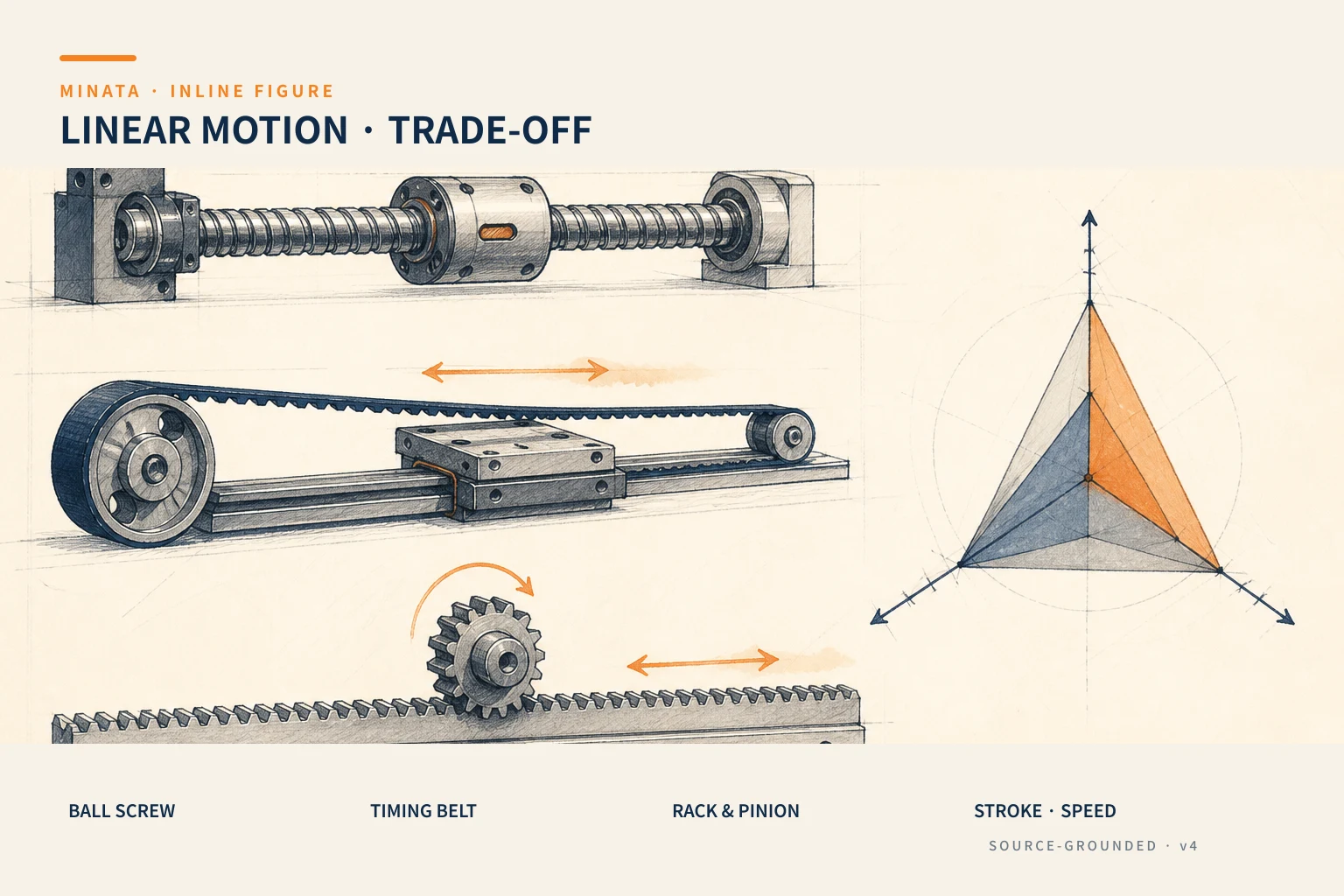
Ball screw: accurate and strong over short strokes
A ball screw transmits force through balls rolling between the screw shaft and the nut, converting rotation into translation with very low friction and high accuracy. It is the classic choice for an axis that needs precise positioning and high thrust: CNC machine axes, press axes, a Z axis for raising and lowering, precision positioning tables.
Its standout strength is accuracy and stiffness: the preloaded type has almost no backlash, so position repeatability is very good. A ball screw also delivers high force and holds its load better at a small lead.
The limitation lies in stroke and speed. As the screw shaft gets longer, it tends to sag and exhibits rotational resonance (whip) at high speed, limiting the maximum speed. So a ball screw is less suited to a very long stroke or very high speed; the price also rises quickly with length. For a stroke up to about 1.5–2 m with accuracy as the priority, a ball screw is usually the answer.
Timing belt: fast and long, at the cost of stiffness
A timing belt uses a toothed belt meshing with pulleys to pull a slider. Because the moving mass is light and it is not whip-limited like a screw shaft, a timing belt achieves high speed and long stroke very economically — positioning conveyors, the X-Y axes of an engraver, high-speed Cartesian robots, pick-and-place axes.
Advantages: high speed, long stroke without much price increase (only more belt), quiet, little complex maintenance. The core disadvantage is low stiffness: the belt is elastic, so when the force changes suddenly the slider oscillates slightly, and position accuracy is lower than a ball screw. The belt also needs tension checks and adjustment, and stretches over time. For an application needing speed, length, a not-too-heavy load and moderate accuracy, a timing belt is a good and cheap choice.
Rack and pinion: for nearly unlimited stroke
A rack and pinion uses a rotating pinion gear meshing with a long straight rack. Because rack segments can be joined, the stroke is nearly unlimited — large gantries, wide-format cutting machines, axes that move the whole machine, long automated storage.
Advantages: very long stroke, high thrust, higher stiffness than a belt. Disadvantages: backlash at the tooth mesh, which reduces position accuracy; eliminating it requires a dual anti-backlash pinion or a helical gear, which costs more. The teeth need lubrication and wear checks. For a stroke exceeding the economical reach of a ball screw and a load heavier than a belt can take, a rack and pinion is the choice.
Choosing: balance the three factors — stroke, speed, accuracy
The process:
- How long is the stroke? Short–medium (< ~2 m) → ball screw is feasible. Long → belt or rack and pinion.
- What position accuracy do you need? High (precise positioning, machining) → ball screw. Medium → belt or rack and pinion.
- What speed do you need? Very high → belt. Medium → all three.
- How heavy is the load? Heavy and needs stiffness → ball screw (short) or rack and pinion (long). Light–medium → belt.
The three factors often conflict: wanting long, accurate and fast at once means no mechanism is perfect, so you must choose the most important. For example, the X-Y axes of a pick-and-place prioritize speed and stroke → belt; a press axis needing force and accuracy over a short stroke → ball screw; a wide-format cutting gantry needing long stroke and force → rack and pinion.
In a multi-axis machine, you can absolutely mix mechanisms: use a belt or rack and pinion on the long axis for speed and economy, and a ball screw on the short axis that needs accuracy. This is a common layout on pick-and-place machines and wide-format machining — do not force the whole machine into one transmission type, but choose by each axis's requirement. The total cost is also better optimized: you pay for high accuracy only on the axis that needs it, while transport axes get the cheap, fast solution. This way of thinking mirrors choosing tolerance by function: invest accuracy where it matters, and let go where it does not.
Do not forget the guide and the coupling
A linear-motion mechanism always comes with a guide (linear ball rail, guide shaft) carrying the perpendicular load, and a coupling between the motor and the shaft. Choose the transmission but ignore the guide and accuracy is still poor: a linear ball rail gives high stiffness and accuracy, suited to a ball screw; roller rails or wheels for a very long stroke go with a rack and pinion. The coupling between the motor and the ball screw should be a zero-backlash type (a flexible or bellows coupling) so as not to add backlash to the chain. The whole chain motor → coupling → transmission → guide → load decides the final accuracy, not the transmission alone.
Example: reading three real axes
- A Z axis pressing components, 150 mm stroke, needing force and accuracy: preloaded ball screw. Short so no whip concern, accurate and strong.
- The X axis of a 1.5 m laser engraver, high speed, light load: timing belt. Fast, long, cheap; accuracy sufficient for engraving.
- A 6 m plasma-cutting gantry: rack and pinion with roller guides. The long stroke and heavy frame load exceed what a belt and screw can do.
Lead and critical speed of a ball screw
For a ball screw, the two parameters governing speed and accuracy are the lead and the critical rotational speed. The lead is the distance the slider travels per revolution of the screw shaft: a large lead travels fast but reduces thrust and gives coarser position resolution; a small lead is slower but gives better force and resolution. Choosing the lead is a balance between speed and force/accuracy for the specific problem.
The screw's rotational speed is limited by two factors. The first is the critical speed: a long screw shaft spinning fast resonates and sags like a plucked string, so the maximum speed drops with the square of the shaft length. This is exactly why a screw does not suit a long stroke. The second is the DN value (ball circle diameter times rpm) that the manufacturer caps so the balls do not overheat. When designing, you must check whether the required working speed sits below both limits; if not, increase the shaft diameter, shorten the length, or switch to a belt.
Life, lubrication and cleanliness
The three mechanisms wear differently and need matching maintenance:
- Ball screw: life is rated by load and revolutions, sensitive to lubrication and dirt; abrasive particles entering the ball nut cause rapid wear. A dusty environment needs a wiper and shielding. The right lubricant applied periodically is vital to life.
- Timing belt: fails through tooth wear, stretch and reinforcement-cord breakage; needs tension checks and periodic belt replacement. The belt needs no lubrication, so it suits cleanrooms and food.
- Rack and pinion: the teeth wear over time and need lubrication (grease or an auto-oiling wheel) and periodic backlash checks; if the gap grows, readjust or replace.
The environmental factor sometimes overturns the technical choice: in a cleanroom or a food line, an (oil-free) timing belt may be preferred over a screw despite its lower accuracy, to avoid lubricant contamination. Always weigh the hygiene, noise and dust requirements of the installation environment, not just the mechanical specs.
Common mistakes
- Using a ball screw for a very long stroke. The long screw shaft sags and whips, limiting speed and inflating the price.
- Using a belt for an application needing high stiffness and accuracy. The elastic belt lets the slider oscillate under a changing load.
- Using a rack and pinion without eliminating backlash for an application needing precise positioning.
- Choosing a good transmission but ignoring the guide and coupling, ruining the accuracy of the whole chain.
- Forgetting maintenance: without belt-tension adjustment or screw/rack lubrication, life and accuracy fall quickly.
Quick selection checklist
- [ ] How long is the stroke needed? Short–medium → ball screw; long → belt/rack and pinion.
- [ ] What position accuracy is needed? High → ball screw.
- [ ] What speed is needed? Very high → belt.
- [ ] Is the load heavy and does it need stiffness? Yes → ball screw (short) / rack and pinion (long).
- [ ] Have you chosen a guide and coupling suited to the whole chain?
- [ ] If using a rack and pinion and needing accuracy, have you planned to eliminate backlash?
- [ ] Have you planned maintenance (belt tension, lubrication)?
- [ ] For a screw, does the working speed sit below the critical speed and the DN limit?
- [ ] Does the environment need cleanliness/oil-free, favoring a belt?
If you are designing an axis or a multi-axis system and are torn between a ball screw, a timing belt and a rack and pinion, MINATA can advise on the transmission by the machine's real stroke, speed, load and accuracy, including the guide and coupling for the whole chain. See MINATA's Engineering & Manufacturing service.
Reference: the ball screw selection method (ボールねじの選定方法), linear-system life calculation (リニアシステムの寿命計算) and drive timing-belt selection (伝動タイミングベルトの選定方法) in the MISUMI technical catalog. Look up the specific formulas (load, critical speed, life) in the supplier's documentation.
More in the Device Selection series
View all MINATA technical articles