Device Selection #04: Harmonic, Planetary or Cycloidal Gearboxes — Choosing by Torque, Backlash and Cost
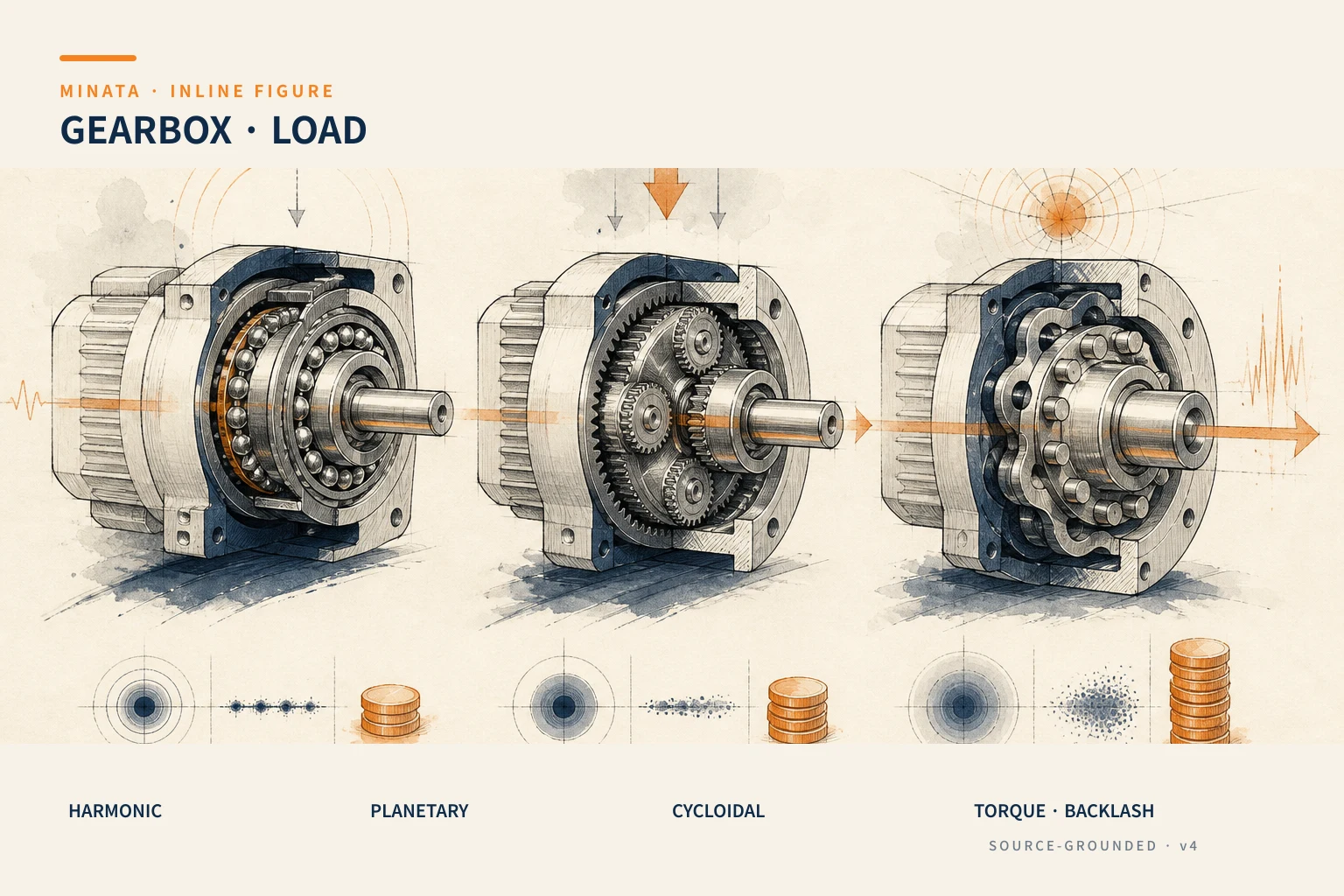
Short answer: choose a harmonic (strain-wave) gearbox when you need a very high ratio, almost zero backlash and light weight for robot joints and precise positioning axes; choose a planetary gearbox when you need a balance of torque, accuracy and cost for most ordinary servo applications; choose a cycloidal gearbox when you need very high torque, shock-load capacity and high durability at the base joints of heavy robots and heavy-duty machines. All three reduce speed and multiply torque from the motor, but they differ in backlash, torque capacity and cost. Choosing by these three factors rather than by habit avoids both overspending and falling short on accuracy. This article helps you decide the right gearbox type for each joint and axis.
Quick comparison of the three gearbox types
| Criterion | Harmonic (strain wave) | Planetary | Cycloidal |
|---|
| Single-stage ratio | Very high (30–160) | Medium (3–10, stackable) | High (30–120) |
| Backlash | Very small (near zero) | Small to medium | Small |
| Torque per weight | High | Medium | Very high |
| Shock/overload capacity | Medium | Good | Very good |
| Torsional stiffness | Medium | High | High |
| Weight, size | Light, thin | Medium | Heavier |
| Relative cost | High | Low to medium | High |
| Typical application | Robot joints, precise positioning axes | General-purpose servo, machine axes | Base joints of heavy robots, heavy-duty machines |
Why a gearbox is needed
A servo motor runs smoothly and efficiently at high speed but low torque. Most loads need the opposite: moderate speed, high torque. A gearbox bridges those two worlds: it reduces speed by the ratio and multiplies torque by roughly the same ratio. A gearbox also improves the inertia matching (reflected inertia) between motor and load, which makes control more stable.
For precise-positioning applications, one gearbox parameter matters as much as torque: backlash. It is the angle the output shaft turns freely before transmitting force when reversing direction. Large backlash loses position accuracy and causes vibration on reversal. So the gearbox-choosing story is always a balance between torque, backlash and cost.
Harmonic: high ratio, almost no backlash, light
A harmonic gearbox uses a flexible toothed ring that deforms in a wave to mesh with a rigid ring gear, producing a very high ratio in a single stage and in a thin, light package. Its most distinctive feature is near-zero backlash, so it dominates industrial robot joints and axes needing very precise positioning.
Advantages: very high ratio in a single stage, extremely small backlash, light and thin (important for a robot joint that must carry its own weight), smooth operation. Disadvantages: high cost, only medium torsional stiffness and shock-load capacity, and the flexible ring has a life limit under continuous heavy load. For robot joints, camera axes, precise indexing tables, and axes needing high position accuracy where the load is not too harsh, harmonic is the right choice despite the price.
Planetary: balanced and economical for most applications
A planetary gearbox uses planet gears revolving around a sun gear inside a ring gear. Because the load is shared among several gears, it handles torque well in a compact size, with high stiffness and a reasonable price. It is the most common type for general-purpose servo.
Advantages: good price, high torsional stiffness, good load capacity and efficiency, a very wide range of ratios and sizes so it is easy to find the right one. Backlash ranges from small to medium depending on the accuracy grade (a low-backlash version exists for accuracy-critical applications, at a higher price). Disadvantages: the single-stage ratio is not high (usually 3–10); a large ratio requires stacking stages, which increases backlash and reduces efficiency. For most machine axes and ordinary servo, planetary is the reasonable default in price and performance.
Cycloidal: high torque, shock-resistant, durable
A cycloidal gearbox uses a cycloid disc rolling inside a pin ring, distributing the load over many contact points at once. Thanks to this it handles very high torque, shock loads and overload well, with high durability and small backlash. It is the choice for the base joints of heavy robots (which carry the entire arm load) and heavy-duty machines.
Advantages: very high torque per weight, excellent shock and overload capacity, high stiffness and durability, small backlash. Disadvantages: heavier and more expensive than planetary, complex construction. When an application demands large torque and reliability under harsh load more than light weight, cycloidal beats harmonic; when it needs lightness and accuracy more than shock resistance, harmonic wins.
Choosing: balance torque, backlash and cost
The process:
- Need very small backlash and light weight (robot joints, precise positioning)? → harmonic.
- Need very high torque, shock-load capacity, high durability (heavy robot base joints, heavy machines)? → cycloidal.
- Need a cost–performance balance for ordinary servo axes? → planetary.
- Limited budget and moderate accuracy? → planetary (choose the appropriate backlash grade).
The three factors — torque, backlash, cost — often conflict: harmonic gives the smallest backlash but is expensive and not as strong as cycloidal; cycloidal is strongest but heavy and expensive; planetary is cheap and balanced but limited in backlash and single-stage ratio. Choose by the deciding factor of the application, do not default to one type.
A quick check: write down three numbers for the application — the maximum working torque (including acceleration), the allowable backlash of the whole chain, and the budget for this joint. If the allowable backlash is very small and the load is moderate, harmonic comes into view. If torque and shock load are the biggest constraints, cycloidal. If both are moderate and price matters, planetary is almost always the economically correct choice. When two factors pull in different directions, it is the budget number and the importance of accuracy that decide.
Reading the specs correctly: ratio, rated torque and peak torque
When choosing specifically, match four parameters:
- Ratio: decides output speed and torque; choose it so the output speed and torque match the load's needs.
- Rated torque: the allowable continuous working torque; the continuous load must sit below this value.
- Peak/momentary allowable torque: for acceleration and shock load; do not choose by rated torque alone if the load has shocks.
- Backlash grade (arcmin): for accuracy applications, check the allowable arc-minutes of backlash for the whole chain.
Also check the allowable radial and axial loads on the output shaft (especially when mounting a pulley or an offset arm), and the load's inertia for matching. Choosing by rated torque while forgetting peak torque during acceleration is a common mistake that wears the gearbox out early.
Example: reading three real joints
- The wrist joint of a 6-axis robot: harmonic. Needs near-zero backlash and light weight so it does not burden the arm; the load at the wrist is not too large.
- The rotary indexing-table axis of a CNC machine: low-backlash planetary. Balances accuracy, torque and cost for an ordinary machine axis.
- The base joint of a 200 kg palletizing robot: cycloidal. It carries the entire arm load and needs very high torque and shock-load capacity during acceleration and braking.
Efficiency, heat generation and torsional stiffness
Three factors often overlooked but with a big impact on real operation:
- Transmission efficiency: planetary is usually high (over 90% per stage), but stacking stages multiplies it down. Harmonic efficiency depends on ratio and load, dropping at very high ratios and light loads. Low efficiency means wasted power and heat, which must be accounted for when sizing the motor.
- Heat generation: a gearbox running continuously at high load heats up; the allowable operating temperature and duty cycle (continuous or intermittent) are real constraints. Choosing a gearbox at its limit and running continuously easily overheats and shortens life.
- Torsional stiffness: even with small backlash, the output shaft still twists elastically under torque due to finite torsional stiffness. For applications needing fast, accurate dynamic response, torsional stiffness affects control stability and overshoot; cycloidal and planetary are usually stiffer than harmonic.
Life, lubrication and maintenance
A gearbox is a wear part, its life rated by load and revolutions. A few points when choosing and operating:
- Choose the gearbox so the working load sits below the rated torque with a reasonable safety factor; running near the rating continuously shortens life quickly.
- Lubricate with the correct oil/grease and change it per the recommendation; many precision gearboxes use a dedicated oil, and the wrong type wears fast and increases backlash.
- For harmonic, the flexible ring is the life-limiting part under heavy load; for cycloidal and planetary, the tooth-contact points and bearings are where wear occurs.
- Backlash grows with wear; accuracy applications need monitoring and recalibration or replacement when the gap exceeds the threshold.
Choosing the right type from the start with a reasonable safety factor is usually far cheaper than replacing a gearbox early or losing accuracy in the middle of a production run.
Common mistakes
- Using harmonic for a heavy robot's base joint. The flexible ring cannot withstand the large torque and shock load; cycloidal is more suitable.
- Stacking planetary stages to reach a very high ratio while accepting cumulative backlash, when a single-stage harmonic solves it cleanly.
- Choosing by rated torque, ignoring peak torque during acceleration. The gearbox wears out early under shock load.
- Ignoring backlash for a precise-positioning application. With the right motor and encoder, the axis still drifts because of gearbox backlash.
- Forgetting to check the allowable radial/axial load when mounting a pulley or an offset arm on the output shaft.
Quick selection checklist
- [ ] Does the application need very small backlash and light weight? Yes → harmonic.
- [ ] Does it need very high torque, shock-load capacity, durability? Yes → cycloidal.
- [ ] Does it need a cost–performance balance for ordinary servo? Yes → planetary.
- [ ] Have you matched the ratio to the required output speed and torque?
- [ ] Have you checked both rated torque and peak torque during acceleration?
- [ ] For an accuracy application, have you checked the backlash grade (arcmin)?
- [ ] Have you checked the allowable radial/axial load on the output shaft?
If you are choosing a gearbox for a robot joint or a servo axis and are torn between harmonic, planetary and cycloidal, MINATA can advise by the application's real torque, accuracy and budget. See MINATA's Engineering & Manufacturing service.
More in the Device Selection series
View all MINATA technical articles