Machine Design #111: Welding, Bolting or Adhesive — Choosing the Joint by Load and Serviceability
Short answer: choose welding when you need a stiff, high-load, sealed joint that does not need to be taken apart; choose bolting (bolts/screws) when you need to disassemble, maintain, replace or adjust; choose adhesive (structural adhesive) when joining different materials, needing an even stress distribution, sealed and light where the load is mainly shear. These three joint types all connect two parts, but they differ in load capacity, serviceability and material requirement. Choosing wrong leads to a weak joint, or one that cannot be serviced, or delamination. This article is written from the compare-to-choose angle; welding symbols and threaded joints already have dedicated articles in the Mechanical Design section, so here we focus on choosing by load and serviceability.
Quick comparison of the three joint types
| Criterion | Welding | Bolting (bolt/screw) | Adhesive (structural) |
|---|
| Serviceable | No (must break the joint) | Yes, many times | No (or very hard) |
| Load capacity | Very high, any direction | High, best in axial tension | Good in shear; poor in peel/cleavage |
| Joint stiffness | Very high | High (can loosen over time) | Medium, elastic |
| Joining different materials | Hard (needs same/compatible) | Easy | Easy (even metal-plastic) |
| Sealing (leak resistance) | Good | Needs a gasket | Good |
| Stress distribution | Concentrated at the joint, with residual stress | Concentrated around the hole | Even over the bonded area |
| Heat effect on the material | Yes (heat-affected zone) | No | No (or low) |
| Skill/process requirement | High (welder, weld inspection) | Low to medium | Medium (surface prep, cure time) |
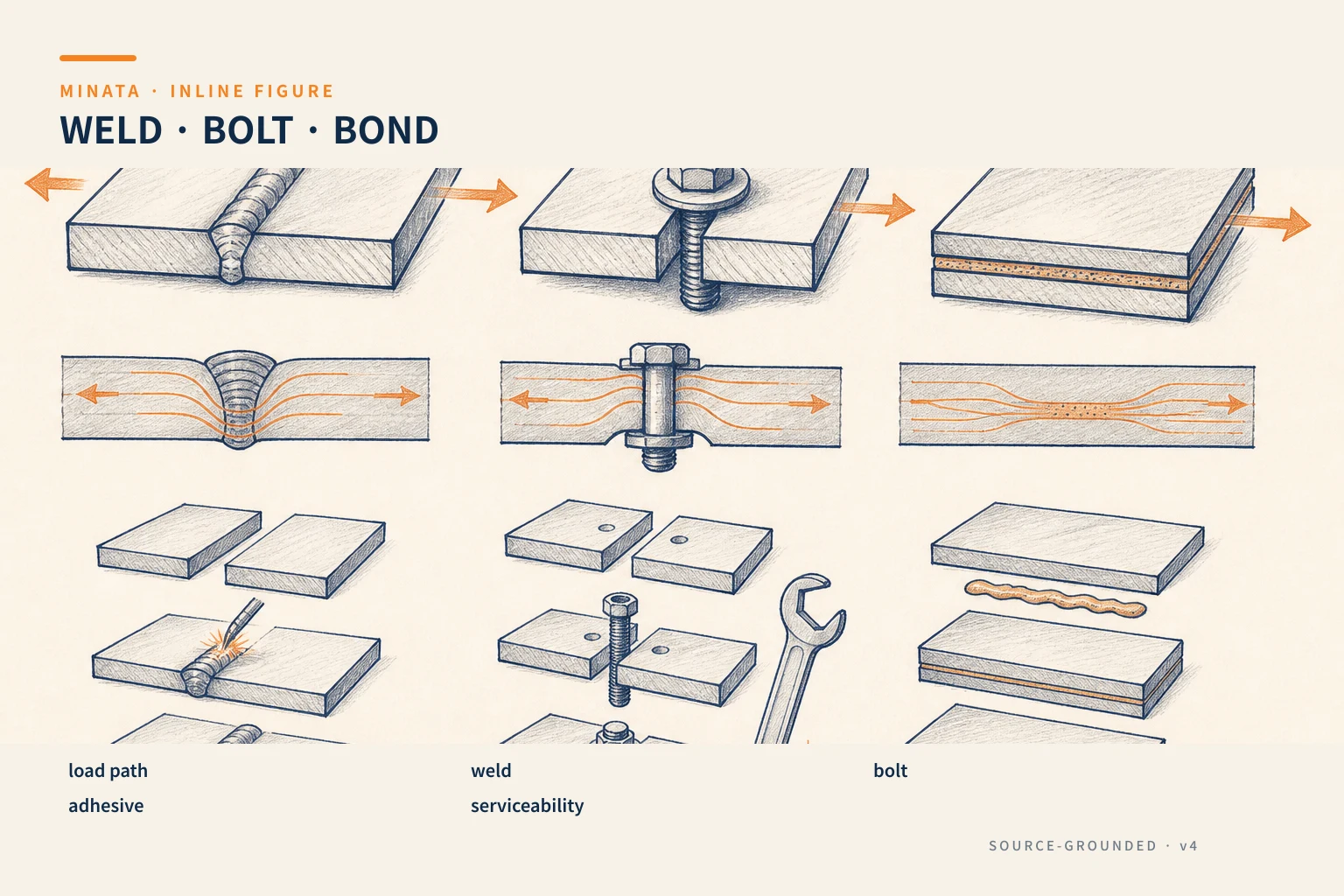
The first question: does it need to come apart
The strongest eliminating factor is whether the part needs to be disassembled. If it needs disassembly for maintenance, replacement, adjustment or shipping disassembled, then bolting is almost a mandatory choice — welding and adhesive are both "permanent" joints, and taking them apart means breaking them.
- Needs disassembly (maintenance, replacing a wear part, adjusting position): bolting.
- No disassembly, prioritizing stiffness and strength: welding.
- No disassembly, joining different materials or needing a light seal: adhesive.
Many design mistakes start here: welding an assembly rigidly then realizing later that an internal part needs replacing, having to cut the whole assembly apart. Conversely, bolting a joint under strong vibration without an anti-loosening measure, and the bolt works itself loose. Answer "does it need to come apart" first, then consider the load.
Welding: stiff and strong, but permanent and with stress
Welding joins parts by melting the metal at the joint, creating a monolithic bond. It is the stiffest and highest-load joint in every direction, seals well, and is cheap for large structures. Machine base frames, steel structures, high-load parts that do not need disassembly usually use welding.
Advantages: high stiffness and strength, load in any direction, sealed, low cost for structures. Disadvantages: permanent (taking it apart means cutting), puts heat into the material causing residual stress and warping (an important structure must be stress-relieved before finish machining), requires a weldable and compatible material (hard to join two dissimilar metals), depends on the welder's skill and needs weld inspection. For the symbols and how to state a weld on the drawing, see the Mechanical Design section. When you need stiff, strong, sealed and no disassembly, welding is the right choice.
Bolting: flexible, serviceable, needs anti-loosening
Bolting uses bolts, screws and nuts to clamp parts by tightening force. Its biggest advantage is being disassembled many times, easy to join different materials, no heat into the material, and allowing adjustment and replacement. It is the joint of anything that needs maintenance.
Advantages: serviceable, flexible, joins different materials easily, no heat effect, controllable tightening force. Disadvantages: needs a hole (weakening the part around the hole and concentrating stress), can loosen itself under vibration without an anti-loosening measure, needs a gasket when sealing is required, and many screwed joints cost assembly labor. A bolted joint takes axial tension best; for shear you should have a locating pin or a load-bearing shoulder rather than letting the bolt take the shear. Under vibration, use an anti-loosening measure (lock washer, thread-locking adhesive, self-locking nut) and tighten to the correct torque. Threaded joints already have a dedicated article in the Mechanical Design section.
Adhesive: even stress distribution, joins any material
Structural adhesive (epoxy, acrylic, polyurethane) joins parts with an adhesive layer bonding two surfaces. Adhesive's distinct strength is an even stress distribution over the whole bonded area rather than concentrating like a screw hole or a weld, so it is good for thin, brittle materials, and for joining different materials (metal to plastic, metal to composite) that welding cannot do. Adhesive is also sealed, light and puts no heat into the material.
Advantages: even stress distribution, joins any material pair, sealed, light, no heat effect, a continuous surface with no holes. Disadvantages: good in shear but poor in peel/cleavage, so the bonded-joint design must let the adhesive take shear not peel; needs careful surface preparation (cleaning, roughening, surface treatment) because the strength depends on adhesion; needs cure time; is sensitive to temperature and environment (some adhesives lose strength when hot or humid); and is hard to disassemble and hard to inspect the internal quality. When joining different materials, needing an even stress distribution, or needing a light seal where the load is shear, adhesive is the right choice.
Choosing: combine load and serviceability
The process:
- Does it need to come apart again? Yes → bolting. No → consider further.
- High load, needing stiffness and sealing, same weldable material? → welding.
- Joining different materials, load mainly shear, needing light/sealed? → adhesive.
- Thin, brittle part, needing even stress distribution? → adhesive (or bolting with a wide washer).
- Strong vibration? If bolting then an anti-loosening measure is mandatory; if no disassembly, welding is stiffer.
In practice, a machine assembly usually mixes all three: a welded frame for stiffness, bolted functional assemblies for maintenance, and some adhesive-bonded parts where materials differ. Do not force the whole assembly into one joint type; choose by each joint's requirement.
A compact way of thinking: the two questions "does it need to come apart" and "how large, which direction is the load" almost settle the choice. Needs disassembly → bolting, no further discussion. No disassembly and high load in every direction → welding. No disassembly, different materials or shear load over a wide area → adhesive. The remaining factors (sealing, weight, vibration, cost) only fine-tune within that frame and rarely overturn it. Starting from these two questions is faster and less error-prone than comparing each property one by one.
Example: reading three real joints
- A load-bearing steel machine base frame, no disassembly: welding, stress relief, then mill the mating faces. Stiff, strong, economical.
- A gearbox cover that must open for maintenance: bolting with a gasket. Disassembled many times, sealed by the gasket.
- A thin aluminum plate joined to the plastic frame of an equipment cover: structural adhesive. Joins two different materials, even stress distribution, sealed and light, no holes on the outer face.
Fatigue and life: where the joint fails
For a part under a varying load (vibration, cyclic), the failure point is usually at the joint rather than in the material itself, because the joint concentrates stress:
- Welding: the weld toe and the heat-affected zone concentrate stress and crack in fatigue easily; the design should avoid a weld in a high-stress zone, use a smooth transition radius, and for a fatigue-loaded structure pay attention to the weld quality and possibly a post-weld treatment.
- Bolting: the bolt hole concentrates stress; a bolt under varying load needs enough initial preload so the joint does not "breathe" and fatigue at the thread. A bolt loosening under vibration is a common failure cause.
- Adhesive: the edge of the bonded area sees the highest stress; the bonded-joint design should increase the area and avoid the edge taking peel, because a fatigue crack starts from the edge.
Understanding where the joint fails helps design it right from the start, rather than just choosing the joint type and letting the load find the weak point.
Combining joints: when one type is not enough
In many cases, combining two joint types gives a better result than a single type:
- Bolting plus adhesive: the bolt holds the position and takes peel, the adhesive distributes stress evenly and seals; common for covers and plates that need to be both strong and sealed.
- Tack welding plus bolting: spot weld for quick location, bolts take the main load and allow removing a subassembly.
- Adhesive plus riveting for a thin sheet joining different materials, common in light structures.
Combining increases reliability but also increases cost and operations, so use it only when a single type does not meet the load, sealing and serviceability together. The thinking is still to choose by each joint's requirement, not apply one general formula.
Cost and production
Choosing the joint also affects the assembly cost and volume. Welding needs a skilled welder, a welding fixture and an inspection step, suiting structures and moderate lots; bolting is fast and easy to automate (power screwdrivers), suiting mass assembly and things needing disassembly; adhesive needs surface preparation and cure time, and can be a takt-time bottleneck if the adhesive is slow to cure. At high volume, the number and type of joints directly affect the assembly time per product, so reducing the number of joints and choosing an easy-to-assemble type is a way to reduce the assembly cost.
Common mistakes
- Welding an assembly that needs internal maintenance. Replacing a part means cutting the whole assembly apart; bolt it instead.
- Bolting a vibration-loaded joint without anti-loosening. The bolt works loose; use thread-locking adhesive, a self-locking nut, correct torque.
- Letting the bolt take shear instead of tension. You should have a locating pin or a shoulder to take the shear.
- Designing a bonded joint to take peel/cleavage. Adhesive is poor in peel; arrange it so the adhesive takes shear.
- Bonding without surface preparation. Poor adhesion, the joint delaminates; you must clean, roughen and treat the base.
- Welding two incompatible dissimilar metals; the joint cracks or is weak, consider bolting or adhesive.
Quick selection checklist
- [ ] Does the part need to be disassembled again (maintenance, replacement)? Yes → bolting.
- [ ] Is the load high and does it need stiffness, sealing, no disassembly? → welding.
- [ ] Are you joining two different materials? → adhesive or bolting.
- [ ] Is the load on the bonded joint mainly shear (not peel/cleavage)?
- [ ] Is there strong vibration needing anti-loosening (if bolting)?
- [ ] For welding, have you accounted for residual stress and stress relief before finish machining?
- [ ] For adhesive, have you planned the surface preparation and cure time?
If you are designing an assembly and torn between joint types by load, serviceability and material, MINATA can advise a joining approach suited to the drawing and the real working conditions. See MINATA's Engineering & Manufacturing service.
Reference figures for calculating a bolted joint
When a bolted joint carries a load, a few quantitative rules are worth remembering (per bolt-calculation technical tables):
- A reasonable axial tightening force is usually taken as Ff = 0.7 × σy × As, i.e. about 70% of the bolt's yield strength in the elastic zone (As is the thread's stress area).
- The bolt strength class is written as a number like 8.8, 10.9, 12.9; the higher the number, the stronger (e.g. class 12.9 has a yield strength of about 1098 N/mm²). Choose the strength class by the load, do not default.
- The tightening torque depends on the friction coefficient, which varies with the surface treatment and lubrication — for the same desired tightening force, a dry bolt and a lubricated bolt need a different torque. So tighten to the specified torque with the surface condition, or use an angle-control method.
- The safety factor is chosen by the load type: static load smaller, one-way and two-way varying load larger, impact load largest — a joint under vibration/shock must reduce the allowable load a lot from the static load.
Reference: the technical tables "ボルトの適正締付軸力/適正締付トルク" and "ボルト・ノックピンの強度" in the MISUMI catalog; safety factor per Unwin. Look up the specific values by the thread size and strength class.
Read more
View all MINATA technical articles