Manufacturing Engineering #04: Machining, Casting or Welded Fabrication — The Break-Even by Volume
Short answer: choose machining from solid stock when the volume is low or the part needs high accuracy and mechanical properties without paying for a mold; choose casting when the volume is high and the shape is complex, to spread the mold cost over many products; choose welded fabrication (assembled from plate and structural steel) for a large part, a base frame, when you need lightness and fast turnaround without a mold. The three methods make the same part but have very different cost structures: machining from solid costs material and machine time, casting costs an upfront mold, welded fabrication costs welding and straightening labor. This article helps you estimate the break-even by volume to choose correctly.
Quick comparison of the three shaping methods
| Criterion | Machining from solid | Casting | Welded fabrication |
|---|
| Upfront mold/fixture cost | Very low | High (mold) | Low to medium (welding fixture) |
| Cost per part | High | Low at high volume | Medium |
| Economical volume | 1–a few dozen | Hundreds and up | 1–a few dozen |
| Material waste | High (much chip removed) | Low | Low |
| Achievable accuracy | High (IT7 easy) | Medium, mating faces need finishing | Low, mating faces need finishing |
| Mechanical properties | Uniform, good | Depends on the casting process | Good, but with weld stress |
| Time to first part | Fast | Slow (making the mold) | Medium |
| Complex shape | Limited, costs machine hours | Very flexible | Limited to box/frame forms |
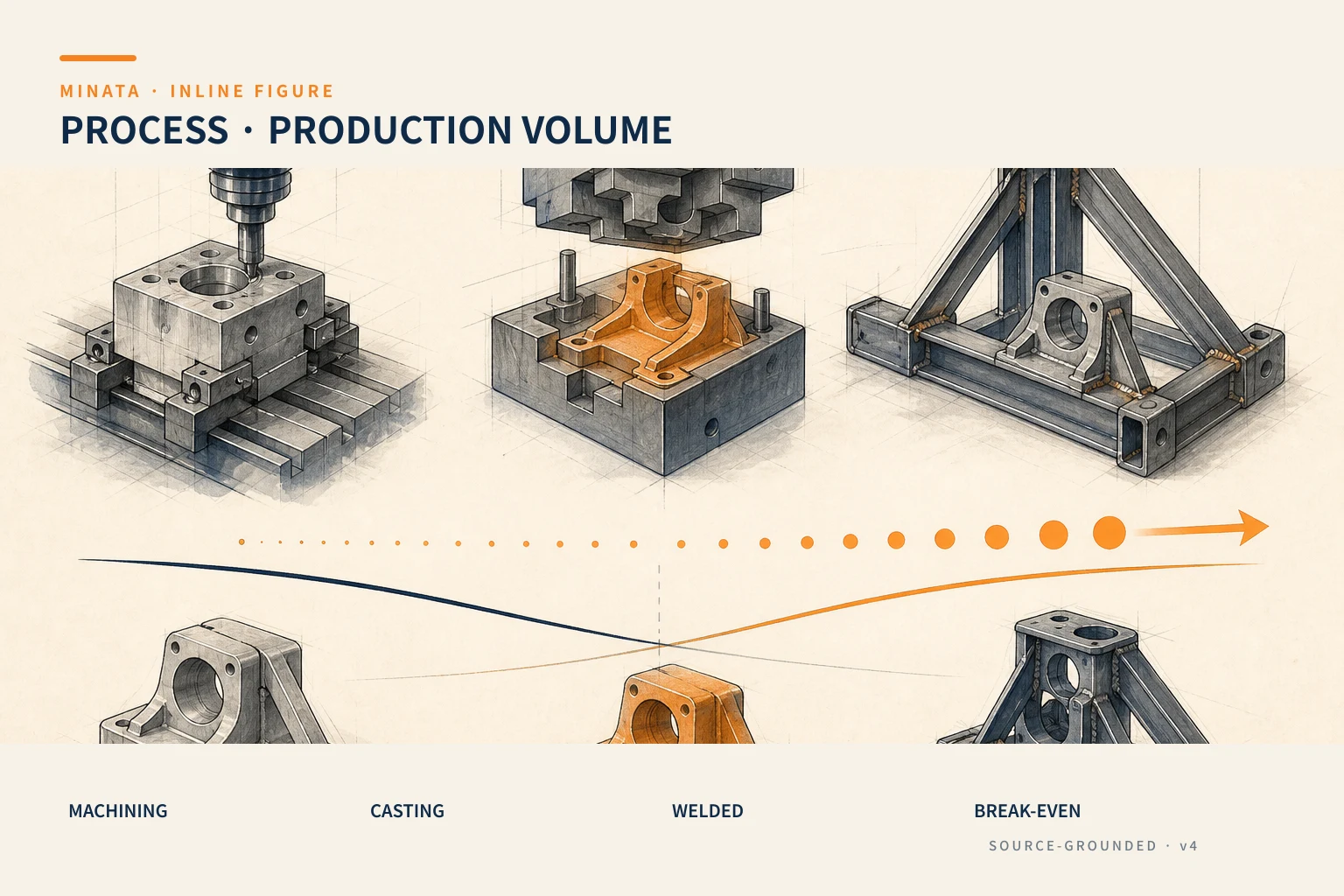
Machining from solid: cheap when few, expensive when many
Machining from solid cuts the part from a solid block of stock (steel, aluminum) by milling and turning. Because no mold is needed, the startup cost is almost zero — you only pay for the stock and machine hours. This is why machining from solid always wins at low volume: making 1 part or 10 parts requires no mold investment.
In return, the cost per part is high and hardly drops as the quantity rises, because each part still costs the same chip removal and the same machine hours. For a complex shape, deep pockets, thin walls, the machine hours rise fast. Material waste is also large: a 1 kg finished part may start from a 5 kg block, the rest becoming chips.
Technical advantage: uniform mechanical properties from the base material (rolled steel, extruded aluminum), high accuracy, no gas porosity or casting defects. So a highly loaded part demanding reliability, or a small quantity, usually chooses machining from solid.
Casting: expensive at first, cheap when multiplied
Casting pours liquid metal into a mold shaped like the part, lets it solidify, then removes it. The biggest cost is making the mold (a pattern, a sand mold, or a metal mold for die casting) — this is fixed, independent of quantity. Divided over hundreds or thousands of products, the mold cost per part becomes very small, so casting dominates at high volume.
Casting also creates very complex shapes that machining from solid would spend many machine hours on: curved walls, internal cavities, stiffening ribs, free-form shapes. Material waste is low because it pours almost exactly the amount needed.
Disadvantages: a cast part usually needs finish machining of the mating faces and precise holes, because the cast surface is rough with a wide tolerance. The mechanical properties depend on the casting quality: there can be gas porosity, shrinkage porosity, segregation if the process is poor. And the mold-making time makes the first part slow, unsuited when you need a quick sample or the design is still changing.
Welded fabrication: flexible for large parts
Welded fabrication assembles the part from cut plate and structural steel (box, I-beam, U-channel) by welding. It dominates machine base frames, vehicle frames, large structures — where a solid block would be too heavy and costly, and a casting mold is uneconomical because of the low volume and large size.
Advantages: low startup cost (only a drawing and a simple welding fixture), makes very large parts, easy to change the design, and lighter than a solid block at the same stiffness because the material is arranged as box beams. Faster to first part than casting.
Disadvantages: welding puts local heat causing residual stress and warping, so an important welded structure usually needs stress relief before finish machining the mating faces. The overall accuracy is low; the mating faces and locating holes must be milled after welding. The quality depends on the welder's skill and the weld-inspection procedure.
The break-even: choose by volume
The break-even way of thinking: each method has a fixed cost (mold/fixture) plus a variable cost (per part). Total cost = fixed + variable × quantity.
- Machining from solid: fixed ≈ 0, high variable. A steep cost line from the origin.
- Casting: high fixed (mold), low variable. A cost line starting high but gentle.
- Welded fabrication: low fixed, medium variable. In the middle.
At very low volume, machining from solid (or welded fabrication for a large part) is cheapest because there is no mold to pay. As the volume rises, at some point the total casting cost drops below machining from solid — that is the break-even point. Above it, casting is cheaper; below it, machining from solid is cheaper. The specific break-even depends on the mold price, complexity and machine-hour rate, but the rule always holds.
Estimation example
You need a moderately shaped aluminum bracket:
- Making 5 for a prototype machine: not worth making a casting mold. Machining from aluminum stock is right — fast, accurate, no mold cost.
- Making 2,000/year for a commercial product: the casting mold cost divided over 2,000 is very small, each part much cheaper than milling one at a time. Casting (then finish-milling the mating faces) is right.
- Making 1 large 2-meter machine base frame: do not make a solid block (too heavy, too costly), do not make a mold (one piece, large size). Welded fabrication from box steel, stress relief, then mill the reference faces.
Not every "casting" is the same
When you say casting, the mold cost and break-even change a lot with the casting technology:
- Sand casting: the mold is made from sand, cheap, can make large parts, but the surface is rough and the tolerance wide. The pattern cost is low so the break-even is low — economical from a few dozen to a few hundred parts. Suits machine bodies, bases, cast-iron parts.
- Die casting: the metal mold is expensive with a high life, gives a nice surface and better tolerance, fast cycle. The break-even is high because the mold is expensive — only economical from thousands of parts up. Common for small aluminum, zinc parts at high volume.
- Investment casting: for complex parts, good surface, little rework, but a high unit price. Suits small parts with difficult shapes, alloy steel.
So when comparing "casting vs machining from solid," you must state which casting. A 300/year part may break even with sand casting but not with die casting. The volume, complexity and surface requirement together decide the suitable casting technology, and only then the real break-even.
Combining methods is often the practical answer
In practice, many parts are not purely one method. Some common combinations:
- Rough casting then finish machining: cast a near-net-shape to reduce chips and machine hours, then only mill/turn the mating faces and precise holes. This is the most common way for a high-volume part with a few faces needing accuracy.
- Welding a frame then milling the reference faces: welded fabrication makes the large frame, and after stress relief you mill the mating faces and drill the locating holes on a large planer mill.
- Combining a cast part and welded plate: for a large part with a complex zone, sometimes cast the complex assembly separately then weld it into the plate frame.
The common point: use the cheap method to make most of the mass, then use the expensive method (finish machining) only on the exact functional faces. This thinking is like choosing the sheet-cutting method in Manufacturing Engineering #03 — split the part by each face's requirement rather than forcing the whole part into one technology.
Beyond price there is time and risk
The pure-cost break-even is not the whole story. Two other factors often decide the choice:
- Time to first part. While still testing, when the design may still change, making a casting mold is risky: a design change scraps the mold. In this phase machining from solid or metal 3D printing is safer despite the higher per-part cost, because a design change only needs a program change, not a lost mold.
- Quality risk. A cast part needs internal-defect inspection (gas porosity, shrinkage porosity) by X-ray or ultrasound for a critical part; a welded structure needs weld inspection. The cost and time of this inspection must be added to the total.
A common roadmap: use machining from solid in the prototype and small-batch phase for speed and flexibility; when the design is locked and the volume rises, switch to casting to reduce the cost. This transition needs planning from the start because the drawing for machining from solid and for casting are not entirely the same (casting needs a draft angle, filleted corners, uniform wall thickness).
Common mistakes
- Making a casting mold for low volume. The mold cost cannot be spread; machining from solid is cheaper.
- Machining from solid for very high volume. Each part is expensive and slow; casting is much more economical.
- Forgetting to finish-machine the mating faces of a cast and welded part. The cast/welded surface is not accurate enough to assemble directly.
- Ignoring the residual stress of a welded structure. Without stress relief before finish milling, the part bows after machining.
- Comparing only the per-part unit price and forgetting the mold cost. You must add both fixed and variable then divide by the real volume.
Quick selection checklist
- [ ] What is the expected volume? Low → machining from solid; high → consider casting.
- [ ] Is the part large, a frame/box form? Yes → welded fabrication.
- [ ] Is the shape complex (internal cavities, curved walls)? Yes → casting has the advantage.
- [ ] Need uniform mechanical properties, high reliability? Yes → lean to machining from solid.
- [ ] Have you added the mold/fixture cost to the total and divided by the real volume?
- [ ] Have you counted the mating-face finish-machining step (and stress relief for welding) in the price and time?
If you are torn between machining from solid, casting and welded fabrication for a product, MINATA can estimate the break-even by the real volume and advise a suitable shaping approach. See MINATA's Engineering & Manufacturing service.
More in the Manufacturing Engineering series
View all MINATA technical articles