Materials #11: Aluminum A5052, A6061 and A7075 — Choosing by Machining, Welding and Strength
Short answer: choose A5052 when you need easy bending, good weldability and corrosion resistance for sheet and enclosures; choose A6061 when you need a balance of strength, machining and welding for general-purpose structural parts; choose A7075 when you need very high strength close to steel for load-bearing parts, in return for poor weldability and high cost. These three grades belong to three different alloy families, so their properties differ greatly: A5052 is soft and ductile, A6061 is versatile, A7075 is ultra-strong but fussy to machine and almost impossible to weld. Choosing the wrong grade leads either to a part that is not strong enough, or cannot be welded, or costs too much and is hard to assemble. This article helps you choose the right aluminum grade by the three factors of machining, welding and strength.
Quick comparison of the three grades
| Criterion | A5052 | A6061 | A7075 |
|---|
| Alloy family | Al-Mg (5000 series) | Al-Mg-Si (6000 series) | Al-Zn (7000 series) |
| Typical tensile strength | Medium (~230 MPa) | Good (~290–310 MPa, T6) | Very high (~570 MPa, T6) |
| Machinability | Good (slightly gummy) | Very good | Good |
| Weldability | Very good | Good | Poor, structurally almost unweldable |
| Bending, sheet forming | Very good | Medium | Poor |
| Corrosion resistance | Very good | Good | Medium (needs protection) |
| Anodizing | Good (decorative) | Good | Possible, but uneven color |
| Relative cost | Low | Medium | High |
| Typical application | Sheet, enclosures, tanks, bent parts | Structure, frames, general machine parts | High-load parts, molds, aerospace |
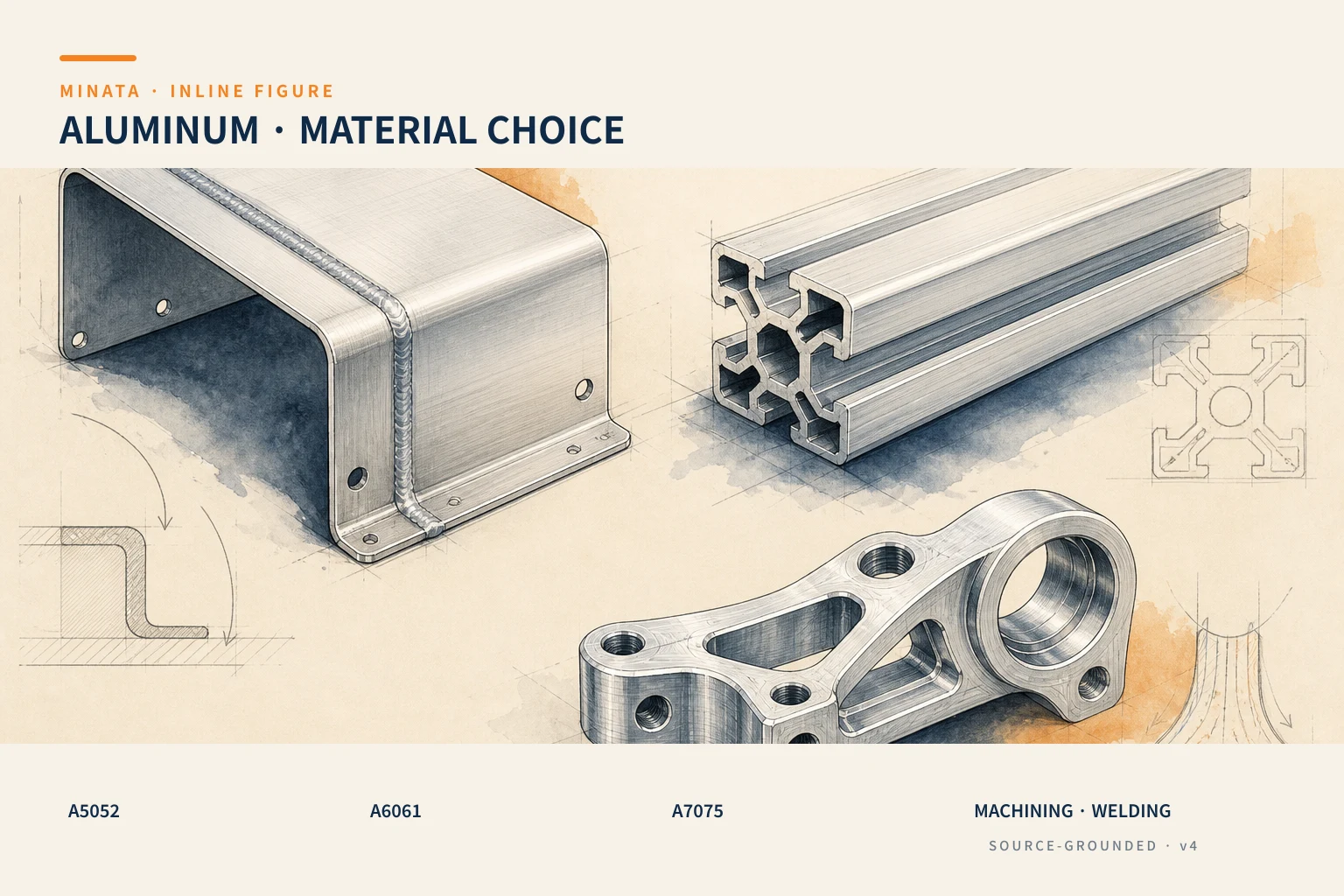
A5052: soft, ductile sheet, good welding and corrosion resistance
A5052 belongs to the 5000 series (aluminum-magnesium), the most common sheet grade when you need bending, forming and welding. It is not heat-treatable but strengthens through cold work; it has medium strength but is ductile and very corrosion resistant, especially in marine and chemical environments.
Widely used for: cabinet enclosures, guards, tanks, stamped/bent parts, equipment covers. Its advantages are easy bending without cracking, good welding, and a nice anodized surface for decorative and corrosion-protection purposes. Its disadvantages: low strength, so it is not suited to high-load parts; when machined it is slightly gummier on the tool than A6061. When the problem is a sheet that must be folded, welded tight and rust-resistant, A5052 is the economical and correct choice.
A6061: the most balanced, versatile grade
A6061 belongs to the 6000 series (aluminum-magnesium-silicon), heat-treatable (the T6 state is common). It is the most balanced grade and the most widely used for structural and machine parts: frames, brackets, base plates, general-purpose CNC-milled parts.
Advantages: very good machinability (nice chips, little sticking), good strength in the T6 state, weldable (though the weld loses strength locally and should be re-heat-treated if needed), good corrosion resistance, good anodizing. Disadvantages: sheet forming (folding) is worse than A5052 in the T6 state, prone to cracking on a sharp bend. When you need a grade that "does everything well" for a machine part, A6061 is almost always a reasonable starting point.
A7075: ultra-strong, but fussy about welding and expensive
A7075 belongs to the 7000 series (aluminum-zinc) and is one of the strongest aluminum alloys, with a T6 tensile strength close to ordinary structural steel while much lighter. It is used for high-load parts: molds, load-bearing fixtures, aerospace parts, machine parts that must be strong and light.
Advantages: a very high strength-to-weight ratio, good machinability. The important disadvantages: it is almost structurally unweldable (welds crack and lose strength severely), it has poorer corrosion resistance so it usually needs anodizing or a protective coating, sheet forming is poor, and it is expensive. So A7075 should only be used when strength is a real constraint and the part is assembled with bolts/rivets rather than welded. Using A7075 for a part that only needs A6061 is overpaying and creating assembly trouble.
Choosing: balance machining, welding and strength
The process:
- Does the part need welding? Yes → A5052 (sheet) or A6061 (structure). Avoid A7075.
- Does the part need a lot of bending/folding? Yes → A5052.
- Need very high strength and no welding (bolted)? → A7075.
- A general-purpose machine part, CNC-milled, decent strength, weldable? → A6061 (good default).
- A strongly corrosive environment (marine, chemical)? → A5052; if using A7075 you must apply a protective coating.
The three factors often conflict: A7075 is the strongest but not weldable and expensive; A5052 welds/bends best but is weak; A6061 is in the middle. So the deciding questions are usually "does this part get welded" and "is strength really a constraint." Answering those two nearly finishes the selection.
A practical tip for beginners: if unsure, start from A6061-T6 and only change with a clear reason. Move down to A5052 when the part is sheet that needs bending or a tight weld and does not carry a large load; move up to A7075 when the calculation shows A6061 is not strong enough and the part is bolted rather than welded. This way avoids both common mistakes: choosing too weak a grade (function fails) and choosing too expensive a grade (waste, hard assembly). A6061 covers most general-purpose machine-part needs, so anchoring on it is safe.
The temper matters as much as the grade
For the same aluminum grade, the properties change greatly with the temper, written as a suffix such as O, H, T4, T6:
- O: annealed soft, most ductile, lowest strength — for deep forming.
- H (e.g. A5052-H32): strain-hardened, used for 5052 sheet.
- T4: solution-treated and naturally aged; T6: solution-treated and artificially aged, highest strength — common for A6061 and A7075.
Writing only "A6061" on the drawing without the temper is incomplete: soft A6061-O is very different from strong A6061-T6. Always state the grade with the temper (e.g. A6061-T6, A5052-H112). For a part welded from A6061-T6, remember the weld zone is locally annealed and loses part of its T6 strength; if the function requires it, re-heat-treat after welding.
Example: reading three real parts
- A control-cabinet enclosure folded from sheet, needing tightness and rust resistance: A5052-H32. Bends well, welds tight, corrosion resistant, cheap.
- A base plate and support frame, CNC-milled, bolted, decent strength: A6061-T6. Machines nicely, strong enough, reasonable price.
- A heavy-load fixture, needing stiffness and lightness, bolted: A7075-T6. High strength, not welded so bolting is correct; anodize for protection.
Product form and availability affect the choice
Beyond properties, the product form and market availability also drive the real choice:
- A5052 is most common as sheet in many thicknesses; there is little bar or large block. If the part is a thick milled block, A5052 is not a natural choice.
- A6061 comes in all forms: sheet, round bar, square bar, tube, extruded profile. This is another reason it is the default grade for machine parts — you can almost always find the right form.
- A7075 is mainly in thick sheet and bar for block machining; expensive and sometimes ordered by lot.
Choosing the grade must go with the question "is the right form and size in stock." A 60 mm thick block part chosen as A5052 will be hard to source; switching to A6061 suits both the properties and availability. For an extruded-profile part (aluminum framing), the 6000 series is the most widely extruded family.
Thermal conductivity, electrical conductivity and special requirements
Aluminum generally conducts heat and electricity well, but the level differs between grades and drops as alloying increases. For a part needing heat dissipation (heat sink, power-supply enclosure), a lower-alloy family conducts better; A6061 is usually a reasonable balance between dissipation and strength. For a part that only needs dissipation and forming, not strength, you can use purer aluminum (1000 series) or A5052.
An often-overlooked factor is compatibility with surface treatment. A5052 and A6061 anodize to an even, nice color, suited to decorative purposes; A7075 can be anodized but the color is uneven due to the high zinc content. If the part needs uniform anodized color on the product's outer face, this is a consideration when choosing the grade. The surface-treatment options and how to choose are presented separately in Materials #13.
A quick comparison with steel: when to choose aluminum
Aluminum is light (density about one third of steel) and corrosion resistant, but its stiffness (elastic modulus) is only about one third of steel. This means an aluminum part of the same shape deflects three times as much as a steel part under the same load. So when replacing steel with aluminum to reduce weight, you usually must increase the section or add ribs to compensate for stiffness — you cannot keep the same shape. Aluminum wins when weight and corrosion resistance matter; steel wins when you need stiffness and absolute strength at low cost. Even high-strength A7075 still has aluminum's stiffness, so "as strong as steel" does not mean "as stiff as steel."
Common mistakes
- Using A7075 for a part that needs welding. The weld cracks and loses strength; choose A6061 or A5052.
- Using A5052 for a high-load part. Not strong enough; you need A6061-T6 or A7075.
- Omitting the temper on the drawing. A generic "A6061"; you must state T6/T4/O.
- Sharply folding A6061-T6. Prone to cracking; sheet that needs bending should use A5052 or a softer temper.
- Forgetting to protect the surface of A7075 in a corrosive environment; it resists rust worse than the other two.
- Using A7075 when A6061 is enough. Overpaying and making assembly harder.
Quick selection checklist
- [ ] Does the part need welding? Yes → A5052/A6061, avoid A7075.
- [ ] Does it need a lot of bending/folding? Yes → A5052.
- [ ] Is strength a real constraint? Very high + no welding → A7075.
- [ ] Is it a general-purpose machine part, CNC-milled? → A6061-T6.
- [ ] Is the environment strongly corrosive? Yes → A5052 or a protective coating.
- [ ] Have you stated the grade with the temper (T6/H32...) on the drawing?
- [ ] If welding A6061-T6, have you accounted for weld-zone strength loss / re-heat-treatment?
- [ ] Is the right form (sheet/bar/block) available for the chosen grade?
- [ ] If replacing steel with aluminum, have you compensated for stiffness (larger section/ribs)?
- [ ] If the outer face needs even anodized color, have you avoided A7075?
For surface treatment of aluminum (anodizing, painting), see Materials #13 — Anodizing, plating or powder coating. If you need to choose an aluminum grade for a specific part and balance machining, welding, strength and form availability, MINATA can advise by the drawing and the real working conditions. See MINATA's Engineering & Manufacturing service.
Reference: the 材料の種類と用途 table (JIS H 4000 aluminum alloys) and the temper symbols (質別記号 T/H/O) in the MISUMI technical catalog (FA用メカニカル標準部品).
More in the Materials series
View all MINATA technical articles