Materials #12: SKD11 and SKH51 — Choosing Steel for Wear-Resistant Parts
Short answer: choose SKD11 (cold-work die steel) for punches, dies, cold-cutting blades and wear-resistant parts at room temperature; choose SKH51 (high-speed steel) when the part must also withstand high heat while working, such as high-speed cutting tools, drills, and friction parts that generate heat. Both are hard, wear-resistant tool steels after hardening, but they differ in the ability to keep hardness when hot (hot hardness): SKH51 keeps its hardness at high temperature, SKD11 does not. Choosing wrong leads to a tool that wears fast or a part that softens when it gets hot. This article helps you choose the right tool steel by the working conditions, especially the heat factor.
Quick comparison of the two tool steels
| Criterion | SKD11 | SKH51 |
|---|
| Steel type | Cold-work tool steel | High-speed steel |
| Equivalent standard | D2 (AISI), X210Cr12 (DIN), Cr12MoV | M2 (AISI), HS6-5-2 (ISO/DIN) |
| Hardness after hardening | ~58–62 HRC | ~62–65 HRC |
| Keeping hardness when hot (up to ~500–600°C) | Poor | Very good |
| Cold wear resistance | Very good | Good |
| Toughness (chip resistance) | Medium | Medium to good |
| Dimensional stability after hardening | Good | Good |
| Relative cost | Medium | Higher |
| Typical application | Cold-stamping punches/dies, cold-cutting blades, gauges | Cutting tools, drills, milling cutters, hot parts |
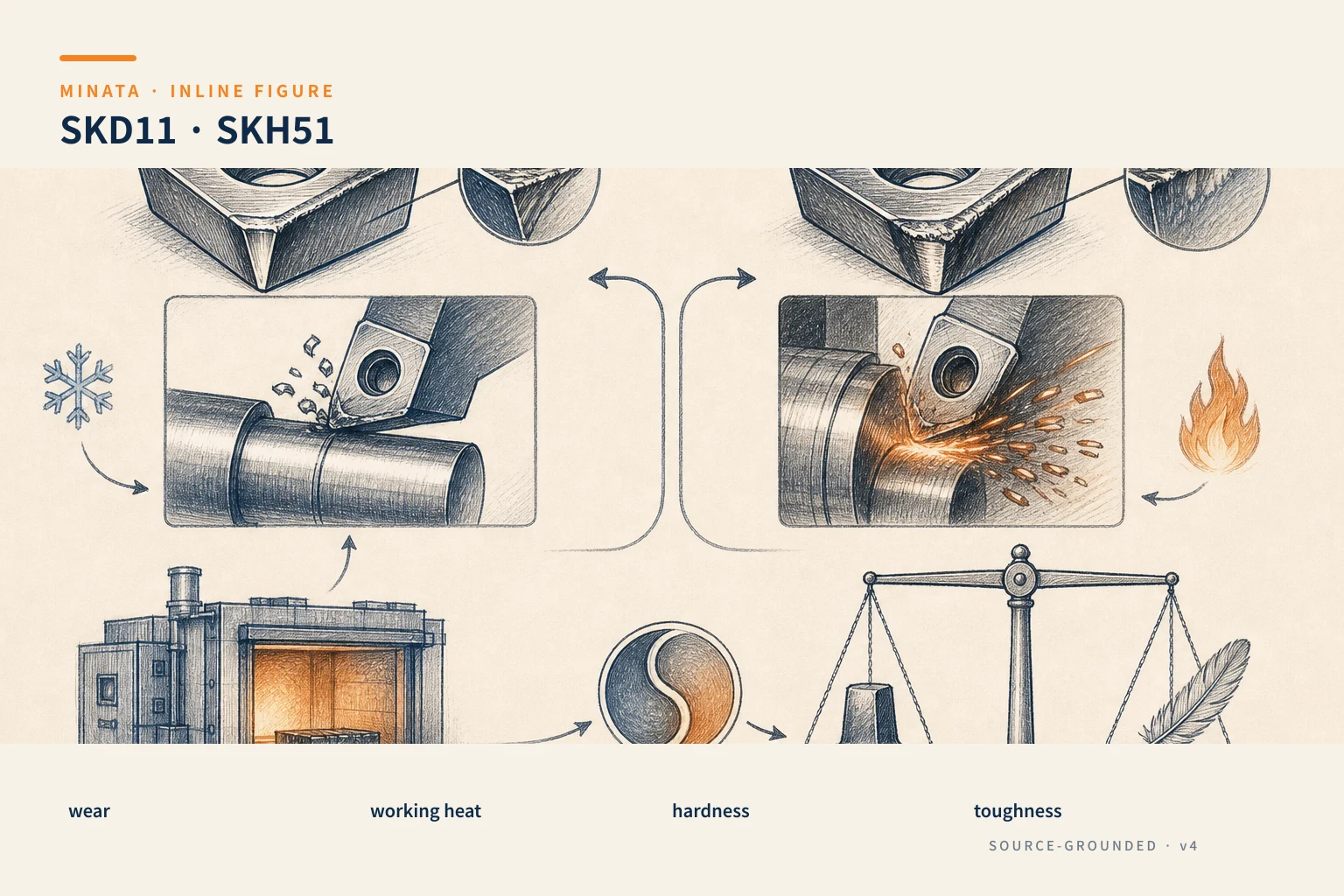
Why "wear resistance" is not enough to choose
Many people choose tool steel by hardness alone: harder means better wear resistance. True, but not enough. The second deciding factor is whether the part heats up while working. Steel generally softens when hot; the big difference between SKD11 and SKH51 lies in the ability to keep hardness at high temperature (hot hardness / red hardness).
- A part working at room temperature (cold stamping, cold cutting, measuring gauges) → cold wear dominates → SKD11.
- A part that generates heat while working (high-speed cutting, drilling, high friction) → must keep hardness when hot → SKH51.
If you use SKD11 for a high-speed cutting tool, the blade heats up, softens and wears very fast; SKH51 keeps its hardness so the edge lasts. Conversely, using SKH51 for a cold-stamping punch is paying for a property (hot hardness) the part never uses.
SKD11: the king of cold-wear parts
SKD11 is a high-chromium cold-work die steel, with many hard chromium carbides distributed in the matrix, giving excellent cold wear resistance and good dimensional stability after hardening. It is the classic grade for punches, cold-stamping dies, sheet-cutting blades, measuring gauges and wear-resistant parts at room temperature.
Advantages: very good wear resistance, holds a sharp edge long in cold work, dimensional stability after heat treatment (little distortion), reasonable cost. Disadvantages: only medium toughness so it can chip under strong impact loads, and it loses hardness when hot so it does not suit heat-generating work. When the part works cold and prioritizes wear resistance, SKD11 is almost always the right and economical choice.
SKH51: keeping hardness when hot for cutting tools
SKH51 is a high-speed steel containing tungsten, molybdenum, vanadium and chromium — elements that form heat-stable carbides. Thanks to this it keeps its hardness at high temperature (up to about 500–600°C), exactly the condition of a high-speed cutting-tool edge. It is the common grade for drills, milling cutters, turning tools, taps, and friction parts that generate heat.
Advantages: high hardness after hardening, keeps hardness when hot, holds a sharp edge in high-speed cutting, good toughness. Disadvantages: higher cost than SKD11, and for purely cold work the hot-hardness advantage is not used. When the part is both worn and hot, or is a cutting tool, SKH51 is the right choice despite the higher cost.
Choosing: start from the working temperature
The process:
- Does the part heat up while working? Yes (cutting, drilling, heat-generating friction) → SKH51. No (cold stamping, cold cutting) → SKD11.
- Prioritize cold wear resistance and dimensional stability? → SKD11.
- A high-speed metal-cutting tool? → SKH51.
- Is there a strong impact load? If so and both chip easily, consider a tougher tool-steel grade (e.g. an impact-resistant group) rather than choosing harder.
The deciding question is almost always the working temperature. Answering "does the part get hot" nearly finishes the choice between these two grades. Hardness and wear resistance at room temperature are good for both; temperature is where they diverge.
You must distinguish two kinds of heat: heat from the environment (the part placed near a furnace, a hot mold) and heat from the work itself (cutting friction, high speed). SKH51 handles both; SKD11 only suits when both kinds of heat are low. An ordinary cold-stamping part generates no significant heat so SKD11 is enough; but if the same part runs at a very high rate causing friction to accumulate heat, or sits in a hot line, reconsider. Measuring or estimating the real working temperature of the part surface is a step worth doing before locking the grade.
Heat treatment decides whether the tool steel performs
Tool steel only reaches its properties when heat-treated correctly. For the same grade, a wrong quench and temper give very different results:
- Quenching: heat to the austenitizing temperature then cool quickly to reach hardness. The quenching temperature and medium must follow the grade.
- Tempering: reheat at a lower temperature to reduce brittleness and stabilize the structure. SKH51 is usually tempered several times at high temperature (secondary hardening); SKD11 is tempered at a lower temperature.
Because a precise part is often wire-EDM cut after hardening, the process order must be correct: rough machining while soft → quench/temper → grinding and finish wire-cutting. If you finish-machine first then harden, the part distorts and loses dimension. The drawing should state the steel grade and the required hardness after hardening (e.g. 60±2 HRC) so the heat-treatment shop gets it right.
Example: reading three real parts
- A punch and die for holes in thin steel sheet, working cold, high volume: SKD11, hardened to ~60 HRC, contour wire-cut after hardening. Good cold wear resistance, holds the edge long.
- A drill and milling cutter machining steel: SKH51. The edge heats up during high-speed cutting and needs to keep hardness when hot.
- A measuring gauge checking dimensions: SKD11. Needs hardness, wear resistance from repeated rubbing and dimensional stability; generates no heat.
Trading hardness for toughness: do not choose too hard
With tool steel there is always a trade-off between hardness (wear resistance) and toughness (chip and crack resistance). Tempering at a low temperature gives the highest hardness but is more brittle; tempering higher reduces hardness a little to increase toughness. The target hardness must be balanced with the working load:
- A purely wear part, little impact → you can leave the hardness high (e.g. SKD11 ~60–62 HRC).
- A part both worn and impact-loaded, shock-loaded → lower the target hardness a little to increase toughness, avoiding mid-run chipping.
This is why "the hardest" is not always "the best." A stamping punch left too hard may resist wear well but chip immediately when it meets a hard or off-center workpiece. The skill is choosing hardness just enough for wear resistance while still tough for the real load. When impact is the main constraint, sometimes you must drop both these grades for a dedicated impact-resistant tool steel, accepting lower wear resistance.
The harder the steel, the more machining costs: account for it in price and order
Tool steel in the hardened state (58–65 HRC) is very hard to cut with ordinary tools; that is why the standard process is to machine most of it while the steel is still soft (annealed), then leave the precise contour for grinding and wire EDM after hardening. These two methods can cut hard material but are slower and more expensive than milling, so they must be accounted for in the price and time.
Practical consequences when planning:
- The allowance left after rough machining must be enough for the hardening distortion while still having material for grinding/wire-cutting, but not so much that it wastes post-hardening cutting.
- The precise contour, sharp corners and tight-tolerance holes for wire-cutting after hardening; reference flats for grinding after hardening.
- A large part needs consideration of stress and distortion during hardening; an asymmetric shape bows easily.
The way to read the drawing to plan the process sequence for a tool-steel part is like the SKD11 guide-plate example in Manufacturing Engineering #02 — CNC milling, turning or wire EDM: rough milling → harden → grind reference faces → wire-cut the contour.
Surface coating extends tool life
For an SKH51 tool, surface coating is a common way to extend life without changing the base material. Coatings like TiN (gold), TiCN, TiAlN create a harder surface, reduce friction and resist heat better, so a coated tool lasts significantly longer than a bare tool in high-speed cutting. For an SKD11 cold-wear part, some cases also coat or nitride the surface to increase wear resistance. When tool life is a big cost problem, consider surface coating before jumping to a more expensive steel grade — sometimes coating on the existing base is a cheaper and more effective solution.
Common mistakes
- Using SKD11 for a high-speed cutting tool. The edge heats up, softens and wears fast; you need SKH51.
- Using SKH51 for a cold-stamping punch. Paying for hot hardness never used; SKD11 is more economical.
- Choosing by hardness alone, ignoring the working temperature. This is the core mistake that causes a wrong choice.
- Wrong heat-treatment order. Finish-machining before hardening distorts the part and loses dimension.
- Omitting the required hardness after hardening on the drawing. The shop does not know how far to temper; the result is inconsistent.
- Ignoring toughness under strong impact; both grades chip easily, you may need a tougher grade.
Quick selection checklist
- [ ] Does the part heat up while working? Yes → SKH51; no → SKD11.
- [ ] A high-speed metal-cutting tool? → SKH51.
- [ ] Prioritize cold wear resistance and dimensional stability? → SKD11.
- [ ] Is there a strong impact load that causes chipping? Consider a tougher grade.
- [ ] Have you stated the steel grade and required hardness after hardening (HRC) on the drawing?
- [ ] Have you ordered the process sequence correctly around heat treatment (rough → harden → grind/wire-cut)?
If you need to choose tool steel for a wear-resistant part and are unsure about the heat factor, MINATA can advise the steel grade, hardness and process sequence by the real working conditions. See MINATA's Engineering & Manufacturing service.
Reference: the 鋼材ブランド対照表 and 材料の種類と用途 tables in the MISUMI technical catalog (FA用メカニカル標準部品); equivalent codes cross-referenced by AISI / DIN / JIS.
More in the Materials series
View all MINATA technical articles