Materials #13: Anodizing, Plating or Powder Coating — Choosing by Environment and Tolerance Stack
Materials #13: Anodizing, Plating or Powder Coating — Choosing Surface Treatment by Environment and Tolerance Stack
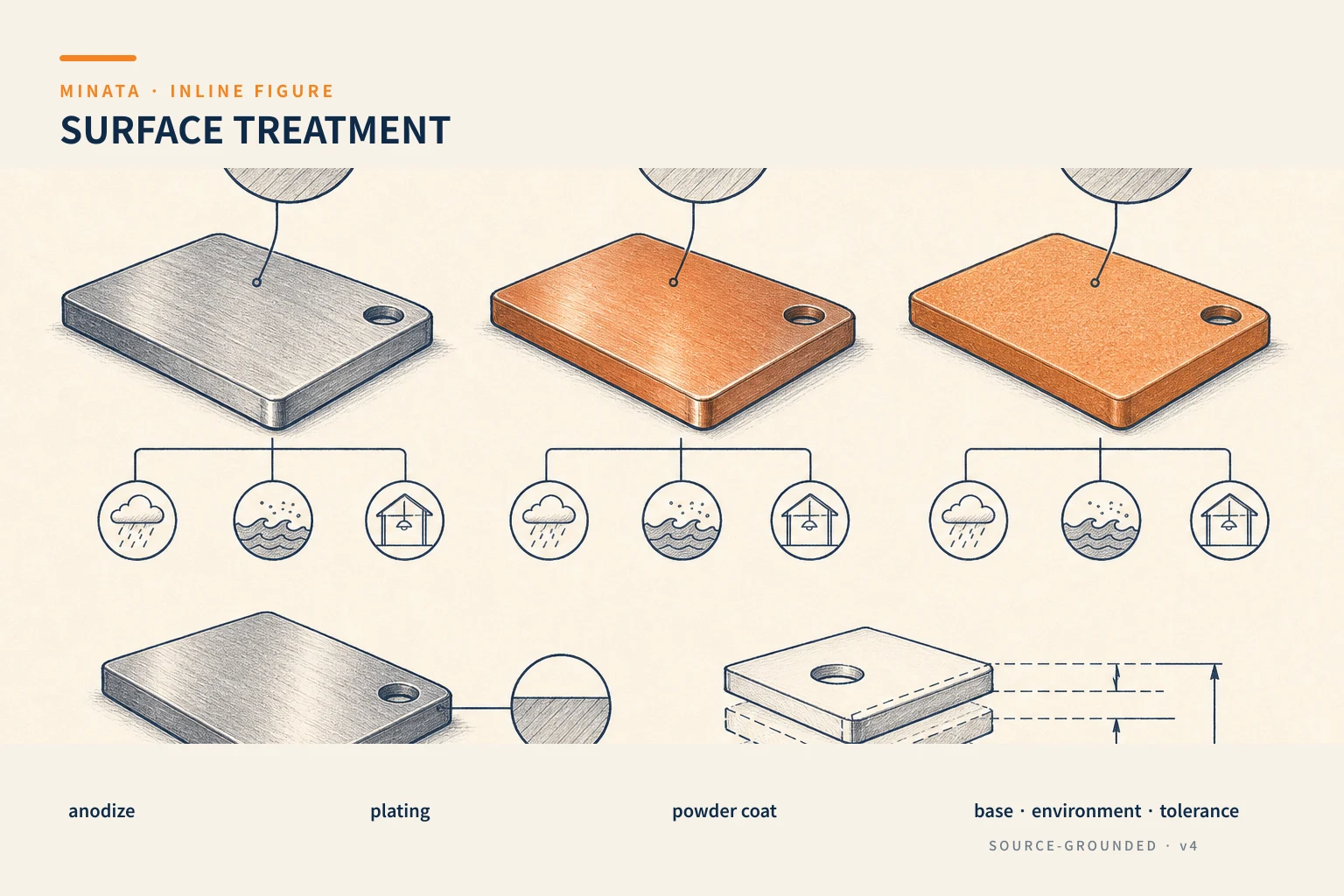
Short answer: choose anodizing for aluminum when you need corrosion resistance, wear resistance and to keep a precise tolerance; choose plating (zinc, nickel, chrome) for steel when you need rust protection or a specific surface property with a thin layer; choose powder coating when you prioritize color, low cost and large area where the tolerance is not too tight. These three groups all protect and finish the surface, but they differ in the suitable base material, the coating thickness (which affects tolerance), and the ability to withstand the environment. This article is written from the compare-to-choose angle, not repeating the detailed explanation of each method — for the Alodine and Alumite mechanisms, see the existing Materials and Machine Design series. Here the focus is on choosing by the working environment and the effect on the tolerance stack.
Quick comparison of the three surface-treatment groups
| Criterion | Anodizing | Plating (zinc/nickel/chrome) | Powder coating |
|---|
| Suitable base material | Aluminum (and aluminum alloys) | Steel, copper, some metals | Most metals |
| Mechanism | An oxide layer grown from the base itself | A metal layer plated onto the base | A plastic-powder layer applied and baked |
| Typical layer thickness | Thin (regular anodizing 3–10 µm; hard anodizing thicker) | Thin (zinc 3–20 µm, nickel/chrome 5–20 µm) | Thick (40–120 µm) |
| Effect on tolerance | Very small, predictable | Small, needs allowance | Large, needs significant allowance |
| Corrosion resistance | Good (aluminum) | Good to very good (depending on layer) | Good, depends on thickness and surface prep |
| Wear resistance | Good (hard anodizing very good) | Medium to good | Worse |
| Color | Limited, can be dyed | Few colors (metallic sheen) | Very varied |
| Surface conductivity | Insulating (except special types) | Conductive | Insulating |
| Cost | Medium | Medium to high | Low |
Reference table of parameters for some common coatings (suitable base, layer thickness, surface hardness):
| Coating | Suitable base | Layer thickness | Hardness (HV) | Main characteristic |
|---|
| Zinc plating | Steel | 3–20 µm | — | Rust protection, cheap, medium appearance |
| Trivalent chromate | Steel | 1–2 µm | — | Rust protection, hexavalent-chrome free |
| Nickel plating | Steel, copper, brass | 5–20 µm | ~500 | Corrosion resistance, decorative, an undercoat |
| Hard chrome plating | Steel | 10–30 µm | ~1000 | High wear resistance, for shafts/sliding faces |
| White anodizing (alumite) | Aluminum alloy | 3–5 µm | — | Corrosion resistance, insulating, heat resistant |
| Black anodizing (alumite) | Aluminum alloy | 5–10 µm | — | As above, with color; dyed through the oxide pores |
Source: the technical table "表面処理の種類と外観色" in the MISUMI catalog (FA用メカニカル標準部品). Hard anodizing gives a thicker, harder layer than regular anodizing; look up the figures with the supplier.
Start from the base material
The first eliminating factor is the base material, because it decides which method is feasible:
- Aluminum → anodizing is the natural choice (the oxide layer grows from the aluminum itself), or powder coating. Do not zinc-plate aluminum.
- Steel → plating (zinc for rust protection, nickel/chrome for function and aesthetics) or powder coating. Do not anodize steel.
- A large part, frame, enclosure with enough material → powder coating covers a large area, many colors, cheap.
This step alone narrows the options: an aluminum part reduces the question to anodizing or coating; a steel part to plating or coating. Only then do you balance the environment and tolerance.
The reason the base material decides so strongly is that each method's mechanism is fundamentally different. Anodizing does not add foreign material but converts the aluminum surface itself into a durable oxide layer — so only aluminum (and a few special metals) can be anodized, steel cannot. Plating coats a layer of another metal onto the base by electrolysis or chemically, suiting steel and many metals but not aluminum in the usual way. Powder coating applies a plastic-powder layer then melts it into a film, and is not fussy about the base so it works for most metals; this is why it is the most flexible on material but also the thickest and least wear-resistant.
Coating thickness and the tolerance stack
This is the most important technical point when choosing surface treatment for a precise part: the coating changes the dimension. For a mating part with a tight tolerance, you must count the coating into the tolerance stack:
- Anodizing gives a very thin, predictable layer; in particular, part of the oxide layer "grows inward" into the aluminum base so the dimension change is very small. This is why anodizing suits precise aluminum parts.
- Plating adds a metal layer to the surface, increasing the dimension; for a hole it decreases the diameter. The layer is thin but you still need an allowance for a tight-fit face.
- Powder coating is the thickest (can exceed 100 µm), changes the dimension significantly and unevenly. So do not powder-coat a precise mating face; you must mask the mating faces, threaded holes and reference faces before coating.
The principle: a functional face with a tight tolerance should either use a thin, predictable coating (anodizing, plating with an allowance), or be masked when coating. The drawing should state clearly whether the dimensions are measured before or after surface treatment, and which faces need masking. Ignoring this is a common cause of a part being correct when machined but not fitting after coating.
Choosing by the working environment
After the base material and tolerance, the environment decides which coating is durable enough:
- Indoor, dry: powder coating or zinc plating is enough; anodizing for aluminum.
- Humid, outdoor: zinc plating (possibly with chromate added) for steel, thick anodizing for aluminum; powder coating needs good surface prep.
- Strong corrosion (marine, chemical): you need a more durable layer — thick hard anodizing for aluminum, multi-layer plating for steel, or a combination (base plating + top coat).
- Friction, wear: hard anodizing for aluminum is very good; hard chrome plating for steel; powder coating is poor at wear resistance.
- Need for conductivity/grounding: paint and anodizing are usually insulating; if the part needs electrical contact you must mask the contact area or use a conductive treatment (e.g. conductive chromate for aluminum).
Choosing: combine the three factors
The process:
- What is the base material? Aluminum → anodizing/coating. Steel → plating/coating.
- Is the coated face a precise mating face? Yes → a thin predictable layer (anodizing/plating with allowance) or masked when coating.
- How harsh is the environment? The more corrosion/wear → a more durable layer (hard anodizing, multi-layer plating).
- Need varied color, large area, low cost? → powder coating (mask the functional faces).
- Need surface conductivity? Yes → avoid paint/regular anodizing in the contact area.
Example: reading three real parts
- An outdoor aluminum machine enclosure, needing rust protection and precise mounting holes: anodizing. The thin layer does not break the hole tolerance, good corrosion resistance for aluminum, can be dyed.
- An indoor steel bracket, needing to look good and have many colors, wide tolerance: powder coating. Cheap, many colors, mask the threaded holes and mating faces before coating.
- A small steel part needing rust protection, precise fit: thin zinc plating with an allowance for the mating face, or mask the functional face.
Not every "anodizing" or "plating" is the same
Within each group there are many variants, and choosing the right variant matters as much as choosing the right group:
For anodizing on aluminum, two common types are regular anodizing (sulfuric, thin layer, can be dyed, for decoration and light corrosion resistance) and hard anodizing (a much thicker and harder layer, for wear resistance and harsh environments). Hard anodizing is thicker so it affects the tolerance more than regular anodizing, which must be counted when the part needs a tight fit. If the aluminum part sees friction and wear (a sliding groove, a moving contact face), hard anodizing is the choice; if it only needs to look good and resist light rust, regular anodizing is enough and cheaper.
For plating on steel, each type serves a different purpose: zinc plating is mainly rust protection (sacrificial protection of the base), usually with an added chromate layer for durability; nickel plating for corrosion resistance and as an undercoat for another layer; hard chrome plating for wear resistance (shafts, sliding parts); decorative chrome plating for aesthetics. Choosing the plating type must follow the function: for plain rust protection, zinc is cheap and enough; for wear resistance, hard chrome; for a metallic-sheen aesthetic, nickel/decorative chrome. Saying "plating" generically without stating the type leaves an important decision open.
Cost, volume and process arrangement
Surface treatment is usually outsourced by lot, so the cost and time depend on the quantity and arrangement:
- Powder coating is cheap per unit area and suits large lots, but needs preparation time (hanging, masking, baking); a small lot still pays the setup cost.
- Anodizing and plating are priced by area and quantity; many small parts are fixtured and processed in batches.
- Masking is manual work, costing money and time; the more faces need masking, the higher the cost. Designing the part so few faces need masking (grouping functional faces on one side) helps reduce the surface-treatment cost.
One optimization: group parts of the same material and treatment type to process in one batch, and design to reduce the number of faces needing masking. The process arrangement also matters — surface treatment is usually near the last step, after the functional faces are machined; but if there is a press-fit or machining step after treatment, you must plan the order so the coating is not damaged or does not break the fit tolerance.
Combining multiple layers for a harsh environment
For a strongly corrosive environment, sometimes one layer is not enough and you must combine: base plating for rust protection then a top coat for color and more protection, or anodizing then an added sealing layer for more corrosion resistance. Combining layers gives higher durability but increases cost and complexity, and each layer adds more thickness to the tolerance stack. Use it only when the environment truly demands it; for normal conditions, one suitable layer is enough and more economical.
Common mistakes
- Powder-coating a precise mating face without masking; the thick paint layer breaks the tolerance and the part does not fit.
- Not stating whether dimensions are measured before or after surface treatment. The shop and customer understand it differently.
- Choosing wrong by base material (zinc plating for aluminum, anodizing for steel) — not feasible.
- Using powder coating for a high-friction/wear part; the paint layer wears fast, so use hard anodizing or chrome plating.
- Forgetting the conductivity/grounding requirement; an insulating coating over an area that needs electrical contact.
- Ignoring surface preparation (cleaning, degreasing, base treatment); however nice the coating, it peels if the base is dirty.
Quick selection checklist
- [ ] Is the base material aluminum or steel? (eliminate the infeasible option first)
- [ ] Is the coated face a precise mating face? Yes → a thin layer or masked when coating.
- [ ] Have you counted the coating thickness into the tolerance stack and added an allowance?
- [ ] How harsh is the working environment (humid, marine, chemical, wear)?
- [ ] Need color, large area, low cost? → powder coating.
- [ ] Is there an area needing conductivity/grounding that must be masked?
- [ ] Have you stated on the drawing whether dimensions are before/after treatment and which faces to mask?
For how to choose an aluminum grade suited to anodizing, see Materials #11 — Aluminum A5052, A6061 and A7075. Details of the Alodine, Alumite mechanisms and surface treatment in design are already in MINATA's Mechanical section. If you need to choose a surface treatment balancing the environment, tolerance and cost for a specific part, MINATA can advise by the real drawing. See MINATA's Engineering & Manufacturing service.
More in the Materials series
View all MINATA technical articles