Technical Japanese #21 — How to Read a Japanese Drawing Title Block (表題欄)
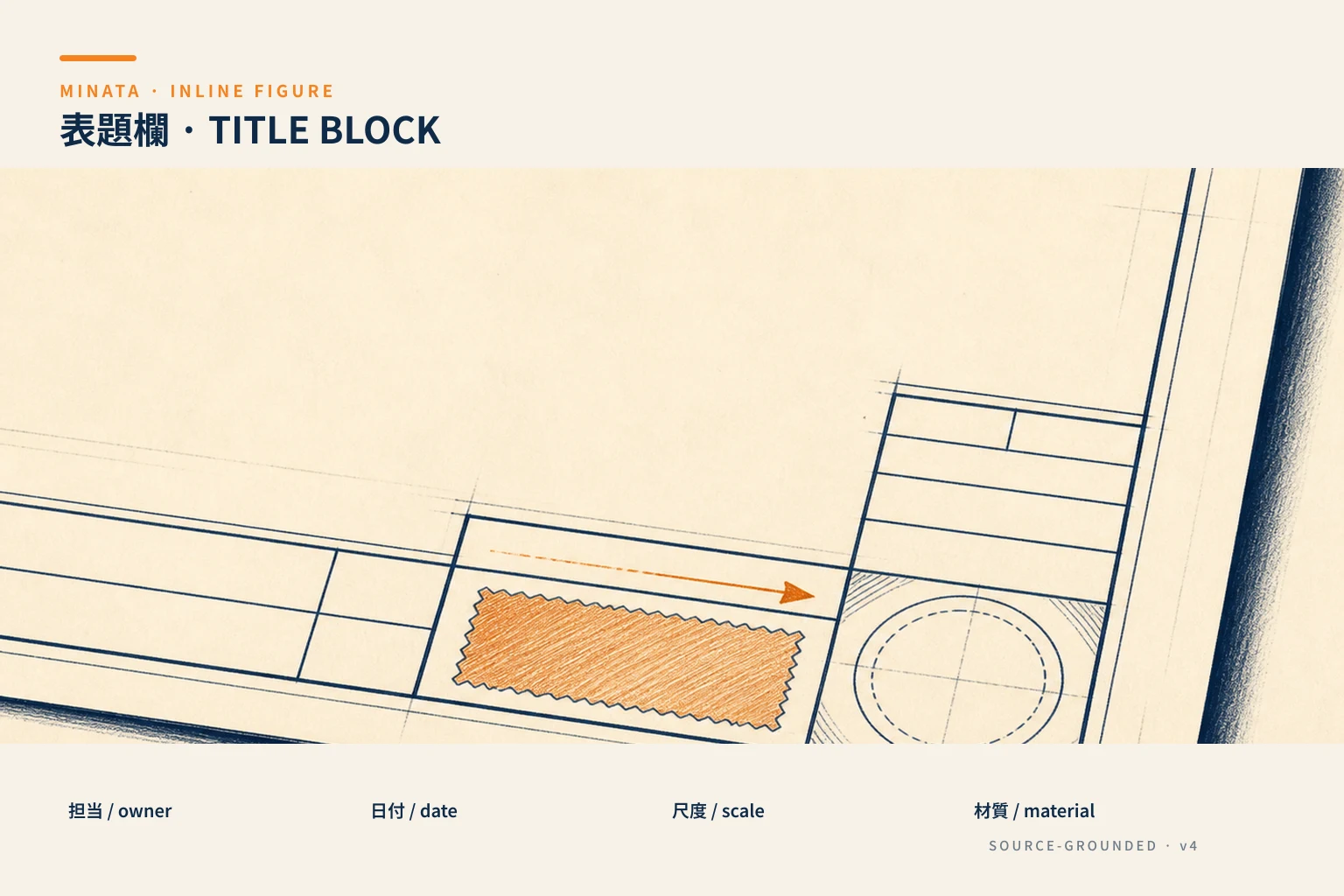
Before you read a single dimension, read the 表題欄 in the bottom right corner. That is where the part name, material, scale, revision and approval live — the information that tells you whether you are holding the right drawing, at the right revision, at all. This post goes box by box.
Core vocabulary of the title block
| Japanese | Reading | Meaning | Where in the block | Note |
|---|
| 表題欄 | ひょうだいらん hyōdairan | title block | Bottom right corner | The block itself |
| 品名 | ひんめい hinmei | part name | Large field | What the object is |
| 図番 | ずばん zuban | drawing number | Code field | Drawing No. |
| 品番 | ひんばん hinban | part number | Next to 品名 | Part No. |
| 材質 | ざいしつ zaishitsu | material | Material field | SUS304, S45C and so on |
| 尺度 | しゃくど shakudo | scale | Scale field | 1:1, 1:2, 2:1 |
| 単位 | たんい tan'i | unit | Usually mm | For the dimensions |
| 個数 | こすう kosū | quantity | Count field | Pieces per set |
| 質量 | しつりょう shitsuryō | mass | Weight field | kg |
| 日付 | ひづけ hizuke | date | Date field | Year, month, day |
| 作図 | さくず sakuzu | drawn by | Signature field | The designer |
| 検図 | けんず kenzu | checked by | Signature field | The checker |
| 承認 | しょうにん shōnin | approved by | Signature field | The approver |
| 版 / 改訂 | はん / かいてい han / kaitei | revision | Rev field | A, B, 1, 2 and so on |
| 表面処理 | ひょうめんしょり hyōmen shori | surface treatment | Notes | See #15 |
| 熱処理 | ねつしょり netsu shori | heat treatment | Notes | Quenching and the rest |
| 社名 | しゃめい shamei | company name | Logo field | Who owns the drawing |
The boxes that matter most
- 図番 is the unique identifier. In any conversation, refer to the drawing by its 図番, never by its name.
- 改訂 / 版 is the revision: A→B→C, or 1→2. An old revision is a dead drawing. Always confirm you are on the 最新版, the latest one.
- 尺度 is the scale.
1:2 means the picture is half the size of the real part, so never measure the paper. Read the printed 寸法. - 材質 is fixed, as in #15. A change goes through 設計.
- 承認 is the approval. A drawing without the approval stamp may be a draft, and a draft must not go into production.
Phrases by situation
Confirming you have the right drawing
- この図面は最新版ですか。 — Is this drawing the latest revision?
- 図番を確認させてください。 — Let me confirm the drawing number.
- 承認済みの図面ですか。 — Is this an approved drawing?
Asking about the title block
- 材質は何になっていますか。 — What material is specified?
- 尺度はいくつですか。 — What is the scale?
Mistakes to avoid
| Mistake | Why it hurts |
|---|
| Working from an old revision because the 改訂 box was never read | You machine to dimensions that have since been changed |
| Measuring the paper when 尺度 is not 1:1 | Every figure you take is wrong |
| Ignoring the 承認 box | Putting an unapproved draft into production is a serious process failure |
Read it, then act — quick self-check
The engineer hands you a drawing and says: 「図番と改訂を確認して、最新版か見ておいて。」
<details><summary>Answer</summary>Check the drawing number (図番) and the revision (改訂), and confirm it is the latest revision (最新版) before any work starts.</details>
The 尺度 says 1:2 and the part measures 50 mm on the paper. What is the real size?
<details><summary>Answer</summary>At 1:2 the picture is half size, so the part is around 100 mm. But always read the printed 寸法 rather than scaling from the paper.</details>
How MINATA helps
Received a stack of Japanese drawings and need the right revision, material and scope established before you quote or machine? MINATA checks the 表題欄, audits the revisions and standardises the technical file across Japanese and Vietnamese. See our Japan–Vietnam projects or engineering and production services.
View all MINATA technical articles