Technical Japanese #25 — Reading a Japanese Work Instruction (作業手順書)
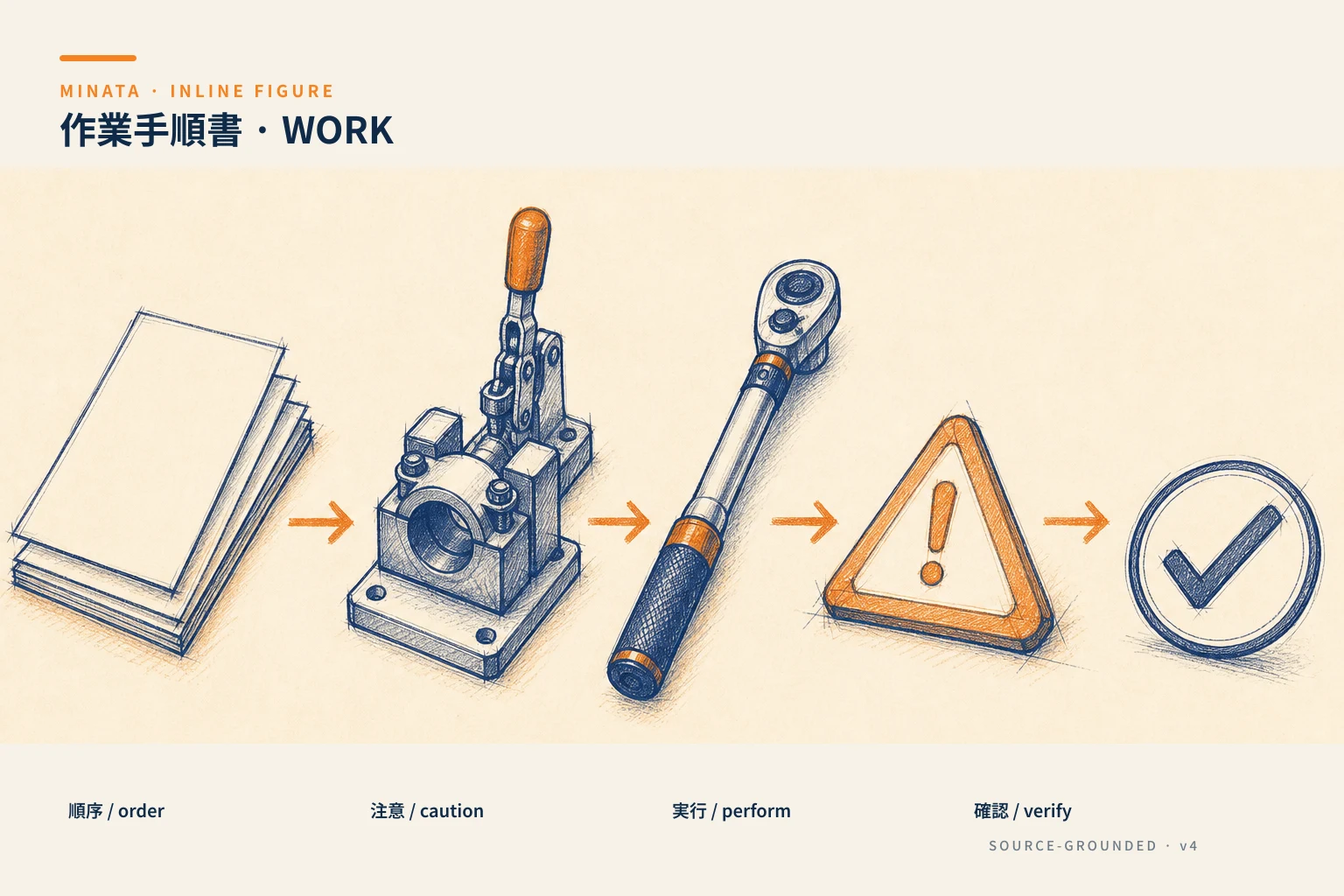
The 作業手順書 states how this job is done, in what order, and what to watch out for. In a Japanese plant, doing it differently without asking is a discipline issue — even when the result looks acceptable. This post shows how to read it and stay on it, step by step.
Core vocabulary of the 作業手順書
| Japanese | Reading | Meaning | In the document | Note |
|---|
| 作業手順書 | さぎょうてじゅんしょ sagyō tejunsho | work instruction | 手順書に従う | The SOP |
| 作業 | さぎょう sagyō | task, operation | 作業を開始 | The work itself |
| 手順 | てじゅん tejun | procedure, steps | 手順①〜⑤ | The steps |
| 順序 | じゅんじょ junjo | order, sequence | 順序を守る | Keep to the order |
| 急所 / ポイント | きゅうしょ kyūsho | key point | 作業の急所 | The point that decides the result |
| 理由 | りゆう riyū | reason | 急所の理由 | Why the key point matters |
| 準備 | じゅんび junbi | preparation | 準備するもの | What to have ready |
| 治具・工具 | じぐ・こうぐ jigu / kōgu | jigs and tools | 使用工具 | Jig and tool used |
| 注意 | ちゅうい chūi | caution | 注意事項 | Points of caution |
| 禁止 | きんし kinshi | prohibited | 手を入れる禁止 | Do not do this |
| 確認 | かくにん kakunin | confirmation | 確認すること | Check this |
| 保護具 | ほごぐ hogogu | protective equipment | 保護具着用 | PPE required |
| 完了 | かんりょう kanryō | completed | 作業完了 | Done |
| 記入 | きにゅう kinyū | fill in | チェック記入 | Enter it on the sheet |
| 異常 | いじょう ijō | abnormality | 異常時は停止 | Stop if it happens |
| 勝手に禁止 | かってに katte ni | no unilateral change | 勝手に変更禁止 | Never change it on your own |
The structure of a 作業手順書
The columns are usually 手順 (step), 作業内容 (what is done), 急所 (the key point), 理由 (why), 使用工具 (tools) and 確認 (check).
The 急所 column is the expensive one. It tells you what will go wrong if you get it wrong — 「締めすぎ注意」 (do not over-tighten), 「向きに注意」 (watch the orientation). Reading the 急所 carefully matters more than skimming the whole page.
The golden rule: 手順 is binding
- Follow the order (順序). Many steps carry a safety or quality reason that is not obvious from the step itself.
- Do not change it yourself (勝手に変更禁止). If the 手順 looks wrong, raise it through 改善 (see #39) rather than deviating.
- When something abnormal (異常) happens, stop and report as instructed. Do not improvise.
Phrases by situation
Confirming and asking
- この作業の急所はどこですか。 — Where is the key point in this job?
- 手順書通りで合っていますか。 — Am I following the work instruction correctly?
- 保護具は何が必要ですか。 — What protective equipment is needed?
When you want to do it differently
- 手順を変えてもいいですか。 — May I change the sequence? Always ask first.
Mistakes to avoid
| Mistake | Why it hurts |
|---|
| Skipping the 急所 column because it is long | You complete every step but miss the point that decides the outcome — orientation, torque |
| Reordering the 順序 to go faster | It breaks the SOP and often the safety logic behind it |
| Not filling in the 確認 box after each step | You lose the evidence that the job was done correctly |
Read it, then act — quick self-check
Step 3 reads: 作業内容「ボルト締付」/急所「対角順・規定トルク」/理由「歪み防止」. What do you do?
<details><summary>Answer</summary>Tighten the bolts in a diagonal sequence (対角順) to the specified torque (規定トルク), because the reason is preventing distortion (歪み防止). Going round in order, or over-tightening, both miss the 急所.</details>
The supervisor says: 「手順を勝手に変えないで。変えたいなら改善で出して。」
<details><summary>Answer</summary>Do not change the sequence on your own. If you want it changed, propose it through the improvement (改善) channel.</details>
How MINATA helps
Do you need a 作業手順書 written or translated into a bilingual Japanese–Vietnamese form so the operating team gets it right from day one? MINATA standardises SOPs with clear 急所 and 理由 columns and photographs of the actual operation. See our Japan–Vietnam projects or engineering and production services.
View all MINATA technical articles