Device Selection #06: Temperature Sensors — Type-K Thermocouple, Pt100 or NTC?
Choose a type-K thermocouple when the measurement point is at high temperature, needs a rugged probe for heating/furnace/mold, and the controller supports the correct K input. Choose a Pt100 (RTD) when you need stability, interchangeability and good accuracy within a suitable industrial temperature range; choose an NTC when measuring in a narrower range, needing a sensitive response to small changes, or when the electronics/manufacturer has already designed a circuit to read an NTC resistance. A sensor must not be chosen by "how many degrees it can measure" alone: the probe type, the wiring, the mounting point and the controller's input decide whether the reading is usable.
The temperature shown on the HMI is the result of the whole chain: medium → probe → wire → module/controller → scaling/algorithm. Mounting in the wrong spot or matching the wrong input can give a very stable number that does not represent the temperature the process needs to control. This article compares the three common options by the measurement task and lists the steps to lock down before putting a part number into the BOM.
Quick comparison
| Criterion | Type-K thermocouple | Pt100 (RTD) | NTC thermistor |
|---|
| Electrical quantity | Thermoelectric EMF between two materials | Platinum resistance changing with temperature | Semiconductor resistance falling as temperature rises |
| Main strength | Suits high temperature, varied probes, widespread | Stable, repeatable and well standardized | Sensitive in the designed working zone, compact |
| Point to check carefully | Correct K from probe to compensating wire, cold-junction compensation | Pt100/JPt100, 2/3/4-wire, class and lead resistance | Nominal value, Beta/Steinhart-Hart curve, read circuit |
| Suits typical application | Furnace, heater, mold, hot surface, hot gas | Tanks/processes needing stable control, industrial probes | Device thermal protection, electronic modules, OEM probes in a narrow range |
| Risk when replaced wrongly | Wrong thermocouple type or extension wire | Confusing Pt100 with JPt100, error from 2-wire | Same "10 kΩ" but a different curve, wrong scaling |
| Output type to controller | mV signal specific to a thermocouple input | Resistance signal specific to an RTD input | Resistance; usually needs a thermistor input/suitable divider circuit |
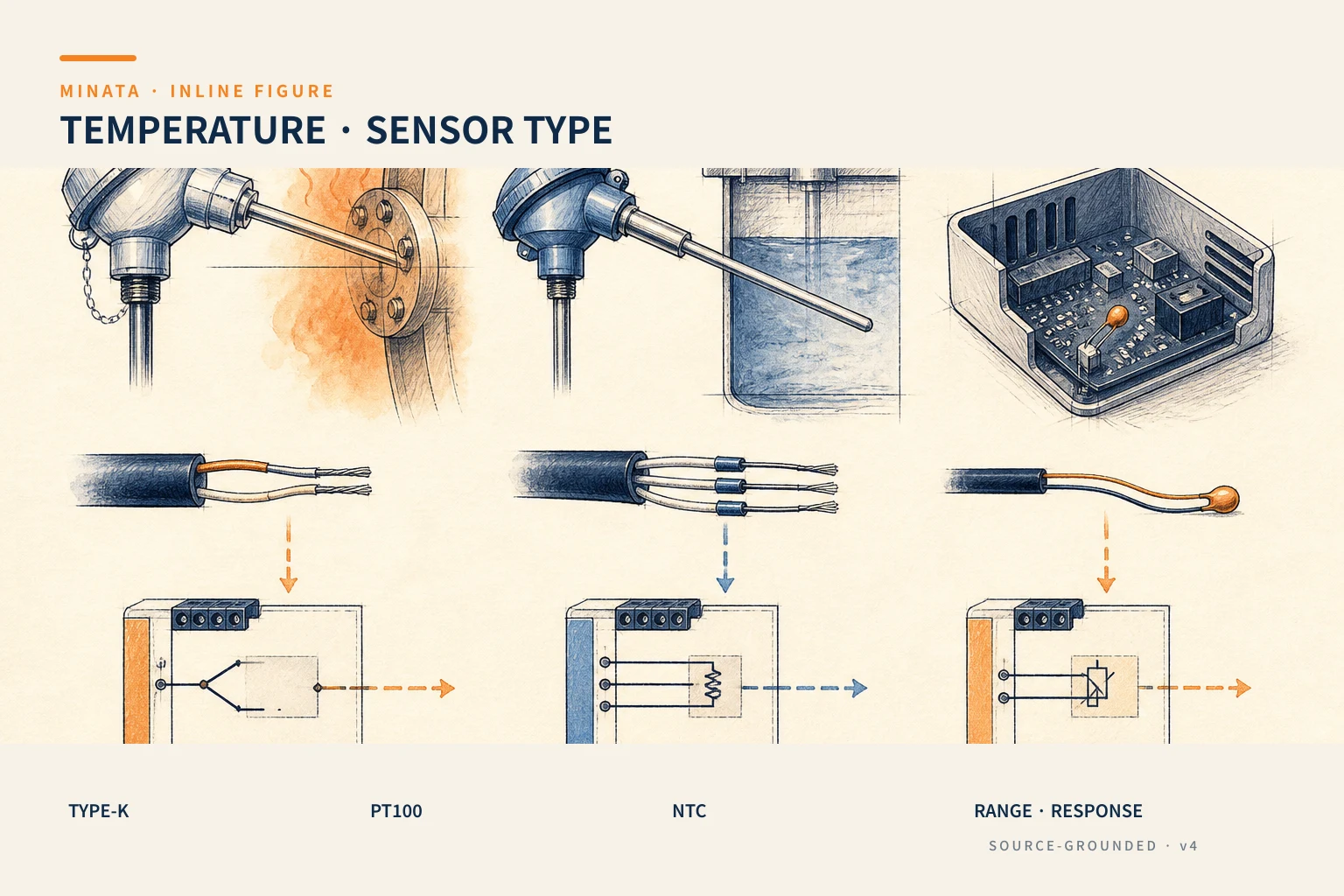
Step one: define which temperature must be controlled
Before talking about K, Pt100 or NTC, define the object to be measured:
- The temperature of the medium in a tank/pipe can differ significantly from the vessel wall or heating jacket temperature.
- The mold surface temperature varies with the depth of the mounting hole, thermal paste, clamping force and machine cycle.
- The heater temperature must be limited to protect the heating element, while the product temperature may need a different sensor.
- The air temperature in an electrical cabinet does not reflect the temperature at a power semiconductor or a winding if the airflow takes the wrong path.
Then lock the conditions: normal and abnormal operating temperature range, required accuracy/repeatability, response time, medium (water, oil, gas, food, chemical), pressure, thread/flange type, immersion length and maintenance space. This is the information to choose the whole probe assembly; choose a "temperature sensor" only last.
Type-K thermocouple: preferred when the problem is high temperature and practicality
A thermocouple produces a small thermoelectric voltage from the temperature difference between the measuring junction and the reference end. Type K is the basic thermocouple used very widely in industry; the OMRON controller catalog lists K among the thermocouple inputs and relates this input type to JIS C 1602/IEC 584-1 on the corresponding models. Its advantage is that the probe can be used at high temperatures depending on construction, responds well with a suitable junction/sheath, and is easy to find in many mounting shapes.
Choose K when:
- The temperature, medium type or mounting position exceeds the suitable range of the intended RTD/NTC.
- The application is a furnace, mold, heater, hot-gas pipe, or a heat point with a high thermal load.
- The controller/module has a dedicated K input and the maintenance team is familiar with thermocouple compensating wire/connectors.
- You need a metal probe that withstands the industrial environment, but will still check the sheath and thermowell material against the medium.
A type-K thermocouple is not automatically "right" just because the controller displays a temperature. The three points below must be treated as part of the design.
Wire type and cold-junction compensation
Because a thermocouple's signal is a very small thermoelectric voltage, the extension/compensating cable, the connectors and the junction points can all add error if the wrong type is used. Do not splice arbitrary copper wire between the K probe and the input and expect the controller to correct it. The controller must know the input is K and perform cold-junction compensation at the input point per its configuration; the connector/cable must follow the manufacturer's specification. When the wire runs through a zone of unusual temperature or near power cables, the wiring route must be treated as a measurement risk.
Junction, sheath and response speed
A grounded or ungrounded (insulated) tip, the sheath diameter, the immersion depth and the protection type change both the response and the durability. A small tip may capture heat faster but is more fragile in a vibrating/corrosive environment; a thermowell improves probe replaceability on a pressurized system but adds thermal inertia. No single configuration wins for every application. The probe datasheet must be cross-checked against the temperature, pressure, chemicals and flow rate at the mounting point.
Drift over time and checking the measurement chain
At high temperature, the ageing of the junction, sheath protection and oxidation conditions can change the result. For a process with important quality/safety limits, plan to check the probe and compare it with a reference standard. Do not compensate by adjusting a controller offset before you know whether the error is at the probe, the wire, the module or the mounting position.
Pt100: the choice to prioritize stability and interchangeability
Pt100 is a platinum RTD with a nominal resistance of 100 Ω at 0 °C in the common IEC system. IEC 60751 specifies the temperature-resistance relationship and requirements for industrial platinum resistance thermometers; OMRON also lists Pt100 and JPt100 as two separate input options on their controllers. The point to remember: Pt100 is the name of a sensor system/characteristic curve, and does not by itself say enough about the class, number of wires, sheath or temperature limit of the actual probe.
Choose Pt100 when:
- The process needs a stable, repeatable result and easy probe replacement to a common standard.
- The working temperature range sits within the capability of the very Pt100 probe you choose, including sheath and wire material.
- There is an RTD controller/module of the correct Pt100 type and you can wire it correctly as 3 or 4-wire when needed.
- Comparing multiple positions, calibration and long-term maintenance matter more than using a cheap sensor in an OEM device.
Do not overlook Pt100, JPt100 and the controller standard
Pt100 and JPt100 do not use the same characteristic curve. Some controllers have a separate configuration entry for each type, so replacing an old probe with a Pt100 while leaving the input on JPt100 can create a systematic error. Check the module label, the controller setting and the device documentation before replacing. If the project requires IEC 60751, state that along with the class in the specification, rather than just writing "RTD 100 Ω".
2-wire, 3-wire, 4-wire: this is a wiring decision
The lead cable resistance is added to the probe resistance. The 2-wire type is simple, but the lead error grows with the length and the wire temperature. The 3-wire type lets the controller compensate on the assumption that the leads have equal resistance; 4-wire uses two current-supply wires and two measuring wires, suited when you need to remove lead-resistance effects better. Which type to choose must follow the actual input capability and the allowable error, then run the correct number of cores to the cabinet.
Do not join two wires right at the probe to "temporarily" use a 3-wire input. This configuration defeats the purpose of lead-resistance compensation. Similarly, using a connector/terminal unsuited to the environment can create a poor contact, making the reading jump even though the Pt100 element is still good.
Class, construction and mounting position
IEC 60751 has tolerance classes; the specific document/model states the applicable class. A better class does not cure a wrong-position mounting error. In a stirred tank, a probe placed too close to the wall may read the vessel temperature; in a pipe, a probe immersed too shallow may read the pipe wall temperature; in a mold, the distance to the water channel decides the sensed temperature. Drawing the immersion depth and the measuring point clearly on the process/mechanical drawing is a practical way to let the element accuracy pay off.
NTC: effective when the system is designed for it
An NTC is a thermistor whose resistance falls as temperature rises. It is very sensitive in the temperature zone the manufacturer designs for and is usually compact, suited to electronic modules, over-temperature protection, batteries, motors or OEM devices. That sensitivity does not make an NTC a direct replacement for a Pt100 or K: the NTC's resistance-temperature curve depends on the model, the nominal resistance and the published constant/characteristic.
Choose NTC when:
- The board/controller already has an NTC input and states the required value/curve.
- The goal is monitoring or protection within a temperature range supported by the element manufacturer.
- You need a small sensor tip that can sit near electronic components or inside an OEM assembly.
- You can verify the compatibility of the nominal resistance, the curve and the software scaling mechanism.
The biggest risk is thinking every "10 kΩ" NTC is interchangeable. That value is usually stated at a reference temperature, while the curve parameters and tolerance can differ. If the HMI/controller reads wrong after replacing an NTC, do not correct it with a single-point offset: two different curves may be close at room temperature but diverge at operating temperature.
Another risk is self-heating. The measuring circuit passes current/voltage through the thermistor; if the reading method, dissipated power or heat-sinking environment is wrong, the element can warm up because of the measurement itself. The datasheet must be the deciding source for the measuring current, power and mounting conditions.
Comparison by five purchasing questions
1. What are the highest and lowest temperatures, at the probe itself?
Do not use the setpoint temperature as the only design temperature. Account for overshoot, a heater fault, the process stopping the fan, the temperature at the terminal, and the cable temperature. A type-K thermocouple often appears early on the list when temperature is high; Pt100/NTC are considered when the real range suits the chosen probe construction.
2. Do you need to control, monitor or protect?
Temperature control needs stability in the setpoint zone and a representative measuring position. Alarm monitoring may prioritize durability and trend detection. Over-temperature protection must consider response time, wire/sensor fault state and the controller's fail-safe logic. A probe that controls a slow tank well may not be fast enough to protect a small heater.
3. What medium does the probe touch?
Choose the sheath, seal, thread and thermowell material by water, steam, oil, chemicals, food or gas. The rated temperature on a table does not say the probe withstands every medium. If the system is sealed/pressurized, the mechanical construction and the probe-replacement procedure must be designed before ordering.
4. What can the existing input read?
Check the I/O card/controller: type-K thermocouple and Pt100 RTD need the correct input/configuration; NTC usually needs a circuit or input dedicated to a thermistor. Record the wiring, sensor type, scaling, unit, alarm limit and the wire-break handling state in the I/O list. Do not use a signal converter as a way to mask an incompatible input before determining the error and power requirements of the whole chain.
5. How much lag is allowed?
A thick probe, a thermowell, a mounting gap and a large metal mass all create thermal inertia. A probe's response time is a spec under test conditions; the real process has a different medium and flow rate. Commission with a controlled step change or compare with a reference sensor at an equivalent position before locking the PID/alarm parameters.
Three sensible selection examples
A heated mold: use a type-K thermocouple or a Pt100 depending on the temperature range, accuracy and controller. More important is the mounting hole, the depth placing the junction/RTD tip near the zone to check, a suitable paste/thread, and a protected wire. Do not choose an NTC just for the small tip if the controller has no correct NTC curve.
A recirculating water tank at moderate temperature: a 3-wire/4-wire Pt100 usually suits when stable control and long-term replacement are needed, with a water-suitable sheath/thread. Place the probe in a representative recirculating flow rather than against the vessel wall; check the wire and terminal temperature if the environment is hot/humid.
Over-temperature protection in a power module: an NTC of the exact value/characteristic the board requires can be the compact choice. The board and NTC datasheets must be read together; do not switch to Pt100/K because the software does not automatically understand the new element type.
Common mistakes when putting a temperature sensor into a machine
- Setting the wrong input type on the controller. Pt100, JPt100 and K are separate configurations; re-check after replacing a probe or a module.
- Wiring 2-wire for a long cable run and expecting a 3/4-wire result. You must evaluate the lead resistance and the accuracy requirement.
- Using ordinary wire for a thermocouple on the extension section. Use the accessory/wire specified for the thermocouple system.
- Choosing a good class but mounting the probe in the wrong position. Element accuracy does not substitute for measuring-point design.
- Replacing an NTC by nominal resistance alone. You need the correct curve, tolerance and read-circuit configuration.
- Ignoring wire-break/sensor-fault detection. Verify the alarm response and output state when the probe is disconnected during FAT/SAT.
Quick selection checklist
- [ ] Have you defined which medium/surface temperature must be measured, not just a generic temperature?
- [ ] Are the normal and abnormal temperature ranges at the probe clearly recorded?
- [ ] Do you need a type-K thermocouple, Pt100 or NTC based on the measurement task and the actual input?
- [ ] For K, are the extension wire/connector and cold-junction compensation the correct type?
- [ ] For Pt100, is the controller set to Pt100 or JPt100, and is the 2/3/4-wire correct?
- [ ] For NTC, are the reference value, curve and read circuit correct for the model?
- [ ] Are the sheath, thermowell, thread, seal and immersion depth suited to the medium/pressure?
- [ ] Have you tested the lag, alarm and wire-break response before operation?
If you are choosing a probe and controller for a heating system, a recirculating tank or device thermal monitoring, MINATA can review the temperature range, mounting point, I/O and maintenance requirements with you before locking the BOM. See MINATA's Engineering & Manufacturing service.
References
More in the Device Selection series
View all MINATA technical articles