Manufacturing Engineering #03: Laser, Plasma or Waterjet Cutting — Choosing by Material and Thickness
Short answer: choose laser cutting for thin-to-medium sheet metal (steel ≤ 20–25 mm, thin stainless and aluminum) when you need a clean edge and high accuracy; choose plasma cutting for thick steel plate, fast and cheap when you do not need a very fine edge; choose waterjet cutting when the material cannot withstand heat, when it is very thick, or when cutting a non-metal such as stone, glass, composite. The three methods all cut a 2D profile from sheet, but they differ in the thickness band, edge quality and heat effect. This article helps you look at the material and thickness and choose the right method, avoiding paying a fine-cut price for a part that only needs rough cutting, or the reverse.
Quick comparison of the three sheet-cutting methods
| Criterion | Laser | Plasma | Waterjet |
|---|
| Material | Metals (steel, stainless, aluminum), some non-metals | Conductive metals | Almost any material, including non-metals |
| Economical thickness | 0.5–25 mm (steel) | 6–50 mm and thicker | 1–150 mm and thicker |
| Profile accuracy | ±0.05–0.1 mm | ±0.5–1 mm | ±0.1–0.2 mm |
| Kerf width | Very narrow (~0.1–0.4 mm) | Wide (~1.5–4 mm) | Narrow (~0.8–1.2 mm) |
| Heat-affected zone (HAZ) | Small | Large | None (cold cutting) |
| Cut edge | Clean, square | Dross, slightly beveled | Clean, slightly rough on the bottom |
| Speed on thick plate | Slow when thick | Very fast | Slow |
| Operating cost | Medium | Low | High |
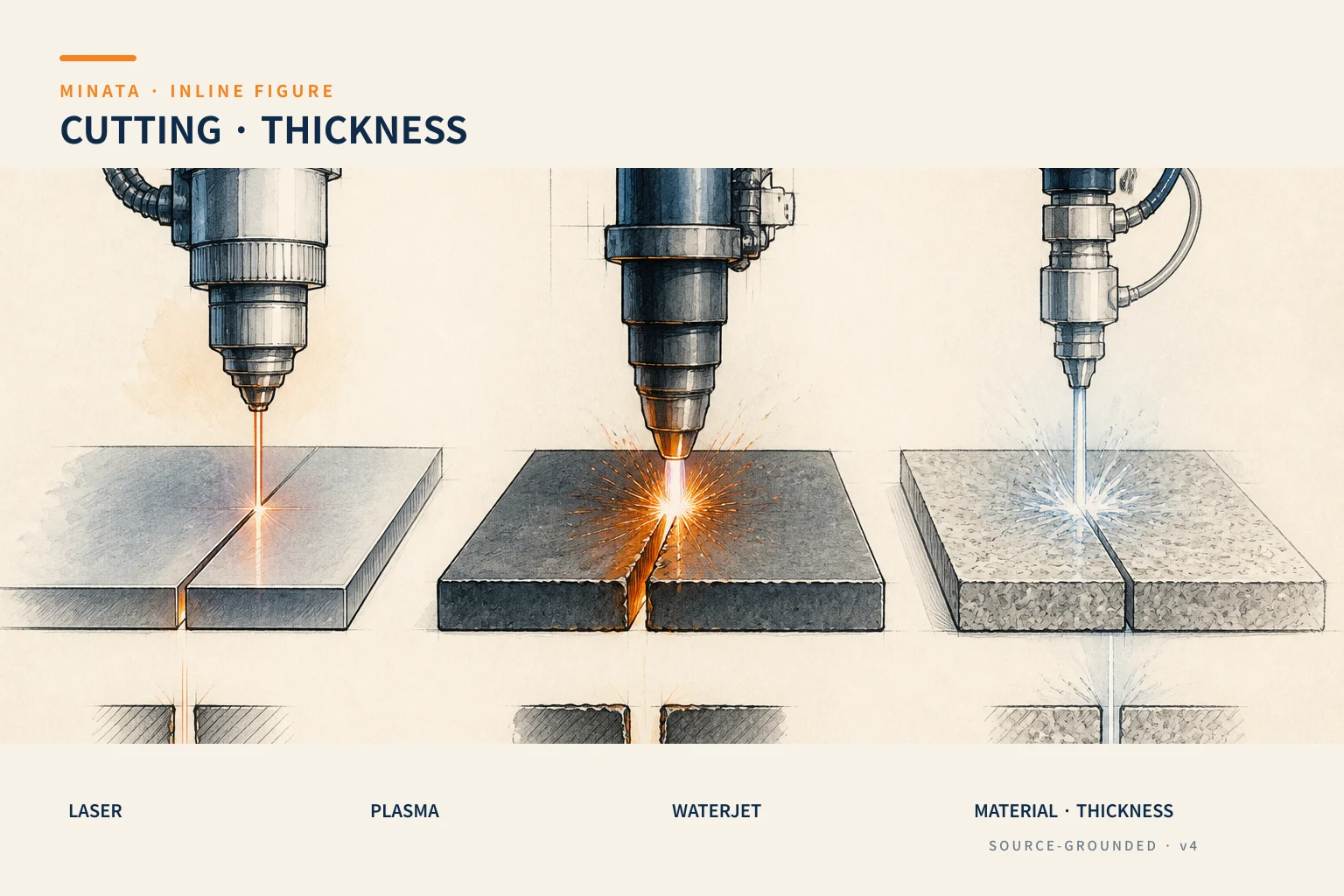
Laser cutting: clean edge, high accuracy for thin-to-medium sheet
Laser cutting focuses a high-energy beam that melts and vaporizes material at a very small point, combined with an assist gas (oxygen, nitrogen) blowing away the molten material. Because the focus point is small, the kerf is very narrow and the cut edge is square and clean, usually needing no rework. This is why laser dominates thin-sheet cutting for electrical-cabinet enclosures, precise mechanical parts and decorative parts.
For carbon steel, laser cuts well up to about 20–25 mm; stainless and aluminum have a lower limit because they reflect and conduct heat strongly. Today's fiber laser cuts reflective metals (copper, aluminum) better than the older CO2 laser. Profile accuracy reaches ±0.05–0.1 mm, enough for most mating parts.
The assist gas also drives the edge quality. Cutting with oxygen gives high speed on carbon steel but leaves a thin oxide layer at the edge, needing cleaning if painted right after. Cutting with nitrogen (clean cutting) gives a bright, oxide-free edge, widely used for stainless and aluminum when the edge is a finished surface, in return for more gas and slower speed on thick plate. When quoting laser, ask about the assist gas because it affects both the price and whether the edge needs further treatment.
A point to note: laser leaves a small but real heat-affected zone (HAZ); for a heat-sensitive material or a part that must keep the cut-edge mechanical properties, consider this. When cutting thick, the speed drops fast and the edge starts to worsen; then plasma or waterjet is more economical.
Plasma cutting: fast and cheap for thick steel plate
Plasma cutting uses a stream of ionized gas at extremely high temperature (a plasma arc) to melt the metal and blow it away. It only cuts conductive material, but in return it cuts thick steel plate very fast and cheaply, so it is common in steel structures, shipbuilding, large machine-frame fabrication.
In exchange for speed and price, plasma has a wide kerf (1.5–4 mm), a slightly beveled edge and usually dross on the bottom needing regrinding, plus a large heat-affected zone. Profile accuracy is only about ±0.5–1 mm. So plasma suits structural parts, base plates, gussets in the rough-cut phase — where the profile will be finish-machined later, or the tolerance is inherently wide. A high-end CNC plasma machine with high-definition (constricted-arc) technology significantly improves the edge quality, narrowing the gap with laser for medium steel.
Waterjet cutting: cold cutting, cuts almost anything
Waterjet cutting sprays very-high-pressure water (usually 3,000–4,000 bar), with added abrasive (garnet) to cut metals and hard materials. Its most important feature: this is cold cutting, with no heat-affected zone. The material does not change its mechanical properties, does not warp from heat, and has no hardened edge at the cut. This matters for tool steel, titanium, aerospace material, or a part that will be finish-machined and you do not want the edge to harden.
Waterjet also cuts materials that laser and plasma cannot handle: stone, glass, ceramic tile, rubber, thick plastic, carbon-fiber composite, and very thick metal (over 100 mm with a powerful machine). Accuracy is ±0.1–0.2 mm, the top edge is clean, the bottom edge is slightly rough with a slight taper if cutting fast; a machine with a head-tilt compensation reduces this taper.
Disadvantages: slow and high operating cost (abrasive, high-pressure pump maintenance, water handling). So waterjet is the choice when other methods cannot meet the heat, material or thickness requirement, not the default for ordinary sheet cutting.
Choosing: read the material and thickness to decide
- Thin steel/stainless/aluminum up to ~20 mm, needing a clean, accurate edge? → Laser.
- Thick steel plate, needing speed and low cost, fine edge not important? → Plasma.
- Heat-sensitive material, very thick, or a non-metal (stone, glass, composite)? → Waterjet.
- Need to keep the cut-edge mechanical properties (no HAZ), cutting titanium/tool steel? → Waterjet.
- The part will be finish-machined later, only needs a blank cut? → Choose by price: plasma for thick steel, laser for thin sheet.
A practical rule: start from the thickness and material, then ask "is this cut edge a final functional surface." If yes, lean to laser or waterjet; if not, plasma is usually cheapest.
For a large part with both a zone needing a fine edge and a zone only needing a rough cut, sometimes combining two methods is cheapest: rough-cut the outline with plasma, then only finish the functional edges with laser or milling. Do not assume a part is cut by only one method — splitting by each edge's requirement optimizes both price and quality.
Example: reading a real part
You need to cut 200 triangular gusset plates from 12 mm thick SS400 steel to weld into a machine frame. The cut edge will be welded, not a precise mating face. Thickness 12 mm and high quantity.
Analysis: the edge will be welded so it does not need laser's fineness; 12 mm steel is plasma's economical band; the high quantity makes speed important. → Plasma is the right choice, cheapest and fastest. Choosing laser here is paying for a fineness the part does not use.
Conversely, if you need to cut 50 SUS304 stainless flanges 5 mm thick with precise bolt holes, as a mating face: thin, needing a clean edge and correctly positioned holes → laser. And if cutting a 30 mm thick titanium plate for an aerospace part that must not have a hardened edge → waterjet.
Where the real cost is, not just the price per cutting meter
When comparing the three methods' prices, do not look only at the unit cutting price per meter of cut line. The real cost of a part has four parts: the cutting price, the edge-cleaning cost, the rework cost if the edge is not acceptable, and the scrap rate from thermal warping. Plasma is usually cheapest in the cutting-price column, but if the part needs a clean edge, the cost of grinding dross and flattening the edge can erase all that saving. Laser is more expensive at the cutting price but the edge is usually usable right away, so the total cost is lower for a part needing fineness.
Waterjet has the highest unit cutting price because of abrasive consumption and high-pressure-pump maintenance, but it erases two hidden costs: no heat-affected zone so no effort handling a hardened edge, and no warping so a low scrap rate for thin, wide parts. For a high-value part where one failure loses an expensive blank, waterjet is often the safest choice on total cost despite the high unit price.
Another factor is the kerf width when nesting many parts on one sheet. Laser's narrow kerf lets you nest parts close together, using the sheet better; plasma's wide 3–4 mm kerf wastes material when cutting many small parts. For expensive material like stainless or titanium, the material saving from a narrow kerf alone is significant.
Second example: same material, different requirement
Both are 8 mm thick SUS304 stainless, but two different parts lead to two different choices:
- A motor cover, the edge will be folded and painted: the edge is not a functional face, moderate quantity. → Laser for an edge clean enough to fold, accurate locating holes, good speed at 8 mm.
- A part in food equipment, the edge contacts product, must have no hardened edge and no iron contamination: → Waterjet, because cold cutting does not alter the edge and puts no heat into the contact area.
The lesson: the material and thickness give you the range of feasible methods, but the functional requirement of the cut edge is what settles the final choice.
Common mistakes
- Using laser for very thick steel. The speed drops, the edge worsens, the cost rises; plasma or waterjet is more suitable.
- Using plasma for a part needing accuracy. The wide kerf and beveled edge make the profile off by a few tenths of a millimeter.
- Forgetting the heat-affected zone. For a heat-sensitive part or one to be finish-machined, the HAZ of laser/plasma hardens the edge and warps it; waterjet avoids this.
- Defaulting to waterjet for everything. Slow and expensive; use it only when you truly need cold cutting or cutting a non-metal/very thick material.
- Skipping the plasma-dross-cleaning step when planning the price and time.
Quick selection checklist
- [ ] Is the material conductive? No → rule out plasma, consider waterjet.
- [ ] How thick is it? Thin → laser; thick → plasma/waterjet.
- [ ] Is the cut edge a final functional face? Yes → laser/waterjet.
- [ ] Is the material heat-sensitive or does it need edge properties kept? Yes → waterjet.
- [ ] High quantity, needing speed, fine edge not required? Yes → plasma.
- [ ] Have you counted the dross-cleaning and edge-rework cost into the price?
If you need to choose the optimal cutting method for a batch of parts, or want to combine a cheap rough cut with later finish machining to reduce cost, MINATA can advise a machining approach suited to your drawing and volume. See MINATA's Engineering & Manufacturing service.
More in the Manufacturing Engineering series
View all MINATA technical articles