Device Selection #23: Plate and Frame Material — Aluminum, Steel or Engineering Plastic
Choose aluminum, steel or engineering plastic by determining the part's task: bearing load, shielding, holding dimension, corrosion resistance, insulation, weight reduction, seeing through, or guiding. Then check the stiffness, environment, machining method, joining, tolerance, cleanability and life cycle. The material name is only the starting point; the alloy/grade, condition, thickness, shape, surface and joint are what create a part that can be produced and operated.
Quick comparison
| Material group | When suitable | To check | What must not be inferred |
|---|
| Aluminum and aluminum alloys | Needs light weight, corrosion resistance, machining/modular structure | Alloy/temper, stiffness, galvanic pair, surface | That every aluminum has the same strength and corrosion resistance |
| Steel/steel plate/welded structure | Needs stiffness, large load, welded frame or material cost | Grade, thickness, welding, coating, thermal distortion | That paint or plating handles every corrosion case by itself |
| Engineering plastic | Cover, guide, insulator, wear part, special environment | Heat, creep, chemical, ESD, humidity, machining | That a thicker plastic always replaces a load-bearing metal |
| Transparent/shielding material | Needs observation, light or protection | Impact, scratching, chemical, joining, guard standard | That any transparent sheet is a suitable safety fence |
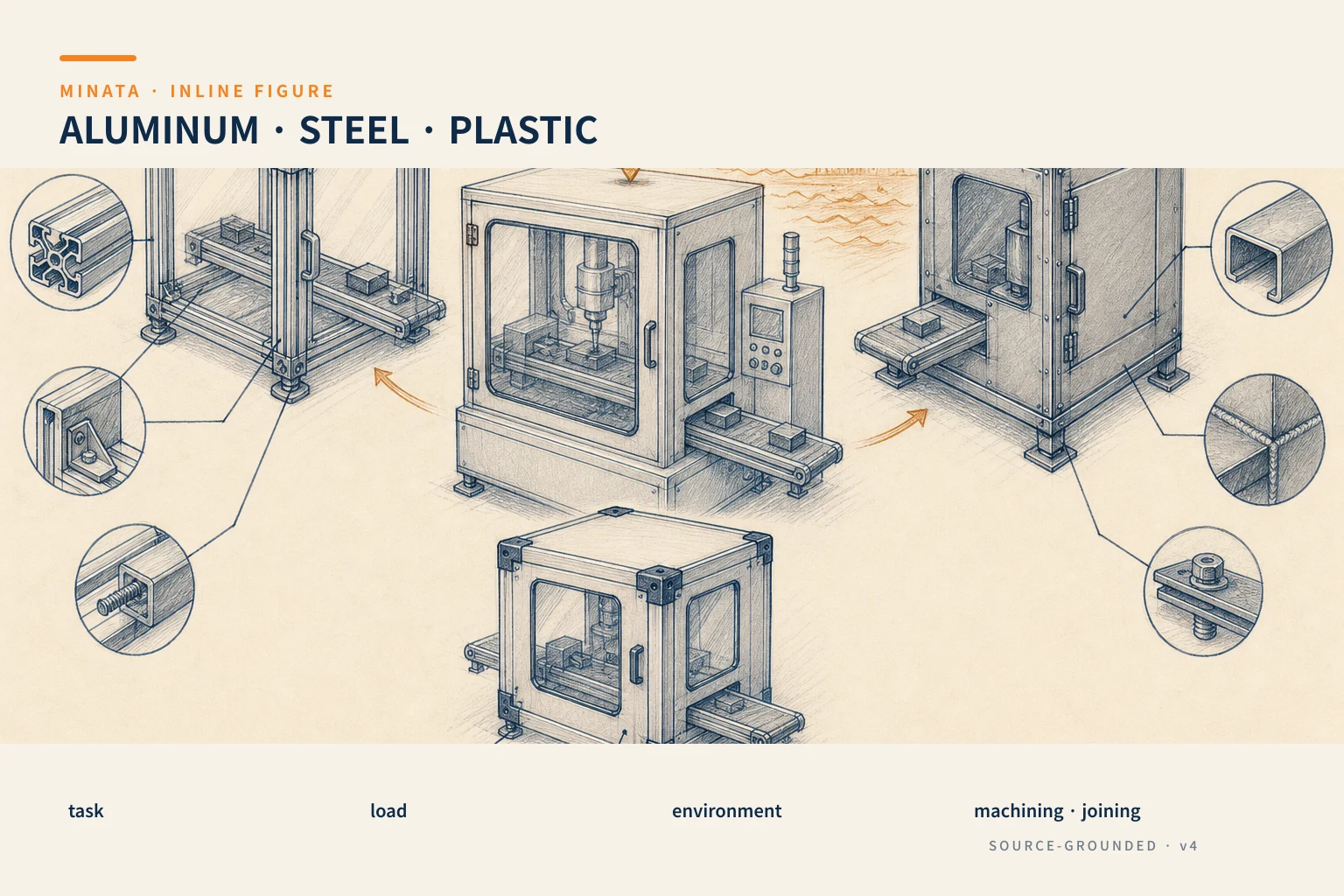
Name the part's task correctly
A cover plate keeping out dust, a motor-mounting plate, a guard door, a plastic slide rail, an electrical-cabinet support frame and an insulating panel have completely different requirements. Describe what the part must do before comparing materials: static/dynamic load, force-application point, allowable deflection, heat, oil/chemical, water, UV, dust, ESD, cleaning, life, aesthetics and how often it needs removing. If there is a safety requirement, it must be stated by the hazard and the standard/risk assessment, not just by the words "protective plate."
The geometry is often as important as the material. A thin plate with ribs, bends or folded edges can be stiffer than a thicker flat plate in one direction; a small plate with holes near the edge can be weaker than a quick calculation; a plastic machined from sheet can creep at the clamp position. The drawing must state the thickness, bend radius, holes, countersink, insert, reference surface and joint so the workshop can assess manufacturability.
Separate the main load-bearing part from the cover/finish part. If a plate is both a cover and takes force from an actuator or door hinge, compute it as a structural member and check the joint. If it only keeps out dust, you may prioritize cleaning removability, weight and cost. Separating the function correctly usually helps choose a simpler material and makes later modification easier.
Aluminum: light, modular, but you must lock the alloy and temper
Aluminum is widely used in modular frames, plates, panels, fixtures and parts needing low weight. The properties of an aluminum alloy change with the alloying elements and the material condition; The Aluminum Association states that strength, density, workability, conductivity and corrosion resistance are affected by elements such as magnesium, silicon and zinc. So there is no single "aluminum strength" value to apply to every sheet/plate.
When choosing aluminum, state the alloy/grade, temper, product form (sheet, bar, profile, cast), thickness and surface. Choose from the machining, bending, welding, stiffness, environment and required documentation. If the part needs anodizing, color/finish, threads, inserts or electrical contact, put these requirements into the drawing/specification before locking. The article choosing A5052, A6061 or A7075 handles the common alloy choice in more detail; here the focus is choosing the plate/frame in the assembly.
Aluminum can reduce weight and is convenient for modular profiles, but does not allow ignoring the deflection, cyclic load, joint and thermal expansion. A large aluminum plate can vibrate or deform if you only increase the thickness without adding a suitable bend/brace. For a plate taking a concentrated load from a motor/guide, check the local stiffness at the bolt hole, the edge distance and the contact face. Do not take profile data to conclude for a plate, and do not take the data of one temper to use for another temper.
In an environment with many other metals, consider the contact pair, water/electrolyte, coating and how to electrically separate them by design. Do not assert that every aluminum–steel joint will fail; the specific condition, surface, humidity and joint decide. What you must do is identify the risk, confirm the solution against the environmental requirement, and keep a drawing with a clear material/finish to buy correctly.
Steel: stiffness and structure, with welding and corrosion protection
Steel suits many base frames, cover plates, enclosures, brackets and welded structures when you need stiffness, a large load or an easy-to-find material. But "steel" must be specified by the grade, product form, thickness, condition and surface requirement. Plated sheet, painted carbon steel, stainless or a welded profile have different machining, joining, corrosion protection and cost.
A welded structure allows creating a large, stiff frame, and also sets requirements for the weld sequence, distortion, fixture, surface treatment, the machining-reference position after welding and transport. If a rail or precise surface mounts on the welded frame, determine which face is machined after welding and how to check the flatness/alignment. Do not require a tight tolerance on every face just because one face needs a reference; that raises the cost without adding function.
The coating must be chosen by the environment and surface preparation, not written as a generic "anti-rust paint." The thread positions, electrical-contact face, bearing/guide mounting face, weld area and cut edges may need different handling. AISC notes that the material, connection and surface-preparation/painting requirements are information to have in the project documentation when they affect integrity and fabrication; this principle is also useful for a smaller machine frame.
Steel is heavier, so it affects the transport, foot/caster, lifting mechanism and assembly time. The article choosing casters, adjusters or leveling feet helps check the floor-support part. If you choose steel for the initial material price, also account for the welding, machining, coating, fixture, lead time and assembly labor; the final choice must be based on the complete assembly.
Engineering plastic: when the polymer's function is an advantage
Engineering plastic is useful for a light cover, guide/wear pad, insulator, wheel/roller, insulating plate, a part needing corrosion resistance or an easy-to-machine shape. Do not treat plastic as "cheap metal." Ensinger emphasizes that the application condition decides the polymer choice and you must consider the mechanical properties, thermal, chemical resistance, dimensional stability, ESD, friction/wear or low outgassing depending on the application.
For a plastic material, check the working temperature, load duration, creep, humidity, UV, chemicals, cutting oil, cleaning agent, friction, sliding speed and electricity. A grade with good initial strength can still creep at a prolonged temperature/load; a chemical-resistant grade may not meet the ESD requirement; a good sliding grade may not suit a food/contact or flame requirement. The datasheet of the exact grade and testing under the application condition are mandatory inputs.
The form of joining matters greatly: a too-tight clamp causes cracking/creep, a small screw head sinks in, a directly cut thread wears through many disassemblies, and an insert may be necessary. Leave a suitable clearance for expansion and do not lock every hole tightly if a long part sees heat. The machined surface can change the friction and cleanability; do not copy the guidance of one polymer to another polymer.
When using plastic as a see-through sheet or guard, determine the material, thickness, impact resistance, ageing, cleaning chemical, mounting method and the applicable standard. A transparent plastic does not mean it is safe for every hazard. A guard is a protective function that needs a separate design/assessment, presented in #24.
Heat, environment and deformation over time
The environment does not stop at room temperature. List the operating/local heat, thermal cycle, oil, coolant, steam, cleaning agent, chips, abrasive dust, UV, ozone, ESD, vacuum or cleanroom if any. Then read the limitations of the material, coating, adhesive, gasket, insert and fastener together. A plate suitable by itself can fail because the seal, adhesive or paint is not compatible with the cleaning agent.
Thermal expansion can warp a long plate, create stress at a bolt hole or change a guard gap. Set the fixed/floating points, slot holes, spacers or gaps by design when there is a difference in expansion to be compensated. Do not cut a slot generically; the slot must have a direction, size, washer/fastener and a clear function so it still keeps the necessary clamping force and alignment.
If there is a clean requirement, the cleanability, the tight surface and the removal access matter as much as the base material. Dead corners, open edges, exposed threads, overlapping panels with no seal and peeling coating all affect operation. Put the cleaning/inspection requirement into a mockup or assembly review before batch machining.
Machining, tolerance and joining
Choose the material together with the process. An aluminum plate can be laser/waterjet/CNC/bent by the workshop's capability and the deburring/finish requirement; steel can be cut, welded, surface-treated and machined after welding; plastic needs suitable tools/parameters to avoid melting, burrs or stress. Do not write "machine per sample" when the part has a functional datum, surface, critical hole or a required flatness.
Design the joint by the material. A bolt/nut, rivet nut, weld, adhesive, insert, snap fit or bracket have different failure modes. If maintenance removal is needed, choose a removable joint and check the number of disassemblies. If water/dust tightness is needed, design the interface, gasket, compression and the drainage path. The article choosing welding, bolting or gluing is a reference for the joint type, but you still need to cross-check the specific material's limits.
The tolerance should be tied to the function and the process. A cover plate may need the correct bend/edge so it does not hit the door, while a guide plate needs a reference surface and datumed holes. Avoid calling the whole part "high accuracy." State the datum, tolerance, surface, inspection position and, if needed, the material/finish documentation requirement. This way the purchasing team, workshop and QA all understand what to check.
Compare life-cycle cost rather than the material unit price
The unit price per kg or the price of one sheet does not reflect the assembly price. Compute the total material yield, cutting, bend, weld, machining, surface finish, hardware, assembly hours, transport, scrap, life, cleaning, replacement and machine downtime. A profile-based aluminum plate can shorten assembly; a welded steel frame can be good for a large load; a plastic guide can reduce wear/noise. These results depend on the task and the project's supply chain.
Order a sample when the material/surface is new, the environment is harsh, the panel has an aesthetic requirement or the joint is difficult. A test fit on a subassembly helps find an inaccessible hole, a bend lacking clearance, a coating covering the reference surface or a vibrating plate before batch production. Save the acceptance sample, the drawing revision and assembly photos so later changes do not return to the decision from scratch.
A re-checkable selection process
- Record the part's task, load case, deflection/accuracy limit, environment and safety/cleaning requirement.
- Choose 2–3 preliminary material groups with a grade/temper/thickness/finish that can be bought and machined.
- Check the structure, thermal/environment, surface, joint, process, tolerances and maintenance for each option.
- Assess the assembly cost, lead time, replacement and supply risk; use a sample/test fit when uncertain.
- Lock the material callout, finish, hardware/interface, datum/inspection and the documentation to hand over.
Common selection mistakes
- Writing "aluminum," "steel" or "plastic" on the drawing without the grade/temper/thickness/finish.
- Using the material strength to substitute for the part's deflection and joint check.
- Choosing plastic by thickness while ignoring creep, heat, chemicals and how it is clamped.
- Choosing welded steel without determining the distortion, machining face after welding and coating.
- Using a transparent panel as a guard without analyzing the hazard, joint and protection requirement.
- Computing the price from the raw sheet, ignoring machining, finish, assembly and maintenance.
Checklist before locking the BOM
- [ ] Are the part's task, load case, stiffness/deflection, environment and safety requirement clear?
- [ ] Does the material callout have the alloy/grade, temper/condition, product form, thickness and finish?
- [ ] Have the thermal/chemical/UV/ESD/creep or wear been checked per the correct material group?
- [ ] Are the machining process, datum, tolerance, joint, insert/gasket and assembly access on the drawing?
- [ ] Does the coating/finish protect the environment but not block the reference face, thread or needed contact?
- [ ] Have the sample/test fit, QA documentation and spare parts been defined for the risky part?
MINATA can work with the machine team to review the material callout, drawing, machining process and test fit before locking the BOM. Talk to the Engineering & Manufacturing team.
References
View all MINATA technical articles